Stay current with our airline news coverage.
What Happened During the Crash
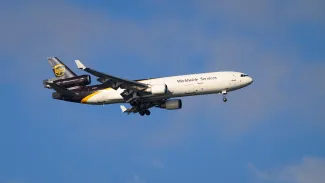
UPS Flight 2976, a 34-year-old McDonnell Douglas MD-11F, was making a routine departure from Louisville Muhammad Ali International Airport on November 4, 2025, when things went catastrophically wrong. The aircraft was accelerating down the runway at approximately 5:13 p.m. EST when the left engine and its entire pylon assembly separated from the wing shortly after rotation. CNN correspondent Pete Muntean reported on X that the NTSB has identified the exact component responsible: a bearing in the engine pylon's aft mount assembly. The bearing experienced fatigue cracking over time, eventually failing completely at the worst possible moment; during the takeoff roll, when the aircraft was committed to flight but hadn't yet achieved a safe altitude. The detached engine didn't just fall away cleanly. Debris from the separation likely entered the MD-11's tail-mounted engine, causing a compressor stall. So now the crew was dealing with one engine gone and another potentially damaged, all while trying to control an aircraft that had just lost a significant chunk of its structure.Boeing Knew About This Problem
Here's where it gets frustrating. Boeing had documented nearly identical bearing failures on MD-11 aircraft through a service letter issued back in 2011; approximately 15 years before this crash. That service letter detailed four previous failures of these spherical bearing assemblies on three different aircraft. According to the NTSB, "The failure of these spherical bearing assemblies was visually identified by observing the displacement of the fractured bearing race pieces beyond the outer surface of the lugs. According to the Service Letter, a review of the spherical bearing failure by Boeing determine it would not result in a safety of flight condition." Read that last part again. Boeing's review concluded the bearing failure "would not result in a safety of flight condition." Yet here we are, with 15 people dead and a hull loss that very much resulted from exactly that failure. The key issue? Boeing issued only an advisory service letter, not a mandatory airworthiness directive. Service letters are recommendations; airworthiness directives are requirements. Airlines can choose whether to follow service letter guidance. They can't ignore an airworthiness directive.A Single Point of Failure at the Worst Time
Aviation safety analysis of the accident paints a stark picture of what went wrong. "This accident represents a single point of failure at a critical phase of flight leading to an entire hull loss," experts noted. "This single point of failure should not happen." And they're right. Modern aviation is built on redundancy and fail-safe design. The idea is that no single component failure should be catastrophic, especially not something as small as a three-inch bearing. But the engine pylon mount is what's called a "hard point"; one of the critical attachments between a massive turbofan engine and the wing structure. When that fails, there's no backup. The engine goes where physics takes it. The MD-11's age is worth considering here too. At 34 years old, the aircraft had been flying for longer than many of the people working on it had been alive. Cargo carriers often operate older aircraft because they're cheaper to acquire and maintain, and cargo doesn't complain about legroom or inflight entertainment. But age means accumulated stress, metal fatigue, and components that have been through tens of thousands of cycles of heating, cooling, flexing, and vibration.What This Means for the Industry
The investigation is still ongoing, but the NTSB's findings raise immediate questions for operators of MD-11 aircraft worldwide. How many of these planes are still flying with potentially compromised pylon bearings? What inspection protocols are in place? And why wasn't Boeing's 2011 service letter escalated to mandatory action after multiple documented failures? UPS operates one of the world's largest cargo fleets, and their maintenance standards are generally considered rigorous. If this bearing failure slipped through their inspection process, it suggests the industry's approach to managing this particular component may have been inadequate across the board. The timing of the failure makes it especially tragic. If the bearing had let go at cruise altitude, the crew might have had options; time to assess, prepare, possibly return for landing. But losing an engine during the takeoff roll, with debris potentially damaging a second engine, leaves almost no margin for recovery.Fifteen Years Is Too Long
The real story here isn't just about a failed bearing. It's about the gap between identifying a problem and requiring action to fix it. Boeing flagged this issue 15 years ago. Four previous failures should have been enough to trigger mandatory inspections or component replacements. Instead, operators received guidance they could choose to follow or not. Now 15 people are gone, and an entire aircraft is destroyed, because a three-inch component that everyone knew could fail was allowed to stay in service until it did exactly that. That's not a failure of engineering; that's a failure of regulatory oversight and industry response. As the NTSB continues its investigation, expect scrutiny of maintenance records, inspection intervals, and the decision-making process that kept Boeing's service letter from becoming mandatory action. Sometimes the smallest details matter most, and in aviation, there's no such thing as an acceptable single point of failure.More travel news
Southwest, United seek older software on new 737 MAX jets
Southwest and United want earlier software on new 737 MAX deliveries as the FAA reviews a glitch that can block automated guidance after a missed approach if pilots alter the flight path.
Certain Boeing 737 Max jets have missed-approach software glitch
Boeing is developing a fix for the glitch affecting in-service Max 8 and Max 9 jets running U.14; Southwest Airlines and United Airlines say their Max fleets la...
Jet Fuel Prices Have Doubled Since January
Jet fuel prices have doubled since January, and Leeham News is modeling potential ticket and cargo price effects if the increase persists.
FAA Orders Boeing 737 Max Inspections for Fuselage Cracks
WASHINGTON - Federal regulators mandate structural inspections on nearly 1,500 Boeing 737 Max aircraft worldwide after identifying potential cracks near forward service doors.
About the Author

Bob Vidra
Bob Vidra is News Editor at Jetsetter Guide, covering airlines, airports and the travel industry since 2023.