Stay current with our travel industry news coverage.
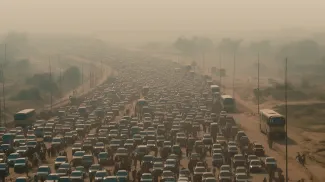
Thick smog covered New Delhi on Monday, Nov. 9, after Diwali fireworks compounded the capital’s seasonal pollution, with several monitoring stations recording Air Quality Index readings above 400, according to FTNnews. For visitors planning monument tours, market visits and long walks, severe air pollution is the immediate concern. Stage III pollution-control restrictions remained in place across Delhi and the surrounding National Capital Region.
Travelers should check updated neighborhood conditions rather than treat a single citywide reading as an all-clear. FTNnews reported that the Commission for Air Quality Management’s dashboard showed a Delhi AQI of 372 in a Nov. 9 snapshot, even as separate monitoring reports put parts of the capital above 400. Those figures describe different views of the pollution, not interchangeable measurements.
FTNnews recommends consulting the commission’s official air-quality dashboard and adjusting outdoor plans to current conditions. It also draws an important distinction: Stage III controls do not, by themselves, announce the closure of tourist attractions or Delhi’s wider transport network.
Why Delhi’s AQI readings tell different stories
Under India’s official classification, AQI readings from 301 to 400 are very poor, while readings from 401 to 500 are severe, according to FTNnews. A citywide snapshot can therefore sit below the severe threshold while individual locations exceed it. Air quality also changes by neighborhood and time of day, making conditions around a particular attraction more relevant to a walking itinerary than a broad city figure alone.
The deterioration did not begin with the fireworks. Delhi recorded a daily average AQI of 382 on Nov. 6, prompting the Commission for Air Quality Management to introduce additional restrictions ahead of Diwali, FTNnews reported. That daily average and the Nov. 9 dashboard snapshot should not be read as a direct before-and-after comparison; one covers a day, while the other captures a moment.
The Associated Press described deteriorating visibility on Monday morning, with gray haze covering streets and high-rise buildings. Its account placed readings above 350 in several areas. FTNnews separately reported monitoring stations above 400, the readings that put parts of the city in the severe category.
Stage III restrictions target pollution sources
The Nov. 6 Stage III measures included restrictions on dust-generating construction and certain older, higher-emission vehicles, alongside controls already introduced, according to FTNnews. Their scope matters: these are restrictions on specified activities and vehicle categories, not a blanket prohibition on movement around Delhi-NCR.
For visitors using a private vehicle or rental car, FTNnews advises checking whether the current restrictions apply to that vehicle’s category. An itinerary that depends on a car needs that check even if the attractions themselves remain accessible. The controls are subject to further review as air-quality conditions change.
FTNnews did not establish flight cancellations or railway suspensions attributable to this pollution episode. That is not a guarantee of uninterrupted service, but it does mean the severe AQI readings should not be presented as evidence of an airport or railway shutdown. The documented immediate issues are polluted air and targeted pollution-control restrictions.
Permitted fireworks were not pollution-free
Diwali fell on Sunday, Nov. 8, and fireworks added smoke and fine particles to air already burdened by other emissions, FTNnews reported. India’s Supreme Court had allowed limited use of approved green firecrackers, rather than unrestricted use of conventional fireworks.
According to BBC News, the permitted windows on Nov. 7 and 8 were 6 to 7 a.m. and 8 to 10 p.m. local time. The court also banned fireworks within 300 meters of hospitals, care homes, schools and other designated silence zones. Approved products were required to carry QR codes allowing their manufacturer and certification details to be checked.
Enforcement remained a problem. BBC News reported that the Supreme Court acknowledged conventional firecrackers had continued to be sold as green alternatives, even under a complete ban. Police were directed to patrol designated sales areas, conduct random QR-code checks and seize illegal products.
Even compliant fireworks still contribute pollution. The Associated Press reported that green firecrackers produce fewer emissions but continue to release particulate matter and other pollutants. Permission to use them was not a finding that their use would leave the air clean.
Weather and regional smoke compound the problem
Fireworks were an additional source, not the whole explanation. FTNnews identified vehicle emissions, industrial activity, construction dust and smoke from agricultural-residue burning in Punjab and Haryana as contributors. Cooler temperatures and weak winds can trap those pollutants near the ground.
The Associated Press reported that farmers burn leftover rice stalks to prepare fields for the next planting season, with smoke drifting toward the capital. Late October and November are particularly difficult because cooler temperatures, low wind speeds and stagnant atmospheric conditions prevent pollution from dispersing. The resulting haze can linger for days.
Plan outdoor exposure, not just sightseeing hours
For travelers, the distinction between an attraction being open and an outdoor visit being advisable is central. FTNnews warns that prolonged visits to monuments, gardens and markets can increase exposure, particularly during extensive walking tours or physically demanding activities. A weather forecast alone does not describe that risk.
FTNnews cites World Health Organization guidance recommending changes to the location and timing of physical activity to reduce pollution exposure. Indoor spaces with effective air filtration can also reduce exposure to fine particles. The relevant feature is effective filtration, not simply being indoors.
Well-fitting certified N95 or FFP2 particulate respirators can reduce inhalation of fine particles when outdoor exposure cannot be avoided, according to FTNnews, but they do not eliminate the risks of severe pollution. Children, older adults and people with respiratory or cardiovascular conditions face greater risks and warrant particular care when considering prolonged outdoor activities.
Keep the sightseeing plan separate from the transport plan. FTNnews’s guidance supports checking local air quality before committing to extended outdoor time and checking vehicle eligibility before relying on a private or rental car. Neither an open monument nor an available ride resolves the exposure problem.
More travel news
Canada warns against India travel amid rising tensions
NEW DELHI, India — Canada reaffirms Level 3 warning for northeastern Manipur state as ethnic violence continues, complicating travel planning for visitors to one of Asia's fastest-growing tourism markets.

Multi-Country Visas Beyond Schengen Now Open to Indians
NEW DELHI, India — Multi-destination visas are cutting costs and paperwork for Indian travelers, with Brazil extending bilateral visas to 10 years and the Gulf preparing a regional visa launch.

India to Build Five Medical Tourism Hubs by 2026
New Delhi, India — Finance Minister Nirmala Sitharaman unveils a landmark scheme to establish regional healthcare complexes integrating AYUSH therapies with advanced medical services.

India Warns Citizens as Venezuela Crisis Escalates
New Delhi, India — India's foreign ministry issued a travel warning for Venezuela following a US military operation that resulted in the capture of President Nicolás Maduro, as flight disruptions spread across affected routes.
About the Author

Jeff Colhoun
Jeff Colhoun is a photographer and filmmaker whose work has appeared in The Wall Street Journal, the Los Angeles Times, Matador Network and Barron’s.