Stay current with our travel industry news coverage.
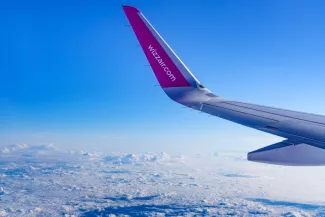
European airline passengers faced diversions, military escorts and security checks during a third wave of false bomb threats in four days, according to ANSA’s Nov. 6, 2026, report. The affected services included a Wizz Air flight bound for Rome Fiumicino that diverted to Venice and a Ryanair flight from Rome to Lisbon that became the subject of an alert.
ANSA reported that all the threats proved false. The disruption was nevertheless real: the Wizz Air aircraft underwent security checks in Venice before departing for Rome that afternoon, rather than arriving at Fiumicino as scheduled at 11 a.m.
For passengers, that distinction matters. A false threat can still interrupt a flight and require checks before the aircraft continues. In the Wizz Air case, ANSA documented a diversion followed by an onward departure, not a canceled service. The report did not announce a general suspension of European flights or a new passenger requirement.
Rome-bound flight diverted to Venice
The alert involving Ryanair came in the early morning after Portuguese police received a telephone call, according to ANSA. The aircraft had departed Rome and landed in Lisbon. ANSA did not describe that flight as having diverted.
A separate call in Prague reported explosives aboard the Wizz Air aircraft scheduled to arrive at Fiumicino. It was sent to Venice for checks and departed for Rome only in the afternoon. These were the two incidents ANSA described on routes involving Italy.
The use of anonymous telephone calls was a change from the threats ANSA described on Thursday. Email remained part of the wider threat campaign, but investigators were no longer dealing solely with messages sent electronically.
ANSA also reported threats involving four aircraft in France, four headed to Madrid and eight originating from Prague. Those geographic figures should not be treated as a count of separate incidents; the report did not establish that the categories were mutually exclusive.
Hungarian fighters escorted three aircraft
Hungarian military fighters were deployed three times within a few hours at NATO’s request, escorting three aircraft until they landed, ANSA reported. Further false alarms reached Copenhagen Airport.
The fighter deployments show the scale of the operational response, but they do not change the reported outcome of the threats. ANSA said the alerts proved false. Military escorts and diversions were responses to suspected danger, not evidence that explosives had been found.
The disruption also extended beyond aircraft. Irish newsrooms received emailed threats of attacks that likewise proved false, according to ANSA. Italian investigators were examining a wider wave that had also targeted about 280 schools.
Unverified claim threatened more transport targets
A purported claim sent by email to several news organizations threatened further attacks against aircraft, cruise ships, subway stations and trains, ANSA reported. The message carried the name Mikhail Andropov, but its authenticity had not been established.
That leaves an important boundary around the cruise and rail references: they were targets named in a threatening message, not confirmed attacks. The concrete aviation consequences described by ANSA were alerts, diversions, checks and military escorts.
Italian postal police were also examining an email from the previous day bearing the name Combattenti dello Stato Maschile. ANSA linked that name to Muzhskoye Gosudarstvo, a Russian ultranationalist and misogynistic movement. A Telegram account associated with the group denied involvement.
ANSA treated the possible Russian connection as unresolved. The names and references in the messages could point toward Moscow, the agency reported, or could be an attempt to steer investigators toward Russia. Neither the signature nor the claimed affiliation establishes responsibility.
Italian prosecutors pursue cross-border investigation
Prosecutors in Milan, Rome and Busto Arsizio opened cases for causing alarm, according to ANSA. The district offices were working under the coordination of Italy’s National Anti-Mafia and Counterterrorism Prosecutor’s Office.
Investigators were examining whether the wave reflected coordination at a European level. International cooperation channels had been activated to trace the servers through which the emails passed and the IP addresses associated with their transmission.
Initial findings suggested messages had come from compromised email addresses or services offering anonymity, including Proton Mail, ANSA reported. That was an investigative lead concerning how messages were sent, not an identification of their authors.
European aviation-security meeting planned
Europol was ready to support national authorities, while aviation-security experts from 27 countries were scheduled to meet in Brussels the week after the Nov. 6 report to discuss necessary measures, according to ANSA. That meeting was a planned response, not an announcement of new airport procedures.
Officials differed in how firmly they characterized the incidents. Italian Prime Minister Giorgia Meloni said the alerts and hacking incidents warranted concern but that links between the recent episodes could not yet be established. Spanish Foreign Minister José Manuel Albares characterized the events as attempted hybrid aggression and psychological warfare, ANSA reported.
Italian Deputy Prime Minister Matteo Salvini sought information from intelligence services and warned of possible cancellations and fear. His warning concerned potential consequences. For affected travelers, the documented consequences were already specific enough: an interrupted journey, an unscheduled airport stop and security checks before a flight could continue.
More travel news
Europe Flight Bomb Threats Disrupt at Least 35 Flights
Bomb threats disrupted at least 35 European flights from Monday through Thursday, and fresh alerts followed Friday; searches found no explosives.
Ryanair begins winter rollout with 45-plus new routes
The airline has announced at least 140 new winter 2026/27 routes, with launches staggered from Oct. 25 into December across the UK, Italy, Poland and Morocco.
UK Plans to End Family Seating Fees for Children Under 14
Parliament is considering rules for airlines operating in the UK that would seat children under 14 beside a parent or accompanying adult at no added cost and make simple booking name corrections free; paid seat selection would remain.
Ryanair Cuts German Winter Schedule, Will Close Berlin Base
Ryanair will remove 700,000 winter seats in Germany and close its Berlin base Oct. 24, halving capacity there but continuing flights to and from the capital.
About the Author

Jeff Colhoun
Jeff Colhoun is a photographer and filmmaker whose work has appeared in The Wall Street Journal, the Los Angeles Times, Matador Network and Barron’s.