Stay current with our airline news coverage.
The familiar airport shuffle of ID, boarding pass, phone and carry-on bag is getting a little less awkward. By June 2026, TSA PreCheck Touchless ID was available at 65 U.S. airports for eligible travelers who opted in, according to the Transportation Security Administration.
The system uses facial recognition and existing passenger information to verify identity and flight eligibility, reducing or eliminating the need to hand physical documents to an officer at participating checkpoints. For travelers who’ve ever tried to retrieve a driver’s license while balancing a roller bag and a coffee, that’s not a trivial improvement.
Still, “touchless” doesn’t mean travelers should leave their wallets at home. Deployment remains uneven, participation is optional, and carrying a physical ID is recommended as a backup while the technology continues to spread.
How TSA PreCheck Touchless ID Works
TSA PreCheck Touchless ID combines PreCheck enrollment information, facial verification at the checkpoint, digital or mobile identification tools, and automated checks against TSA and airline systems.
At checkpoints equipped with newer Credential Authentication Technology, known as CAT-2, a passenger looks into a camera. The system compares the live facial image with the traveler’s identification photo and backend data, confirming identity and flight eligibility in one step.
At participating airports, that process can reduce the document-check interaction to a matter of a few seconds per passenger, although exact time savings vary by airport and lane, according to implementation analyses included in TSA modernization research.
Eligible passengers must opt in. Depending on the airport and program, they may no longer need to present a physical boarding pass and, in some cases, a driver’s license or passport at the document podium. The system is particularly focused on TSA PreCheck travelers, rather than functioning as a universal replacement for conventional identification checks.
Airlines Are Building Touchless ID Into the Journey
The technology isn’t limited to the TSA checkpoint. Airlines are also integrating digital identity verification into other parts of the airport process.
Delta Air Lines, for example, offers dedicated TSA PreCheck Touchless ID bag-drop service at 10 major airports: Atlanta, Boston, Detroit, Los Angeles, New York LaGuardia, New York John F. Kennedy, Minneapolis-St. Paul, Seattle, Salt Lake City and Washington Reagan National.
That airline involvement matters because a genuinely smoother airport trip requires more than shaving a few seconds off the security podium. Connecting identity verification with check-in, bag drop and screening can reduce repeated document handling across several airport touchpoints.
TSA’s expansion is part of its Horizon 25 modernization strategy, which emphasizes enhancements to TSA PreCheck, greater use of biometrics and wider deployment of computed tomography scanners. TSA is reportedly completing a $781 million rollout of CT scanners at U.S. airports, showing that touchless identity checks are only one piece of a much broader screening technology overhaul.
Convenience Comes With Privacy Questions
The appeal is easy to understand. Touchless ID can reduce physical document handling, make identity verification more accurate and potentially ease bottlenecks where officers traditionally inspect IDs and boarding passes. It may also allow TSA personnel to spend less time on routine document checks and more time handling exceptions.
Facial recognition, however, brings a different set of questions. Travelers may reasonably want to know how biometric information is stored, shared and governed, along with what happens when a system produces a mismatch. Those concerns become more important as digital identity moves beyond limited pilots and into everyday airport use.
There’s also the issue of consistency. Major hubs and many secondary airports are gaining touchless capabilities, but smaller regional airports may still have limited or no access. A passenger could encounter an automated identity check on one leg of a trip and a conventional document inspection on the next.
That uneven rollout doesn’t make the technology less useful. It does mean travelers shouldn’t assume that enrolling or opting in creates the same experience at every airport.
Keep the Physical ID, At Least for Now
Here’s my read as someone who watches airport technology rollouts closely: 65 airports is a meaningful footprint, but the backup plan still matters more than the marketing language.
Travelers using Touchless ID should continue carrying the physical identification required for their trip. Technology can be unavailable, an airport may not have participating lanes, or a traveler’s itinerary may include a location where the system hasn’t been deployed. A phone battery problem or data mismatch shouldn’t become the reason a trip goes sideways.
It’s also worth checking availability before departure rather than assuming “TSA PreCheck” automatically means “Touchless ID.” PreCheck remains the underlying eligibility program; touchless verification is an additional, opt-in capability available only at participating airports.
For frequent flyers passing through equipped hubs, the biggest benefit may be predictability. Less fumbling with documents and faster identity confirmation can make the front end of the security process feel calmer, even if the rest of screening remains unchanged. Travelers without compatible digital tools or those who prefer conventional identification can continue using physical documents.
The airport of the near future increasingly looks like your face, phone and travel record working together behind the scenes. That may be convenient, and at 65 airports it’s no longer a tiny experiment. Just keep the driver’s license within reach. We’re not quite at the wallet-free checkpoint yet.
More travel news
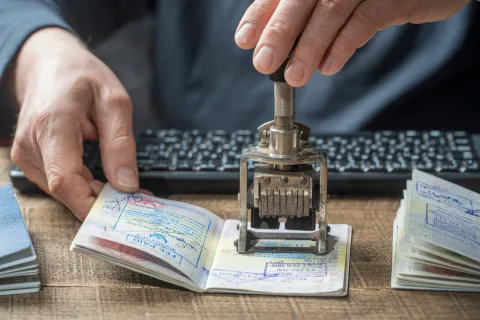
U.S. Customs and Border Protection to End Routine Passport Stamps
CBP announced routine passport stamping will end during primary inspection, with limited exceptions; foreign visitors can access admission and authorized-stay details through I-94 or CBP Link.
United Flight Attendants Can Refuse ICE Questions
Washington, United States - United flight attendants were told they may remain silent when ICE asks about passengers or coworkers as airport arrests increase nationwide.
Airlines Put Elite Status on a Higher Price Tag
NEW YORK, United States - Delta, United and other major airlines are raising elite status hurdles, leaving frequent flyers on discounted fares with less credit.

Carnival Rewards Sets Sail With Spending Based Status
Carnival Rewards ties cruise status to eligible spending while keeping separate recognition for lifetime sailing days.

About the Author

Bob Vidra
Bob Vidra is News Editor at Jetsetter Guide, covering airlines, airports and the travel industry since 2023.