Stay current with our airline news coverage.
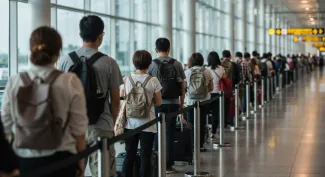
Passengers boarding international flights to the United States will need to complete a CDC flight attestation beginning at 11:59 p.m. EST on Nov. 3, 2026, under a federal public health order responding to Ebola concerns. According to FTNnews, travelers must confirm they have not been present in the Democratic Republic of the Congo during the previous 21 days. Airlines must deny boarding without the declaration unless a U.S. government exemption applies.
This is not a requirement limited to flights from Africa. FTNnews reports that it applies regardless of departure country, nationality or final destination. U.S. citizens returning home and passengers connecting through a U.S. airport are covered alongside foreign visitors.
The immediate distinction is between completing the paperwork and being eligible to board. Travelers who have not been in the DRC still need the declaration. Those who have been there must satisfy the waiting period or qualify for a government exemption, according to FTNnews.
When the CDC flight attestation takes effect
The departure time controls. The CDC’s amended order, published in the Federal Register via Justia, applies to flights departing a foreign country for the United States at or after 11:59 p.m. EST on Nov. 3, 2026. It is not an arrival-time cutoff.
The Federal Register notice says the original order was signed Oct. 22, 2026, and amended Oct. 28, 2026. Among the changes, the amendment replaced references to passengers with broader language covering people aboard the aircraft, explicitly bringing crew members within the requirement.
The order is scheduled to remain in effect through 11:59 p.m. EST on Dec. 18, 2026. According to the notice, it can be amended or rescinded before then. Any amendment or extension will be based on outbreak metrics, including case counts, geographic spread, community-transmission indicators and containment capacity in affected countries.
Who must complete the declaration
FTNnews reports that the requirement covers U.S. citizens, U.S. nationals, lawful permanent residents and foreign visitors. A U.S. passport or green card does not remove the attestation requirement.
It also reaches beyond ordinary airline tickets. Private, charter and cargo aircraft are covered, as are relevant operating and repositioning crew members, according to FTNnews. The Federal Register notice expressly includes commercial, general aviation, cargo and private aircraft.
Connecting through the United States does not create an exception. FTNnews says international transit passengers must have an attestation completed even when their final destination is elsewhere or they remain aboard during the U.S. stop. The Federal Register notice excludes overflights that do not land at a U.S. airport.
Travelers entering by land or sea are not covered by this attestation requirement, according to FTNnews. That distinction concerns this particular order, not the separate public health restrictions that may apply because of a traveler’s recent whereabouts.
How to complete the form before boarding
Airlines and other aircraft operators must provide and collect the declaration before boarding, FTNnews reports. They can use signed paper forms, authenticated digital signatures or electronic attestation systems at check-in or another point before departure.
Travelers should check their airline’s collection method rather than assume a printed CDC form is mandatory. According to FTNnews, passengers do not need to print the online form in advance when the carrier provides another compliant method. The Federal Register notice encourages operators to incorporate the attestation into paperless check-in.
Each passenger needs a separate attestation record, but not everyone must personally complete the process. FTNnews reports that parents, guardians and other authorized representatives may complete declarations for children or people unable to sign for themselves. An authorized representative can also complete individual declarations for several members of the same traveling party.
The Federal Register notice specifically permits a parent or authorized representative to sign for a person under 18. Airline employees or agents may assist with data entry or submission at the direction of the traveler or representative.
DRC airport connections count toward the waiting period
The declaration concerns physical presence in the Democratic Republic of the Congo, not simply an overnight visit or passage through immigration. According to FTNnews, a connection through a DRC airport counts, including time spent inside a terminal or aboard an aircraft during a stop.
The calendar calculation matters. Under the Federal Register order, the day a traveler departs the DRC is Day 0. Day 1 is the first full calendar day outside the country. A person who has been present in the DRC may board a U.S.-bound flight on Day 22.
FTNnews reports that this restriction also applies to U.S. citizens, and all other entry conditions must still be satisfied. Individual exemptions are limited to U.S. government provisions, including humanitarian or other important government considerations.
Separate screening rules should not be confused with this waiting period. According to the National Business Aviation Association, U.S. citizens and U.S. nationals who have been in Uganda or South Sudan, but not the DRC, within 21 days of arrival must enter through designated screening airports: Washington Dulles, Hartsfield-Jackson Atlanta or John F. Kennedy International Airport.
Airlines face collection and enforcement duties
The airline industry has challenged both the scope and rollout timetable. Paddle Your Own Kanoo reported that Airlines for America sought a delay and a more targeted approach, citing the work needed to update check-in systems, digital signatures, station procedures and training. The publication reported that the implementation date had not been postponed.
Operators also have recordkeeping obligations. The Federal Register order requires them to retain completed attestations for at least 42 days after the flight departs for the United States and provide them to the U.S. government upon request. FTNnews says passengers are not required to retain their own copies.
This is a signed declaration with legal consequences, not an optional health questionnaire. The Federal Register notice says the Justice Department may seek prosecution of people who knowingly and willfully submit false attestations.
For existing bookings, the useful checks are specific: establish how the carrier will collect the declaration and review whether any recent itinerary included a DRC stop. FTNnews reports that the CDC considers the overall risk to travelers and the American public low. That assessment does not change the boarding requirement.
More travel news
Iraq Travel Advisory Remains at Level 4 Do Not Travel
The Oct. 23 update did not change Iraq’s warning level: U.S. citizens are advised not to travel, while those there should prepare independent departure plans.

U.S. Customs and Border Protection to End Routine Passport Stamps
CBP announced routine passport stamping will end during primary inspection, with limited exceptions; foreign visitors can access admission and authorized-stay details through I-94 or CBP Link.

United Flight Attendants Can Refuse ICE Questions
Washington, United States - United flight attendants were told they may remain silent when ICE asks about passengers or coworkers as airport arrests increase nationwide.
Airlines Put Elite Status on a Higher Price Tag
NEW YORK, United States - Delta, United and other major airlines are raising elite status hurdles, leaving frequent flyers on discounted fares with less credit.

About the Author

Jeff Colhoun
Jeff Colhoun is a photographer and filmmaker whose work has appeared in The Wall Street Journal, the Los Angeles Times, Matador Network and Barron’s.