Stay current with our travel industry news coverage.
Buying cannabis legally on vacation is one question. Taking it home, or using it in your hotel room, is another. A newly published Alexis 420 guide aims to help travelers untangle those distinctions across all 50 states, according to TravelPulse, which reported on the resource Oct. 26, 2026.
Alexis 420, a directory of licensed cannabis dispensaries, covers purchasing requirements, identification rules, taxes and restrictions affecting out-of-state visitors. TravelPulse describes the guide as recently released, without specifying its publication date.
The timing puts it ahead of Thanksgiving and year-end travel. But this is a new planning resource, not an announcement that marijuana laws have changed. Its value lies in explaining which rules apply to visitors, rather than leaving travelers to assume that a state’s legal cannabis market works the same way for everyone.
Where tourists can legally buy cannabis
According to TravelPulse’s account of the Alexis 420 guide, adults 21 and older can purchase recreational marijuana at licensed dispensaries in 23 states. Another 10 states and Washington, D.C., offer purchasing options for visiting medical marijuana patients. The guide identifies 17 states that do not offer state-licensed cannabis sales to tourists.
Those are the guide’s reported categories, not a blanket permission slip. Recreational access and medical access involve different qualifications; being old enough to buy in one destination doesn’t establish eligibility in another.
TravelPulse names California, Colorado, Nevada, New York, New Jersey, Massachusetts, Michigan, Arizona and Washington among the states allowing recreational purchases by eligible out-of-state visitors. Its report also highlights two restrictions worth noticing: Illinois imposes lower purchase limits on nonresidents than residents, while Ohio requires marijuana possessed in the state to have been purchased from an Ohio dispensary.
That’s why a simple legal-or-illegal map only gets a traveler so far. The Illinois example concerns how much a visitor can buy; the Ohio rule concerns where the product came from. Both matter even after someone has established that recreational sales are permitted.
Medical marijuana visitors may need advance registration
A medical marijuana card isn’t necessarily enough to walk into a dispensary away from home. TravelPulse reports that some states recognize qualifying out-of-state cards, while others require temporary registration before visitors can make purchases.
Supporting guidance from LegalHelp.us illustrates how different those arrangements can be. Hawaii offers a 60-day card that out-of-state patients apply for online before traveling. Oklahoma issues a 30-day temporary license. Nevada honors valid out-of-state medical cards at the point of sale without a separate application.
Washington, D.C., allows visitors to register for periods ranging from 3 to 365 days, according to LegalHelp.us. The site also notes that most reciprocity programs ask patients to apply before traveling and that visitor purchase limits are often lower than resident limits.
For patients, the useful distinction is between recognition and registration. One destination may accept an existing card; another may require a separate visitor credential. Check which process applies before counting on a dispensary visit after arrival. A home-state card should be the start of that research, not the end.
Identification and payment rules deserve a closer look
TravelPulse says the Alexis 420 guide addresses identification and taxes, and recommends checking dispensary hours and local consumption restrictions. Those details belong alongside eligibility in the planning process; permission to purchase doesn’t resolve every requirement at the counter.
New York offers a concrete example. According to a visitor guide published by cannabis retailer Nicklz, adults 21 and older, including out-of-state and international visitors, can purchase cannabis at licensed New York dispensaries with valid government-issued photo identification. An out-of-state driver’s license or passport can establish age; a photo of an ID on a phone is generally not accepted.
Nicklz also advises checking payment methods before visiting. Its guide says many cannabis retailers cannot accept standard credit cards, with cash, debit or cashless ATM-style options commonly used instead. That’s store-specific information worth confirming, rather than assuming checkout will work like any other retail purchase.
These New York details shouldn’t be treated as nationwide rules. They show why the guide’s state-by-state approach matters: identification, payment arrangements and purchasing restrictions need to match the actual destination.
A legal purchase doesn’t make cannabis travel-ready
The most consequential distinction in TravelPulse’s report is between buying marijuana at a destination and transporting it elsewhere. Recreational marijuana remains prohibited under federal law, and carrying it across state lines can violate federal regulations even when both states permit recreational sales.
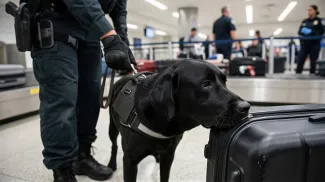
Air travel introduces another point travelers can easily misunderstand. According to TravelPulse, Transportation Security Administration screening focuses on aviation security rather than searching for drugs. Officers who discover illegal substances, however, refer the matter to law enforcement. A security agency’s screening priorities are not permission to pack cannabis.
International borders have their own restrictions. Legal Cannabis Traveler, in guidance last verified Oct. 10, 2026, warns that lawful possession in one country does not authorize export or import. It reports that U.S. Customs and Border Protection enforces federal restrictions on marijuana imports, including medical marijuana that is legal where the traveler obtained it.
The same guide notes that a U.S. state medical card does not authorize carrying cannabis across an international border. Its advice is to purchase only through the destination’s legal pathway and not carry cannabis onward when leaving.
Check the room rules, not just the dispensary rules
Even a lawful purchase leaves one important question unresolved: Where can you use it? TravelPulse cautions that buying legally does not automatically permit consumption in public places, hotels, rental vehicles or other accommodations. Hotel and vacation rental policies need their own check, as do local restrictions.
National parks and other federal lands also remain subject to federal restrictions, according to TravelPulse. A state’s retail rules don’t erase those boundaries.
Used as a starting point, the Alexis 420 guide can help separate three decisions that shouldn’t be bundled together: whether you qualify to buy, where you’re allowed to consume and what restrictions apply when you leave. Confirm the destination’s current requirements before purchasing. The dispensary receipt answers only one part of the trip.
More travel news
TSA Touchless ID Lands at 65 US Airports
WASHINGTON, U.S. - TSA PreCheck Touchless ID is now available at 65 U.S. airports, reducing document handling while making biometric screening more common.
TSA Spending $781M to Change How You Go Through Security
UNITED STATES - The Transportation Security Administration's massive technology rollout is quietly reshaping the checkpoint experience for millions of passengers.
TSA Workers Abandon Posts as Pay Crisis Hits Airports
WASHINGTON - Transportation Security Administration staffing collapsed during peak spring break travel as unpaid workers resigned and called in sick amid the Department of Homeland Security funding standoff.

DHS Shutdown Hits Month Two as TSA Crisis Looms
WASHINGTON — The Department of Homeland Security partial shutdown hit its second month with no funding deal in sight, leaving TSA barely functioning and thousands unpaid as spring break looms.

About the Author

Bob Vidra
Bob Vidra is News Editor at Jetsetter Guide, covering airlines, airports and the travel industry since 2023.