Stay current with our airline news coverage.
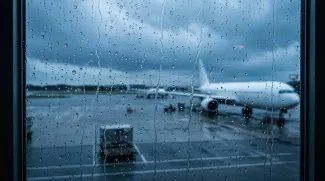
NEW YORK, United States - A violent round of thunderstorms, torrential rain and wind disrupted air travel across the Northeast and Mid-Atlantic on Friday, Aug. 21, with New York’s John F. Kennedy International Airport recording 114 delays and 34 canceled flights.
More than 1,662 flights were delayed across the United States on Friday, while 153 were canceled, according to NJ.com. JetBlue reported 110 delays and 21 cancellations, making the New York-focused carrier a major part of the day’s disruption.
The trouble was not confined to JFK. The Federal Aviation Administration issued arrival delays for JFK, LaGuardia Airport and Newark Liberty International Airport as storms interfered with air traffic and the evening commute. Wind was forecast to affect all three New York-area airports as well as Philadelphia International Airport, according to NJ.com.
Low clouds were reported at Ronald Reagan Washington National Airport and San Francisco International Airport. Rain and thunderstorms were also expected to affect airports in Boston, Charlotte, Atlanta, Memphis, Minneapolis-St. Paul and Florida.
JFK flight delays followed extreme New York weather
The aviation disruption unfolded during a severe weather event affecting the corridor from Washington, D.C., to New York City around Aug. 20 and 21. Parts of the New York City area received 2 to 3 inches of rain, triggering urban flash flooding and interfering with surface transportation around the region’s airports.
Flooding forced closures along the Brooklyn-Queens Expressway and portions of the Long Island Expressway. Both are critical road corridors for travelers moving through Queens and Long Island. Streets and subway stations also experienced water intrusion, including flooding documented in Times Square.
The storm carried hazards beyond rain. Two waterspouts came onshore between about 6:30 and 7 p.m. Thursday, one in Queens and another in Nassau County on Long Island, according to Reuters. The events led to tornado warnings and shelter-in-place instructions.
The National Weather Service also confirmed a rare tornado at Atlantic Beach on Long Island. Farther south, a likely tornado struck Dover, Delaware, causing significant damage and prompting the city to declare a state of emergency.
The combination of extreme rainfall rates, damaging winds, tornado activity and flooded roads created several overlapping problems for travelers. Airlines had to manage weather-related airspace restrictions and reduced airport capacity while passengers faced difficult ground transportation conditions getting to or leaving terminals.
Disruptions stretched beyond New York
The storms were part of a broader severe-weather threat across the Northeast. CNN warned ahead of the event that damaging storms and flooding could affect the region. The severe weather ultimately unfolded over roughly a 24- to 36-hour period spanning Aug. 20 and 21.
New York’s airports were particularly exposed because all three major facilities faced FAA arrival delay programs during the event. Even when an individual airport remains open, an arrival delay program reduces the number of aircraft that can enter the system during a given period. That can leave inbound flights waiting at their departure airports and create schedule problems that persist after the worst weather moves away.
JFK’s 114 delays and 34 cancellations show how quickly that operational pressure can become visible to passengers. JetBlue’s 110 delays and 21 cancellations are also significant for travelers using the airline during a weather event concentrated around New York.
The recovery matters as much as the storm
In my assessment, the hard part for passengers is not always the hour when the rain is heaviest. It is the recovery period, when delayed aircraft, crews and passengers are no longer where the airline schedule expected them to be. Friday’s nationwide count of more than 1,662 delays illustrates how a regional storm can become a much wider network problem.
Travelers connecting through JFK, LaGuardia, Newark or Philadelphia should treat a weather alert as an operational warning, not simply a forecast. Monitor the flight before leaving for the airport, enable notifications in the airline’s app and move quickly if a cancellation opens rebooking options. Waiting can sharply reduce the remaining choices as other affected passengers search for the same seats.
Allowing additional connection time is especially important when thunderstorms are moving through the Northeast corridor. A legal connection on paper can become unrealistic once arrival restrictions begin. Essential medication, identification, electronics, chargers and one change of clothing should remain in a carry-on bag because checked luggage may not follow the same recovery path as its owner after a cancellation.
Ground conditions deserve equal attention. Flooding on the Brooklyn-Queens Expressway and Long Island Expressway showed that a flight listed as operating does not guarantee a straightforward trip to JFK. Travelers should check road and transit conditions before departure and build in more time when flash flooding is affecting Queens or Long Island.
What affected passengers should do now
Passengers should review their airline’s refund and rebooking policies before accepting a replacement itinerary. They should also confirm each segment of a connecting trip rather than assuming the entire booking has moved automatically.
Those already at an airport should use both the airline app and customer-service channels. Rebooking through an app can be faster than waiting in a physical line, particularly during a multi-airport disruption. Travelers with time-sensitive plans should look at the whole regional picture before switching airports because JFK, LaGuardia and Newark were all subject to FAA arrival delays during the storm.
The central lesson from Aug. 21 is straightforward: A Northeast thunderstorm can close roads, flood transit stations and reduce airport capacity at the same time. At JFK, that combination produced a difficult day with 114 delays and 34 cancellations. For travelers, the best defense remains early information, flexible timing and a carry-on packed for the possibility that the airline’s recovery will take longer than the weather itself.
More travel news
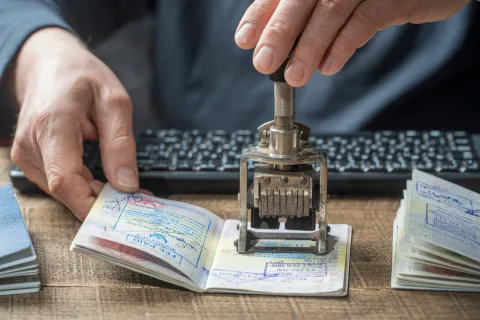
U.S. Customs and Border Protection to End Routine Passport Stamps
CBP announced routine passport stamping will end during primary inspection, with limited exceptions; foreign visitors can access admission and authorized-stay details through I-94 or CBP Link.
United Flight Attendants Can Refuse ICE Questions
Washington, United States - United flight attendants were told they may remain silent when ICE asks about passengers or coworkers as airport arrests increase nationwide.
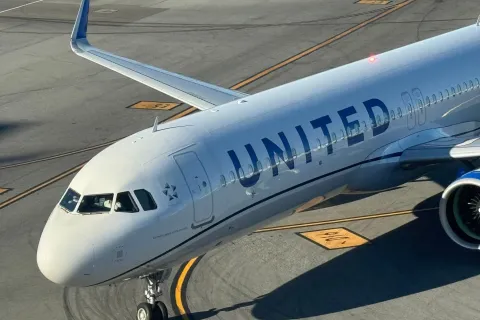
Airlines Put Elite Status on a Higher Price Tag
NEW YORK, United States - Delta, United and other major airlines are raising elite status hurdles, leaving frequent flyers on discounted fares with less credit.

Carnival Rewards Sets Sail With Spending Based Status
Carnival Rewards ties cruise status to eligible spending while keeping separate recognition for lifetime sailing days.
About the Author

Jeff Colhoun
Jeff Colhoun is a photographer and filmmaker whose work has appeared in The Wall Street Journal, the Los Angeles Times, Matador Network and Barron’s.