Stay current with our travel industry news coverage.
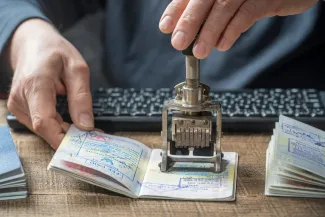
U.S. Customs and Border Protection is ending routine passport stamps during the initial inspection travelers undergo when entering the country. The change, announced in an Oct. 1, 2026, bulletin, makes electronic admission records more important for foreign visitors, according to Live and Let’s Fly, which reported the announcement on Oct. 5.
Stamps are not being eliminated outright. Officers retain discretion to use them in secondary inspection and certain situations during initial processing. For visitors, the consequential change is less about losing a souvenir than knowing where to retrieve evidence of admission and the length of their authorized stay.
What CBP Is Changing at U.S. Borders
The bulletin addresses primary processing, the first immigration inspection travelers encounter when entering the United States. According to Live and Let’s Fly’s account, CBP will cease routinely stamping passports at that stage. The publication describes the new direction plainly: stamps become an exception rather than a standard part of entry.
CBP says eliminating routine stamping reduces processing time and operating costs, Live and Let’s Fly reported. The agency places the change alongside broader efforts to automate forms, expand mobile technology and use biometric facial matching.
Those are the agency’s stated reasons, not a measured promise of shorter lines at a particular border crossing. The source provides no processing-time results. Removing a step from the inspection process is the operational argument; travelers should not read that as a guarantee about how long their own arrival will take.
The timing also requires care. According to Live and Let’s Fly, the bulletin does not specify a separate implementation date or an airport-by-airport schedule. Oct. 1 is the announcement date, not evidence that every inspection booth stopped issuing routine stamps that day.
When a Passport Stamp May Still Be Available
According to Live and Let’s Fly, the bulletin preserves stamps for secondary inspection and limited circumstances during primary processing. Immigrant-visa processing is one example. A traveler’s specific request is another, when officers consider it appropriate.
That distinction matters for anyone who still wants a physical entry mark. You can ask, but the language does not guarantee that asking will produce a stamp. The publication specifically cautions against treating the exception as an entitlement.
The same restraint applies to the other exceptions: the source says officers may use stamps in those circumstances, not that every secondary inspection or immigrant-visa arrival will result in one. The policy leaves room for stamps without preserving them as a routine expectation.
Foreign Visitors Should Check Their I-94 Records
For foreign visitors, CBP directs travelers to its I-94 website or the CBP Link app to retrieve evidence of admission and their authorized stay, according to Live and Let’s Fly. These are the electronic channels identified in the report for accessing the information that matters after entry.
Admission and authorized stay deserve attention together. The purpose of retrieving the record is not simply to see that an arrival appears online; it is to review the evidence of admission and the authorized stay CBP recorded. That is the practical focus of the agency’s guidance as summarized by the publication.
Live and Let’s Fly recommends checking the record after each arrival rather than assuming it was entered correctly. That recommendation is the publication’s advice, not a separately identified CBP requirement. It is a sensible habit when the routine paper marker is being removed from the process.
For travelers who cannot retrieve their record, the agency’s stated fallback is to contact a local CBP port of entry for assistance, Live and Let’s Fly reported. The report presents that route specifically for retrieval problems; it does not establish a detailed procedure for correcting inaccurate information.
A Transition That Began Before This Bulletin
This is not CBP’s first move toward entries without stamps. According to Live and Let’s Fly, the agency began a stampless-entry pilot in August 2022, and a 2023 memo suggested the program would expand. The October bulletin makes the direction clearer by ending routine stamps during primary processing while retaining limited exceptions.
For travelers, that history puts the announcement in context: it extends an existing shift toward electronic processing rather than introducing the idea for the first time. The new emphasis is on stamps no longer being the default at the initial inspection.
A requested stamp may still matter as a keepsake. For foreign visitors, however, retrieving and reviewing the electronic admission record is the more useful priority. CBP’s guidance points to the I-94 website and CBP Link app; Live and Let’s Fly’s advice is to check after arrival. That is where attention belongs, whether or not an officer adds ink to the passport.
More travel news
United Flight Attendants Can Refuse ICE Questions
Washington, United States - United flight attendants were told they may remain silent when ICE asks about passengers or coworkers as airport arrests increase nationwide.

Airlines Put Elite Status on a Higher Price Tag
NEW YORK, United States - Delta, United and other major airlines are raising elite status hurdles, leaving frequent flyers on discounted fares with less credit.

Carnival Rewards Sets Sail With Spending Based Status
Carnival Rewards ties cruise status to eligible spending while keeping separate recognition for lifetime sailing days.

9 National Parks Where Fall Colors Steal the Show
MOUNT DESERT ISLAND, Maine - Nine national parks are drawing autumn travelers with vivid foliage, scenic drives and trails that are generally quieter than in summer.

About the Author

Jeff Colhoun
Jeff Colhoun is a photographer and filmmaker whose work has appeared in The Wall Street Journal, the Los Angeles Times, Matador Network and Barron’s.