Stay current with our airline news coverage.
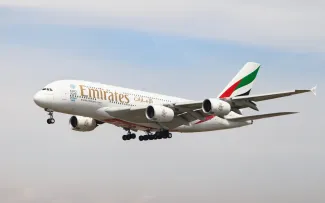
Denver has made Emirates’ list of possible destinations, but not its departure board. Emirates President Tim Clark named Denver International Airport among three candidates for nonstop Dubai service during the Routes World conference in Frankfurt, according to a Nov. 1 report from Live and Let’s Fly.
Detroit and Philadelphia are also under consideration. The report describes a potential addition as Emirates’ first new U.S. station since Miami returned in June 2021; the airline serves 12 U.S. airports.
There’s an important distinction here: Clark identified candidates, not a confirmed route. The report gives no Denver launch date or schedule, and Clark did not identify an aircraft. For Colorado travelers, this is a development worth watching rather than a flight to build a trip around.
Denver’s Dubai ambitions get a clearer signal
The idea of Emirates serving Denver predates Clark’s remarks. According to Live and Let’s Fly, former Denver International Airport CEO Phil Washington said in spring 2025 that Dubai service with Emirates would likely be the airport’s next new route. Emirates said at that time that it had no official plans.
Clark naming Denver puts the possibility on a different footing: the airline’s president has now publicly identified it as a candidate. That’s more substantial than an airport expressing interest, even if it stops well short of a commitment.
The geographic gap is meaningful. Live and Let’s Fly reports that Denver has no nonstop flights to the Middle East or Africa. Its only Asian destination is Tokyo Narita, served by United Airlines with a Boeing 787. Denver served 34 international destinations in 19 countries in 2025, according to the publication.
A Dubai flight would therefore add more than another overseas destination. Live and Let’s Fly identifies Emirates’ connections to South Asia and Africa as part of the potential appeal. The opportunity involves both travelers headed to Dubai and those continuing through the airline’s hub.
A long flight, with a large-aircraft problem
Denver is the farthest from Dubai of the three candidate destinations. Live and Let’s Fly puts the distance from Dubai at 7,758 miles, compared with 7,083 miles to Detroit and 6,928 miles to Philadelphia. The publication says aircraft choice depends largely on market size and distance.
For Emirates, the equipment question is particularly consequential. Citing the airline’s late-2025 fleet figures, Live and Let’s Fly reports that 235 of its 269 aircraft, or 87%, were Airbus A380s and Boeing 777-300ERs. Those aircraft carry roughly 350 to 500 seats, depending on configuration.
Those are historical fleet figures, not a fresh inventory. Still, they explain the constraint behind the publication’s analysis: Emirates has built much of its operation around aircraft that require substantial passenger demand. Opening a new market with hundreds of seats per departure is a different proposition from starting small and adding capacity as bookings develop.
The same late-2025 figures showed 13 Airbus A350-900s, according to Live and Let’s Fly. Its report describes the 298-seat A350-900 as Emirates’ smallest widebody and notes that it was entering the U.S. network through Orlando. It also reports that Emirates had no Boeing 787s in service, despite having 35 on order.
Denver adds an operational complication. Live and Let’s Fly describes a possible 777-300ER service as requiring roughly 350 or more seats to be filled on a long flight departing an airport at about 5,400 feet of elevation. The publication notes that high elevation, particularly in hot conditions, hurts takeoff performance.
In other words, this isn’t simply a matter of finding an available airplane. The publication’s central concern is whether Emirates can match the route’s demand and operating requirements without committing more capacity than the market can comfortably support.
Connections are the opportunity, and the competition
A missing nonstop doesn’t necessarily mean travelers lack alternatives. Live and Let’s Fly points to existing connecting options through Frankfurt and Munich on Lufthansa, Istanbul on Turkish Airlines, and Toronto on Air Canada.
The publication argues that those options matter especially for travelers who favor Star Alliance. It also identifies United loyalty status and corporate contracts as potential obstacles to attracting passengers away from Denver’s established hub carrier. United already operates long-haul service to Europe and Tokyo, according to the report.
Emirates and United have been codeshare partners since 2023, Live and Let’s Fly notes. That relationship belongs in the discussion, but the publication’s demand analysis still treats winning Denver passengers as a challenge. An existing partnership and a commercially viable new nonstop are not the same thing.
The potential audience extends beyond Dubai-bound travelers. Live and Let’s Fly identifies passengers headed to India, the Gulf, Africa and the Indian Ocean, along with leisure travelers attracted to Emirates’ premium offering. Its assessment is skeptical about whether that pool would be sufficient; that is the publication’s analysis, not a demand forecast released by Emirates.
A promising option, not yet a booking choice
For travelers, the most useful distinction is between a new destination and a new way to connect. Dubai would fill a gap in Denver’s nonstop network, while Emirates’ onward service could give passengers another routing option to South Asia and Africa. Those are the concrete possibilities supported by the report.
My read: Clark’s comments make Denver worth taking seriously, but the aircraft question deserves as much attention as the destination itself. A route needs an airplane that fits both the journey and the market. Denver has Emirates’ attention; turning that interest into a useful, sustainable flight is the harder part.
More travel news
Air France extends Dubai and Riyadh flight cancellations
Air France has extended cancellations in both directions. Passengers whose covered flights are canceled can choose a refund or rerouting, with replacement seats subject to availability.

Flydubai passengers reach Tel Aviv after cockpit attack
Passengers reached Tel Aviv after Israeli officials said passengers and crew stopped a co-pilot’s attempt to crash Flight FZ1073.
U.S. Level 3 Advisory Covers Dubai and Abu Dhabi
The nationwide Level 3 advisory is not a travel ban; Americans can still visit Dubai and Abu Dhabi but should assess the risks and prepare for possible flight changes.

Airlines Extend Middle East Flight Suspensions to 2027
LONDON, England - Virgin Atlantic has suspended Dubai flights until October 2027 as global carriers reroute, delay returns and cautiously rebuild Middle East service.

About the Author

Bob Vidra
Bob Vidra is News Editor at Jetsetter Guide, covering airlines, airports and the travel industry since 2023.