Stay current with our airline news coverage.
What Controllers Told Pilots on Approach
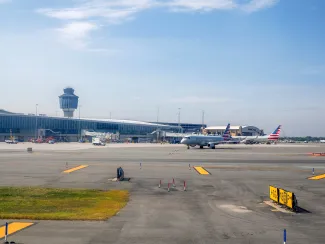
The transmission that alerted crews came without preamble. After issuing a standard landing clearance to Delta Flight 2604, a Boeing 737 arriving from Detroit, the LaGuardia tower controller added without pause: "MANPAD alert issued at LaGuardia Airport at 0027, use extreme caution," according to coverage from Paddle Your Own Kanoo. The Delta pilots immediately asked for clarification on what a MANPAD was, prompting the controller to explain that it stands for man-portable air defense system. "Yeah, that's a man portable air defense system… basically was a report of a rocket launcher," the controller told the crew, according to reporting from AeroXplorer and Paddle Your Own Kanoo. Controllers acknowledged uncertainty in real time, telling pilots there had been "conflicting reports" and that "nothing has been an issue as of yet." The original tip had come through Port Authority Police, who relayed concerns about a possible weapon near Terminal C, though the exact nature of the initial report and who made it have not been publicly disclosed. Minutes later, after law enforcement began searching the area, controllers updated inbound flights with an important clarification: "Port Authority Police reported that it was a non-credible threat," according to the same ATC audio.How Authorities Cleared the Report
Law enforcement and airport security conducted a swift sweep of Terminal C and the surrounding perimeter. Investigators found no weapon, no individual matching any description, and no evidence to support the initial report, according to coverage from 5 Towns Central and AeroXplorer. The all-clear came quickly enough that LaGuardia operations continued without ground stops, flight diversions, or evacuations. No passengers were moved, no aircraft held on the ground, and no injuries or damage resulted from the incident, according to multiple reports. The nearly 900 flights that pass through LaGuardia daily maintained their schedules with minimal disruption. The episode underscores how airport security and air traffic control handle low-probability, high-consequence threats: treat the report as credible until law enforcement can definitively rule it out, even when the tip ultimately proves unfounded. Controllers are required under standard protocol to relay credible security threats to aircraft when there is any potential risk to safety of flight.MANPADS Threats in U.S. Aviation Context
MANPADS alerts at major U.S. airports are exceptionally rare. Shoulder-fired missiles pose the greatest danger to commercial aircraft during takeoff and landing, when planes fly at reduced altitudes and speeds, typically below 15,000 feet. The weapons are designed for exactly this scenario: targeting low, slow-moving aircraft in the critical phases of flight when evasive maneuvers are limited. According to AeroXplorer, the LaGuardia incident represents only the second publicly documented MANPADS-related alert at a major U.S. airport in recent years. A similar non-credible report occurred at Los Angeles International Airport in 2013. Military pilots operating in conflict zones may receive such warnings routinely, but civilian crews flying domestic U.S. routes do not train for or expect this type of threat briefing. Intelligence agencies have long tracked the concern that terrorist groups might attempt to acquire portable anti-aircraft systems to target civilian flights in countries where such threats seem improbable. Most U.S. airlines do not equip their fleets with missile countermeasure systems, though some cargo carriers have explored the technology. Israeli flag carrier El Al is widely believed to be the only commercial airline that installs such defensive equipment on its passenger aircraft as standard practice. The LaGuardia alert also raises questions about the source of the original report: whether it was a genuine misidentification of equipment or personal items, a deliberate hoax intended to disrupt operations, or poor-quality intelligence passed along without proper vetting. Authorities have not disclosed whether the tipster has been identified or whether any charges are being considered in connection with a false report.The Reality Check for Travelers and Crews
This incident matters because it exposes how quickly perceived threats can escalate in dense urban airspace, and how effectively the system can de-escalate when a report turns out to be baseless. For travelers flying into or out of LaGuardia, the episode should be reassuring in one critical sense: the communication and investigation protocols worked exactly as designed. Controllers warned pilots, law enforcement responded immediately, and the threat was assessed and cleared without panic or operational chaos. That said, the nature of the warning itself, broadcast over open radio frequencies and later circulated in recordings, highlights the fine line airports walk between necessary transparency and public alarm. Pilots need real-time intelligence to make decisions about safety of flight. Passengers, on the other hand, would likely prefer not to know their aircraft was told to watch for rocket launchers unless the threat proved real. For flight crews, the LaGuardia transmission serves as a reminder that the unexpected can intrude even on the most routine domestic approaches. Pilots train for engine failures, weather, and traffic conflicts. A MANPADS alert at a U.S. airport falls outside the normal threat matrix, and the confusion in the Delta cockpit, evident in the crew's request for a definition, reflects that gap. Travelers should understand that hoax reports and misidentifications are part of the noise in any large security apparatus. The system errs on the side of caution, and that occasionally means issuing warnings that turn out to be unfounded. What matters is whether authorities can investigate, clear, and move on without grinding operations to a halt. In this case, they did. The broader takeaway: security at major U.S. airports remains layered and responsive, but it is also reactive and dependent on the quality of tips from the public. When someone calls in a rocket launcher sighting, controllers and police must treat it as real until proven otherwise. For passengers and crews, that means occasional alerts that sound alarming but resolve quickly. The alternative, ignoring such reports until a threat materializes, is not an option anyone in aviation is willing to accept.More travel news
Summer Storms Ground Hundreds of Flights Nationwide
NORTHEAST U.S. - Severe thunderstorms grounded hundreds of flights at major East Coast hubs, leaving travelers stranded and budgets strained as disruptions cascaded nationwide.
American Airlines Launches 13 New Global Routes in 2026
DALLAS, Texas - American Airlines launches 13 new international routes in 2026, strengthening hubs in Dallas, Philadelphia, New York, and Miami with expanded Europe, South America, Caribbean, and Canada service.
Ultra-Long Flights May Require Fuel Stops Now
GLOBAL - Ultra-long-haul aviation is hitting hard operational limits, with even minor route changes forcing airlines to add unexpected fuel stops on record-breaking nonstop flights.
Philippine Airlines Boosts North America Routes
MANILA, Philippines - Philippine Airlines expands trans-Pacific reach with increased frequencies to three major North American gateways, betting on diaspora demand and new wide-body capacity.

About the Author

Jeff Colhoun
Jeff Colhoun is an acclaimed travel writer, photographer, and filmmaker, whose work is respected both in the United States and internationally.