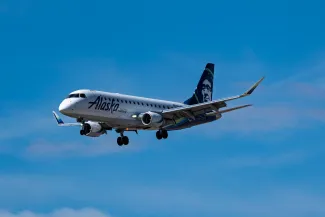
Stay current with our airline news coverage.
A lie-flat bed on an Alaska Airlines domestic flight? That’s the plan, though travelers will have to wait. Alaska announced a premium-cabin expansion that includes a dedicated Boeing 737 MAX 10 fleet with Aurora suites and Premium Reserve premium economy, plus redesigned cabins for its Boeing 787s, according to PaxEx.Aero.
This isn’t just a new name for a little more legroom. The plans introduce different seating layouts, built-in entertainment and, on the Dreamliners, business-class privacy doors. Alaska is pursuing growing demand for premium travel on both domestic and long-haul flights, PaxEx.Aero reported. The publication disclosed that Alaska provided airfare and hotel accommodations for its attendance at the Media/Investor Day where the products were unveiled.
Alaska’s premium MAX 10s are expected in 2028
Alaska expects at least 25 MAX 10s to receive the Aurora configuration, with the first entering operations in 2028, according to PaxEx.Aero. These will be a dedicated premium sub-fleet, not a change to every Alaska 737. Reuters reported that the aircraft will serve select transcontinental routes.
Up front, each premium MAX 10 will have 12 lie-flat Aurora seats arranged across six rows in a 1-1 layout, PaxEx.Aero reported. That means one seat on either side of the aisle, rather than a pair of seats sharing each side. Elevate Aircraft Seating will supply its Ascent narrow-body product, with the seats angled away from the center aisle.
The planned hardware is substantial: a 19-inch 4K entertainment screen, Bluetooth connectivity, wireless charging, USB-C charging and AC power, according to PaxEx.Aero. There is one important distinction behind the suite branding, however. The MAX 10 seats won’t have privacy doors.
Behind Aurora, the aircraft will have three rows of Premium Reserve in a 2-2 layout, followed by economy in the familiar 3-3 arrangement. PaxEx.Aero reported a total capacity of 159 passengers, compared with 162 on Alaska’s MAX 9. The point of the larger aircraft here isn’t simply to pack in more travelers; the published layout gives more space to premium cabins.
The schedule also comes with a qualification. Alaska hopes to begin taking delivery of MAX 10s as early as 2027, but that depends on Federal Aviation Administration certification, according to The Points Guy. Those initial deliveries and the expected 2028 introduction of Aurora-configured aircraft are separate milestones.
Premium Reserve is a separate cabin, not a bed
For travelers who want more room without buying the full lie-flat experience, Premium Reserve will be the middle option. On the MAX 10, PaxEx.Aero described the seat as looking nearly identical to Alaska’s current 737 first-class seat, but with an added headrest privacy wing.
The MAX 10 version will offer 38-inch seat pitch, increased recline, a 16-inch entertainment screen, USB-C and AC power, according to PaxEx.Aero. Its 2-2 layout also eliminates the middle seat within that cabin. It stops short of lying flat, so the distinction between Premium Reserve and Aurora is more than branding: one is a roomier reclining seat; the other becomes a bed.
PaxEx.Aero reported that these will be Alaska’s first 737s with in-seat entertainment systems. That’s a notable part of the cabin upgrade, particularly alongside the larger screens specified for the two premium sections.
The 787 Aurora suites will have doors
On the Dreamliners, Aurora will use the wide-body version of Elevate’s Ascent seat in a 1-2-1 arrangement, according to PaxEx.Aero. Window-side seats will face toward the windows, while the center pair will angle toward each other. Unlike the MAX 10 version, these suites will include privacy doors.
The planned business-class counts are 34 mini-suites on the 787-9 and 40 on the 787-10, PaxEx.Aero reported. The shared Aurora name therefore won’t mean an identical experience across aircraft. For anyone who particularly values an enclosed seat, that door difference matters.
Premium Reserve will occupy five rows on both Dreamliner variants, with 35 seats in a 2-3-2 layout, according to PaxEx.Aero. These seats will have headrest privacy wings and calf and foot supports. Unlike the MAX 10’s premium-economy arrangement, the Dreamliner version will have a middle seat in each center section.
The 787-9 cabin changes also show how much capacity Alaska is willing to trade for more premium seating. PaxEx.Aero reported that total seats will fall from 300 to 279. Business class stays at 34 seats, while economy drops from 266 to 210 to accommodate the 35-seat Premium Reserve cabin.
For the 787-10 layout, PaxEx.Aero lists 40 Aurora suites, 35 Premium Reserve seats and 245 economy seats. The coverage reviewed here does not establish rollout dates for the Dreamliner or A330 cabin changes, so the MAX 10’s 2028 expectation shouldn’t be treated as a fleetwide launch date.
Hawaiian’s A330s join the premium push
The upgrades extend to the Airbus fleet, although the business-class branding differs. PaxEx.Aero reported that the A330s will receive a nose-to-tail refresh featuring 22 lie-flat Leihōkū Suites in a 1-2-1 layout. Premium Reserve will have 28 seats across four rows in a 2-3-2 arrangement.
That broader scope follows Alaska’s 2024 acquisition of Hawaiian Airlines, which brought wide-body aircraft and a larger Pacific network into the group, Reuters reported. Premium Reserve will span Boeing and Airbus aircraft, while the Aurora name applies to the Boeing suites, according to PaxEx.Aero.
A bigger bet on travelers paying for comfort
Alaska sees a financial opportunity here, not just a cabin makeover. President and Chief Financial Officer Shane Tackett told Reuters that the premium investments could eventually add $3 to $4 to earnings per share and lift margins by 2 to 3 percentage points within a couple of years.
There’s competition for those passengers. Reuters reported, citing Visual Approach Analytics, that industry domestic premium-seat capacity in June was 27% above 2019 levels, nearly three times the growth in economy seats. Reuters also noted the risk that supply could eventually outpace demand and pressure fares.
For travelers, the promising part is the planned range of genuinely different seats. The detail worth keeping straight is that the cabin name alone won’t tell the whole story: Aurora’s doors and Premium Reserve’s middle seats will depend on the aircraft. Alaska plans to offer more choice; the seat map will still deserve a close look.
More travel news
Hawaiian Airlines Plans Seattle Nonstops to Osaka, Tahiti
The planned routes will run four times weekly to Osaka and three times weekly to Papeete on Hawaiian Airlines Airbus A330-200s; neither will operate daily.
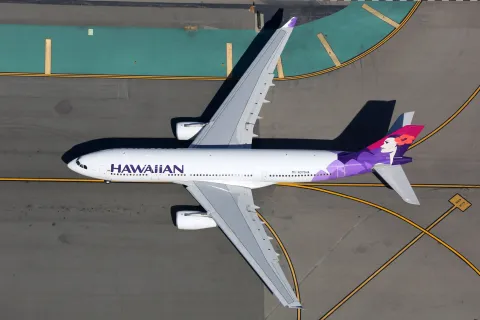
Alaska Airlines plans screens in select 737 MAX 10 premium cabins
Alaska plans seatback screens from 2028 for Aurora Suites and Premium Reserve passengers on select transcontinental 737 MAX 10s, while the main cabin will rely on personal devices.
Passenger threats trigger emergency landings and lockdowns
MILWAUKEE, Wis. - Passenger threats on United and Alaska Airlines flights prompted lockdown protocols and emergency responses, adding to 2026's growing tally of in-flight disruptions.
Evangelist Banned After Preaching on Delayed Flight
Orlando, Florida - A 40-year-old evangelist's one-minute sermon during a ground delay led to her removal and ban from Alaska Airlines, igniting tensions over speech, safety, and consent at 30,000 feet.
About the Author

Bob Vidra
Bob Vidra is News Editor at Jetsetter Guide, covering airlines, airports and the travel industry since 2023.