Stay current with our travel industry news coverage.
Australia has raised its Saudi Arabia travel advisory to Level 4, Do Not Travel, citing escalating security risks, missile and drone threats, and widespread disruption to international flights, according to Rustourismnews. The warning applies across the kingdom and urges Australians to postpone religious, leisure and business visits.
The publication reported that the advisory was updated in October 2026 and remained at Australia’s highest warning level as of Oct. 20.
For Australians already in Saudi Arabia, the reported guidance is to monitor security developments and consider leaving if it is safe. That qualification matters: airport operations remain unstable, and an airport reopening does not establish that a particular flight is operating.
Saudi Arabia warning covers religious and business travel
According to Rustourismnews, the Australian Department of Foreign Affairs and Trade advises against travel anywhere in Saudi Arabia because of the volatile security situation. The warning specifically includes religious journeys to Makkah and Madinah, along with leisure and business trips.
The advisory identifies possible further missile and drone attacks against civilian infrastructure, airports and airspace. Airport closures, cancellations and airspace restrictions could occur with little notice, leaving travelers stranded or unable to complete their journeys, Rustourismnews reported.
The publication also reported a specific Australian warning against travel to King Khalid International Airport in Riyadh following attacks that disrupted operations. Australian authorities advise extreme caution when using other Saudi airports and warn that consular assistance could be limited if security conditions deteriorate.
This is not simply a warning about delays. The reported advice addresses both the security of the journey and the ability to complete it.
Riyadh airport reopened, but flight disruption persists
The extent of the disruption is visible in aviation data. According to Skift, citing aviation analytics company Cirium, 322 out of 941 scheduled flights from Saudi Arabia, or 34%, were canceled or did not fly on Monday. That was an improvement from Sunday, when more than half of scheduled flights were canceled or did not fly.
Skift reported that King Khalid International Airport reopened Sunday after a week-long shutdown, but the majority of international and regional airlines continued to suspend flights to Riyadh. Cirium’s figures showed Riyadh had the highest cancellation rate Monday at 66%, followed by Abha at 48%, Dammam at 31% and Jeddah at 15%.
Airline responses have not been uniform. Rustourismnews reported that Lufthansa Group carriers extended certain Riyadh suspensions into November, while Air France-KLM postponed the resumption of affected services. Several Indian airlines canceled services to Riyadh, Jeddah, Dammam and Madinah.
By contrast, Malaysia Airlines restarted scheduled flights to Jeddah and Madinah on Oct. 18 after a safety review, according to Rustourismnews. Those differing decisions make individual booking checks essential, particularly for itineraries connecting between airlines.
The Australian guidance reported by Rustourismnews is explicit: passengers should not go to an airport until their airline or travel provider has reconfirmed that their flight is operating. A general announcement that an airport has reopened is not that confirmation.
Pilgrims face risks beyond the holy cities
The warning’s inclusion of religious travel reflects the exposure travelers can face in transit. Reuters reported Oct. 14 that pilgrims were among the passengers caught up in the Oct. 10 attack on Riyadh’s airport.
Reuters reported that the Houthis had promised not to attack Mecca or Medina but were targeting other Saudi airports. Most international pilgrims fly directly into Medina or Jeddah, according to Reuters, while others use the kingdom’s other main aviation hubs, including pilgrims who already live in Saudi Arabia.
Saudi officials have offered assurances about visitor safety, Reuters reported. Australia’s reported guidance nevertheless calls for postponing religious travel. The distinction is practical: a journey to the holy cities can still involve airports and connections affected by attacks or disruption.
Major Riyadh conference moves to 2027
Business travel has also taken a direct hit. CNN reported that the Future Investment Initiative canceled its Oct. 26-29 conference in Riyadh following the series of Houthi attacks.
The event will instead take place on an undisclosed date in 2027, according to a conference statement reported by CNN. Organizers said registrations and partnerships remain valid.
For delegates, that separates the conference arrangements from the travel arrangements. The registration remains valid, but the October event is no longer taking place. Rustourismnews reported that Australians with existing flight bookings should contact their airlines or booking providers to review available changes, refunds and alternative arrangements.
Leaving Saudi Arabia requires a route-specific assessment
Alternative departures are already being used. Reuters reported that a senior executive was arranging road transport to Doha for foreign employees to catch onward flights. A diplomat told Reuters that several embassies had also used Doha for travel to and from Saudi Arabia, including for staff temporarily leaving with their families.
Those examples do not establish that an overland departure is suitable for everyone. According to Rustourismnews, Australia’s advice suggests considering alternative transport only where safe, with security conditions, border requirements and onward transport availability assessed before departure.
Cost and availability are additional constraints. Reuters reported that a representative of a company organizing transport to Doha and Dubai said fares to those destinations had doubled. Reuters also cautioned that paying for transport did not guarantee onward travel, noting earlier flight disruption around the Gulf during the U.S.-Iran conflict.
Insurance needs a separate check. Rustourismnews reported that traveling against a Level 4 advisory may affect coverage, with policies potentially excluding claims involving war, military activity, civil unrest or travel despite government warnings. That does not mean every claim is automatically rejected; travelers should check their own policy conditions directly.
For Australians remaining in the kingdom, the reported guidance is to follow local authority instructions, stay alert to emergency warnings and avoid unnecessary time at airports. Rustourismnews directs those needing assistance to Australia’s Consular Emergency Centre and travelers seeking current security and airport information to Smartraveller’s Saudi Arabia advice.
More travel news
Riyadh airport reopened - Foreign flight suspensions persisted Monday
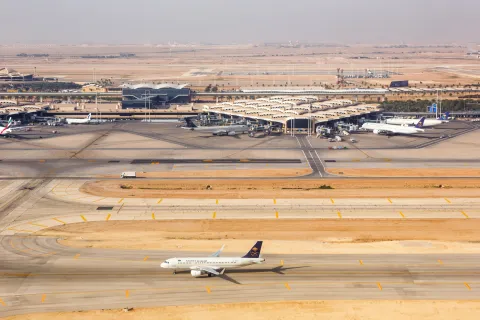
King Khalid International Airport reopened Sunday after a week-long shutdown, but as of Monday most international and regional airlines still suspended Riyadh flights.
U.S. Embassy Reportedly Urges Americans to Reconsider Saudi Arabia Travel
A reported U.S. Embassy warning urges Americans to reconsider Saudi Arabia travel amid deadly airport attacks; the reports establish neither a new advisory level nor Riyadh airport’s Oct. 14 status.

King Khalid International Airport attacks halted flights
The Riyadh airport canceled 99.7% of scheduled flights Sunday after two attacks killed 14; Lufthansa Group cancellations run until Oct. 16, while Air France-KLM’s Riyadh suspension lasts until the end of October.
FAA warns operators of U.S.-registered aircraft in Saudi airspace
Citing military activity and navigation-system interference, the FAA urges operators of U.S.-registered aircraft to use extreme caution during overflight, arrival and departure in Saudi Arabia through Dec. 10.

About the Author

Jeff Colhoun
Jeff Colhoun is a photographer and filmmaker whose work has appeared in The Wall Street Journal, the Los Angeles Times, Matador Network and Barron’s.