Stay current with our travel events coverage.
The Road to Ituri: What Happens When the WHO Chief Shows Up to an Ebola Zone Without Vaccines
BUNIA, Democratic Republic of Congo - There are dusty roads that end in adventure, and then there are dusty roads that end in an Ebola ward. On May 31, 2026, the WHO chief took the latter route into Ituri province in eastern Congo, traveling to what has become the undisputed epicenter of an outbreak that is, to put it plainly, outrunning the people trying to stop it. "Ebola is now back. This time, the outbreak is hitting Ituri province the hardest. More than 90% of all cases have been reported in Ituri province," the WHO Director-General told the people of the Democratic Republic of the Congo, according to Travel and Tour World. That's not a statistical quirk. That's the entire crisis concentrated in one place.When There's No Vaccine and No Treatment
Here's what makes this visit different from your standard high-level WHO handshake tour: this outbreak is caused by Ebola Bundibugyo, a rare strain for which there are currently no approved vaccines or treatments. None. The Ebola vaccine stockpiles that helped control previous outbreaks in West Africa and eastern Congo? Useless here. The experimental antivirals that gave patients a fighting chance? Not applicable. "There are currently no approved vaccines or treatments for [Ebola Bundibugyo]. This is serious, and you deserve to hear that plainly," the Director-General said in a message to Congolese communities. And that plainness is doing a lot of work, because what it means on the ground is that health workers in Bunia and the surrounding villages are essentially fighting a lethal hemorrhagic fever with isolation tents, basic protective gear, and hope. Hundreds of suspected cases and more than 200 suspected deaths have been reported nationally in connection with this outbreak, according to WHO and media briefings. The overwhelming majority are in Ituri, a province already dealing with chronic insecurity from armed groups, weak health infrastructure, and communities that have learned the hard way not to trust official responses to crises.An Air Bridge to a Forgotten Epicenter
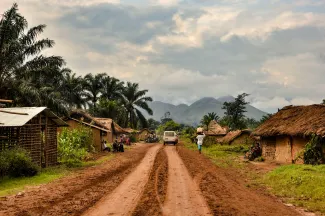
Ituri is not easy to get to. It's not on a backpacker trail. It's not a digital nomad hub. The fact that international partners including the United Nations and European Union have had to establish a humanitarian air bridge from Kenya just to move doctors, supplies and equipment into the region tells you everything about how remote and under-resourced this corner of Congo is. The outbreak is described by WHO and aid workers as outpacing the response, with medical teams struggling to keep up with new suspected cases and deaths. "What needs to be done is first to bring humanitarian assistance, to train the doctors, to make hospitals ready, to have screening facilities, to make sure that every case is recorded because that's how you fight Ebola," a WHO official said, outlining the basics that are still not in place. During a previous outbreak from 2018 to 2020, the WHO Director-General made 14 visits to eastern Congo. That's an extraordinary level of high-level engagement for a region that most of the world forgets exists until a virus starts spilling across borders. This latest trip to Bunia signals that the crisis is serious enough to warrant that kind of attention again, and that frontline health workers need more than supplies. They need visibility, political will, and the message that they haven't been abandoned.The Frontline Nobody Travels To
Health workers in Ituri are operating under conditions most travelers can't imagine: lack of equipment, hospitals that aren't ready, distances so vast from the capital Kinshare that it takes an international airlift just to get basics in. Add deep community mistrust, the stigma of being labeled the epicenter, and the daily risk of contracting a virus with no specific treatment, and you have a scenario where showing up to work is an act of extraordinary courage. Community engagement has become a central pillar of the response. WHO and partners are working to convince people to seek treatment, avoid traditional contact with bodies of the dead, and collaborate with surveillance and screening efforts. That's not a bureaucratic checkbox. In a region where mistrust runs deep and where communities have been marginalized by conflict and broken promises, convincing people that an isolation tent will help rather than harm them is its own kind of frontline work.Why This Visit Matters Beyond the Headlines
A high-profile WHO visit to an outbreak zone is part optics, part morale boost, part global alarm bell. For the health workers in Bunia, it means someone with power is paying attention. For affected communities, it's a signal that their crisis is being taken seriously, even if the response is still playing catch-up. For the rest of the world, it's a reminder that Ebola doesn't care about borders, and that outbreaks in remote, conflict-affected regions require sustained international support, not just emergency airlift when the case count gets scary. The reality is that much of what needs to happen now, prevention, rapid isolation, community trust, training, screening, doesn't require a vaccine. It requires money, people, and political will. The air bridge is a start. The WHO chief showing up in person is a signal. But the measure of success won't be photo ops in Bunia. It will be whether the response can finally match the speed of the virus, whether health workers get the support they need to do an impossible job, and whether communities in Ituri feel seen as people, not just statistics in an epicenter. This is not the Congo that shows up in travel brochures. But it's the Congo where real people are living, working, and trying to survive an outbreak that the world is only now starting to notice. And for the health workers on those dusty roads, the visit from the WHO chief might matter less than what happens after the cameras leave.More travel news
US Tightens Travel Screening Amid Congo Ebola Crisis
WASHINGTON - The United States has barred certain international travelers from Ebola-affected countries and is routing permitted arrivals through designated screening airports following an outbreak that has killed at least 131 people.
Hawaii Probes Sixth Cyclospora Case With No Travel
HONOLULU, Hawaii - A sixth cyclosporiasis case, involving an Oʻahu resident with no recent travel, puts Hawaii inside a major national parasite investigation.

Google Launches Interactive National Parks Hub
WASHINGTON, United States - Google and the National Park Service opened a digital gateway to U.S. parks, but the project's launch timeline and anniversary framing require context.

Spain Warns Eclipse Chasers as Wildfire Danger Soars
MADRID, Spain - Authorities urge travelers heading to see Wednesday's total solar eclipse to avoid sparking wildfires as nearly half a million visitors converge on dry, fire-prone regions already scorched by a record season.
About the Author

Mariana Torres
Mariana is a 33-year-old travel writer and backpacker who specializes in finding the pulse of a place far beyond the tourist maps.