Stay current with our cruise news coverage.
Understanding the Danger: Why Distance Matters
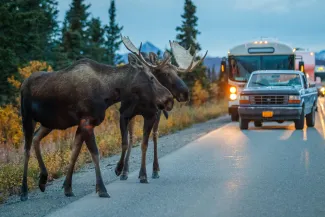
The National Park Service maintains clear distance requirements for visitor safety: at least 100 yards from grizzly bears and wolves, and at least 25 yards from all other wildlife, according to Travel. These regulations exist not as suggestions but as critical safety protocols informed by decades of wildlife behavior research and unfortunate incidents. Moose, despite their seemingly docile appearance while grazing, represent one of North America's most unpredictable and potentially dangerous large mammals. Adult bull moose can weigh between 1,000 and 1,500 pounds and stand up to 10 feet tall at the shoulder. They're capable of charging at speeds reaching 35 mph, and they're responsible for more human injuries across North America than bears, precisely because visitors underestimate their temperament and capabilities. Their massive antlers and powerful hooves can cause devastating injuries. When startled, threatened, or simply irritated by human proximity, moose can react with sudden aggression. The tourist in this video was extraordinarily fortunate that the animal remained focused on foraging rather than perceiving the intrusion as a threat.The Social Media Effect on Wildlife Encounters
This incident reflects a troubling pattern documented across national parks: visitors prioritizing close-up photographs over safety and ethical wildlife viewing. The rise of social media platforms has fundamentally altered how many people interact with wild spaces. The desire for dramatic, shareable content often overrides common sense and explicit park regulations. Instagram commenters responding to the viral video expressed both disbelief and anger. "Show respect. GIVE THIS BEAUTIFUL BEING SPACE," one user wrote, according to Travel. Another questioned the logic: "The camera literally has a zoom option. Why do they get that close?" The @touronsofnationalparks account, which has become a repository for documenting reckless outdoor behavior, serves a dual purpose: it calls out dangerous actions while simultaneously educating followers about proper wilderness etiquette. Yet the fact that such documentation is necessary in the first place speaks to a broader cultural challenge facing park management.What Families and Travelers Should Know
For families planning visits to Grand Teton or any national park with significant wildlife populations, this incident offers several critical lessons. First, treat all distance requirements as non-negotiable minimums. The 25-yard rule for moose translates to roughly 75 feet, approximately the length of a standard city bus. This distance provides sufficient buffer for both human safety and animal welfare. Second, invest in proper photographic equipment. A quality telephoto lens or even modern smartphone zoom capabilities can capture compelling wildlife images without requiring dangerous proximity. The technology exists to document these magnificent creatures responsibly; there's simply no justification for the behavior shown in this video. Third, educate children before arrival. Wildlife encounters create teachable moments about respect, boundaries, and our role as temporary visitors in these animals' permanent homes. Grand Teton is home to approximately 500 to 600 moose. These animals aren't props for vacation photographs; they're wild creatures navigating their own survival needs.Legal and Ethical Consequences
Beyond the immediate physical danger, approaching wildlife in violation of park regulations carries legal consequences. Federal law allows for fines up to $5,000 and potential criminal charges for visitors who harass, disturb, or approach protected wildlife too closely. Park rangers have authority to issue citations, and repeat offenders face escalating penalties. Yet enforcement remains challenging given the sheer volume of visitors and the difficulty of monitoring behavior across vast park landscapes. Grand Teton, like many national parks, has experienced record visitation in recent years, stretching both infrastructure and ranger resources. Some online commenters expressed little sympathy for those who ignore safety guidelines. "I do not one bit feel sorry for tourons. If they get hurt, they deserve what they get," one Instagram user wrote, according to Travel. While harsh, the sentiment reflects growing frustration within the outdoor recreation community about the minority of visitors whose actions endanger themselves, others, and the animals they claim to admire.Respecting Wildlife for Future Generations
The privilege of experiencing wildlife in natural settings comes with corresponding responsibilities. Every close approach, every disruption to natural behavior, every moment an animal must assess whether a human represents a threat creates stress that compounds over time and across individual encounters. For families seeking authentic wildlife experiences, the most memorable moments often come from patient observation at appropriate distances. Watching a moose forage naturally, observing its behavior patterns, understanding its place within the ecosystem; these experiences offer far more educational and emotional value than a risky selfie. This viral video serves as both cautionary tale and teaching opportunity. As we plan our national park adventures, let's commit to being the kind of visitors these extraordinary places deserve.More travel news
Grand Teton Fall Recommendation Favors Early Visits
Travelers planning an autumn trip to Grand Teton can find golden aspens and fewer crowds, but should favor early fall and confirm trail, road and campground status because access is weather-dependent.
Google Launches Interactive National Parks Hub
WASHINGTON, United States - Google and the National Park Service opened a digital gateway to U.S. parks, but the project's launch timeline and anniversary framing require context.
United Unveils Boston to Jackson Hole Ski Nonstop
BOSTON, United States - United Airlines is adding a short-run nonstop to Jackson Hole, giving New England skiers a direct flight during the core 2026-27 winter season.
Yellowstone Tops Rocky Mountain Parks With 4.76M Visitors
ROCKY MOUNTAINS, North America - Five iconic parks along the 3,000-mile mountain chain welcomed record crowds in 2025, from Wyoming's thermal features to Alberta's alpine wilderness.
About the Author

Jennifer Wilmington
Jennifer Wilmington is a distinctive voice in the world of family and luxury travel, offering unique perspectives derived from her diverse background and experiences.