Stay current with our cruise news coverage.
Aurora Expeditions Opens Polar Voyages to School-Age Children
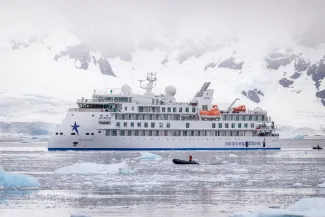
Sydney, Australia - Aurora Expeditions has lowered its minimum age requirement to six years old, opening its purpose-built expedition ships to families traveling with school-age children on voyages to remote regions including Antarctica, the Arctic, Scotland, Central America and the Mediterranean, Travel Pulse reported. The policy shift represents a significant departure for the Australian expedition cruise operator, which has historically focused on older, experienced adventure travelers. Under the new Aurora Young Explorers program, children aged six and over can now join their families on expeditions that have traditionally been marketed as high-adventure, adult-oriented experiences in environmentally sensitive and logistically challenging environments. To support the new family focus, Aurora is offering children aged six to 15 savings of up to 50% off the best available fare.
Education-Focused Model, Not Entertainment
Aurora is positioning these trips as immersive, nature-focused educational experiences rather than conventional family cruises with kids' clubs and entertainment complexes. All activities are led by the company's onboard expedition team, with parents or legal guardians responsible for supervision at all times. The minimum age to travel on an Aurora Expeditions voyage is now explicitly six years at embarkation. Children aged six to 12 are defined as young explorers eligible for child-specific fare reductions, while passengers aged 13 and over are charged the applicable adult fare but remain eligible for certain teen discounts through age 15.
Discount Structure and Cabin Requirements
The fare reduction structure is tiered based on cabin occupancy. Children receive 50% off the best available fare when up to two children aged six to 12, or one to two teens aged 13 to 15, share a cabin with two adults. When sharing a cabin with one adult, the discount drops to 25% off the best available fare, according to company policy documents. All children must travel with a parent or legal guardian, who is responsible for the child's supervision, behavior and compliance with safety procedures and expedition staff instructions throughout the voyage. Participation in certain expedition activities, such as Zodiac landings and adventure options, may be subject to minimum age and safety requirements, with children required to be accompanied by a parent or legal guardian on all off-ship activities unless otherwise advised by the expedition team.
Opening Polar Access to Families
The practical implications here are straightforward: families who have been priced out or age-restricted from polar and remote-region expeditions now have a materially lower barrier to entry, both financially and operationally. Aurora's 50% child discount can cut per-person costs significantly on voyages where double-occupancy fares often run $10,000 or more, making Antarctica or the Arctic accessible to families willing to travel during shoulder seasons or book well in advance. But this isn't a soft-adventure pivot. Aurora is explicitly not building entertainment infrastructure or dedicated kids' programming in the traditional sense. Parents considering these trips should understand that responsibility for supervision, safety compliance and managing children's behavior in extreme environments rests entirely with them. There is no kids' club. There is no babysitting service. On a Zodiac landing in Antarctica or a shoreline walk in Svalbard, you are your child's primary supervisor, with expedition staff setting boundaries and safety parameters but not acting in loco parentis. The educational framing is credible if you know Aurora's operational model. The company runs naturalist-led, small-ship expeditions with low passenger-to-guide ratios, where daily briefings, wildlife encounters and cultural visits are the core product. A six-year-old capable of listening to instructions, staying with a parent during landings and managing the physical demands of boarding Zodiacs in cold, wet conditions can have a genuinely formative experience. A six-year-old who struggles with focus, compliance or cold-weather tolerance will make the voyage harder for everyone on board. From a market perspective, this is part of a broader trend in the expedition sector. As new ships enter service and capacity grows, operators are diversifying their customer base beyond the traditional older, high-net-worth adventure traveler. Families represent a multigenerational booking opportunity with strong repeat potential if the first trip delivers. Aurora is betting that educational positioning and deep discounts can capture that segment without diluting the expedition experience that defines the brand. For families seriously considering these trips, the math is compelling but the preparation is non-negotiable. Polar regions and remote expedition environments do not accommodate improvisation. If your child can handle cold, wet, physically demanding days with patience and focus, Aurora has just made some of the planet's most extraordinary places accessible at a price point that wasn't available to families before. If not, wait a few years. The glaciers, unfortunately, will still be there.
More travel news
Saudi Arabia: Australia Raises Advisory to Do Not Travel
Australians should postpone all Saudi Arabia trips, including religious travel; those already there should consider leaving if safe and confirm flights before going to an airport.

Aurora Plans 27 Antarctic Voyages for 2026-27
The planned three-ship season includes nine- to 34-day itineraries and up to 130 travelers per polar departure; researchers are scheduled on 11 of 27 voyages.
Antarctica21 Publishes Its First Sustainability Report
The report sets a fiscal 2025-26 baseline, including a 6,878 tCO2e footprint across Scopes 1–3 that Antarctica21 says it fully offset.

A 28 Day Private Jet Odyssey Across Seven Continents
MIAMI, United States - Abercrombie & Kent unveils a 28-day, seven-continent journey by private Boeing 757, combining Antarctica, Uluru, the Maldives and Egypt.

About the Author

Jeff Colhoun
Jeff Colhoun is a photographer and filmmaker whose work has appeared in The Wall Street Journal, the Los Angeles Times, Matador Network and Barron’s.