Stay current with our airline news coverage.
United Airlines has equipped just under 600 aircraft with Starlink Wi-Fi, according to Yahoo Finance. American Airlines is expanding its own commitment to the satellite internet service, but its installations are still ahead: The carrier plans to begin equipping more than 1,000 mainline aircraft in early 2027, according to Bloomberg.
That is the distinction behind the competing fleet announcements. United has aircraft flying with the system now. American has broadened the scope of a future rollout. For passengers weighing connectivity when choosing an airline, an installation commitment is not the same thing as an equipped aircraft.
Yahoo Finance’s Oct. 12 report bases United’s installed-aircraft count on a note from Sheila Kahyaoglu, an analyst at Jefferies, following a meeting with the airline’s vice president of technology. It is an analyst’s account of the deployment, rather than a direct United announcement in that report.
United’s Starlink rollout has moved beyond a limited introduction
United expects 50% of its mainline fleet to have Starlink by year end, Yahoo Finance reported. The same report puts expected coverage at 100% of the fleet by the end of 2027. Those are rollout targets, not completed installations; the reported count of just under 600 is the measure of progress already made.
The distinction between regional and mainline aircraft also matters. Yahoo Finance reports that United’s installed base includes both categories. A combined aircraft count does not establish the percentage of mainline aircraft equipped, which is why the separate 50% target is more useful for understanding that portion of the rollout.
Kahyaoglu sees the timing as a competitive advantage. According to Yahoo Finance, her assessment places United ahead of U.S. peers in next-generation Wi-Fi deployment, with American’s Starlink installations scheduled for the first quarter of 2027 and Delta’s Amazon Leo rollout scheduled for 2028.
United is also treating connectivity as part of its effort to attract premium customers, rather than as an isolated technology upgrade. Yahoo Finance reported that the airline identified next-generation Wi-Fi alongside its mobile app, seat-back entertainment and new interiors as tools for attracting those travelers.
Installing Wi-Fi at fleet scale takes a maintenance network
The work behind United’s expansion is substantial. Simple Flying reported an accelerated installation plan requiring work on more than 20 aircraft every week across 17 maintenance stations. Its account describes a geographically distributed effort designed to fit installations into scheduled maintenance opportunities and reduce the time aircraft must be removed from service.
That maintenance capacity helps explain how an airline can move from a partial rollout toward broader coverage. The passenger-facing announcement is faster internet; the operational task is repeatedly getting aircraft equipped without taking too many out of service at once.
Simple Flying also reported that United had equipped virtually its entire dual-cabin United Express regional fleet, while mainline installations accelerated throughout 2026. That detail helps put the combined fleet count in context: Progress on regional aircraft and progress on mainline aircraft have not been identical.
There is evidence that passengers notice the difference. According to Simple Flying’s account of United’s second-quarter results, Starlink-equipped flights generated Wi-Fi satisfaction scores more than twice as high as aircraft using other onboard connectivity systems. That is a reported satisfaction measure, not a speed test or a guarantee of performance on an individual flight.
American adds Boeing aircraft to its Starlink plan
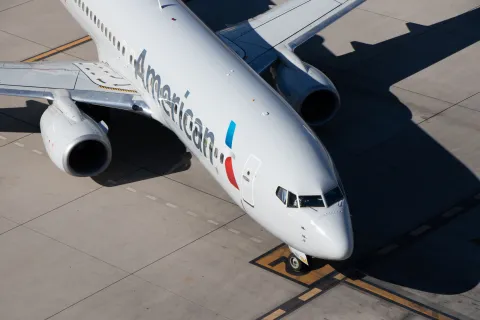
American’s Oct. 8 announcement expands a commitment first disclosed in May. The earlier plan covered more than 500 Airbus aircraft; the expanded agreement adds more than 530 Boeing aircraft, according to Reuters.
Bloomberg reported that the broader program covers American’s entire mainline fleet, including Airbus and Boeing narrowbody jets and widebody aircraft. Its report says the expanded agreement more than doubles the initial commitment. The relevant scope is mainline, not a promise covering every aircraft operating under the airline’s broader network.
The larger commitment does not move the installation start forward. According to Simple Flying, American’s installations remain scheduled to begin in the first quarter of 2027. Bloomberg similarly places the start in early 2027. Neither description means the entire fleet will be equipped at that point.
American’s equipped aircraft will use SpaceX’s Performance Aero Terminal, Reuters reported. The airline says the system can provide speeds of up to 1 gigabit per second. Simple Flying specifies that the stated capability is per terminal. It should not be read as a promised connection speed for each passenger’s device.
Choose based on installed service, not fleet promises
For a traveler booking around onboard connectivity, United’s existing deployment is more immediately relevant than American’s expanded future commitment. But United’s own coverage targets still describe a rollout in progress. Neither airline’s fleet announcement establishes that a particular booked flight will have Starlink, and the supplied reports do not provide flight-level availability or complete passenger access terms.
The useful comparison is therefore straightforward: United has a substantial installed base and further coverage targets; American has widened the aircraft types included in a program scheduled to start next year. American’s expansion addresses the scope of its eventual mainline offering. United’s current advantage is deployment already completed. Keep those two measures separate when deciding how much weight to give Wi-Fi in a booking.
More travel news
United Airlines plans two winter San Francisco-Barcelona round trips
Two planned Boeing 777-300ER round trips will operate Feb. 27-28 and March 3-4, 2027, around Mobile World Congress; they do not extend the route through winter.

Alaska Airlines plans screens in select 737 MAX 10 premium cabins
Alaska plans seatback screens from 2028 for Aurora Suites and Premium Reserve passengers on select transcontinental 737 MAX 10s, while the main cabin will rely on personal devices.
United Airlines Plans Base Fares for Domestic First, Short-Haul Business
United Airlines plans Base tiers for domestic first class and eligible non-Polaris short-haul international business, with paid seat selection, one free bag and no changes; Business Base excludes United Club access.
American Airlines may adjust capacity if fuel prices stay high
American Airlines says persistently high fuel prices may force further capacity changes, while United Airlines has cut capacity roughly 5% and Southwest Airlines has modified schedules.
About the Author

Jeff Colhoun
Jeff Colhoun is a photographer and filmmaker whose work has appeared in The Wall Street Journal, the Los Angeles Times, Matador Network and Barron’s.