Stay current with our airline news coverage.
MINNEAPOLIS, Minnesota - For years, Spirit Airlines was the airline everyone loved to hate. You know the drill: the cramped seats, the eye-watering fees for everything from carry-ons to printing a boarding pass, those memes about its bright yellow planes. People roasted Spirit relentlessly on social media, swore they'd never fly it again after some indignity involving a $50 personal item charge. And yet, here's the uncomfortable truth nobody wanted to admit: even if you never once set foot on a Spirit flight, you were quietly benefiting from its existence.
Now that benefit is gone, and your wallet is about to notice.
The Minneapolis Warning Sign
When Spirit pulled out of Minneapolis-St. Paul International Airport in late 2025, something predictable happened: fares doubled across the routes it had served, according to Simple Flying. Not a 10% bump here or a seasonal adjustment there; we're talking actual doubling of average ticket prices. It was a localized warning shot that most travelers outside the Twin Cities probably didn't notice at the time.
That localized problem became everyone's problem on May 2, 2026, when Spirit abruptly ceased all operations. The collapse came after a proposed $500 million government bailout fell through and jet fuel costs spiked to levels the airline simply couldn't absorb, according to The Points Guy.
The numbers tell the ugly story: Spirit's restructuring plans reportedly assumed fuel prices around $2.24 per gallon, only for prices to surge to roughly $4.51 by the end of April, The Points Guy reported. For an ultra-low-cost carrier built entirely around razor-thin margins and rock-bottom fares, that kind of fuel shock was unsurvivable.
The Competition That Wasn't Flying
Here's the thing about Spirit that the legacy carriers never wanted you to fully grasp: its mere presence on a route kept everyone else honest. Even travelers who wouldn't dream of boarding a Spirit flight benefited from the competitive pressure the airline created. When Spirit announced service on a route, Delta, American, United, and Southwest all had to respond with lower basic economy fares or risk losing price-sensitive customers.
"When any airline leaves a market, it results in a drop in the supply of seats. That generally means that airfare will increase, and it doesn't much matter which airline departs a market," Mike Arnot, an airline industry consultant, told Business Insider.
But it does matter which airline leaves, actually. When Spirit exited roughly 90 routes between 2024 and 2025, average fares on those routes jumped 14%, or about $19 per ticket, compared to just 6-7% increases on routes where Spirit maintained service, according to analysis from Business Insider and Cirium cited by Simple Flying. That's not a coincidence; that's what happens when the industry's most aggressive price competitor disappears.
Another analysis from CBS News and Cirium found an even starker pattern: a 23% average airfare increase and a 20% drop in passenger volume when Spirit left a route. The twin Cities experience wasn't an anomaly. It was a preview.
The Nationwide Ripple Effect
Spirit's market share had already shrunk nearly 25% by February 2026 compared to the prior year, according to Cirium data reported by Simple Flying. The airline was wounded long before it finally collapsed; a failed merger with JetBlue, two separate bankruptcy filings, and relentless losses (Spirit posted a $2.8 billion net loss in 2025 despite generating $3.8 billion in revenue) had already forced route cuts across its network.
But those gradual cuts became a sudden vacuum when Spirit shut down entirely. And the timing couldn't have been worse for consumers: U.S. domestic economy fares were already up 27% compared to the prior year as of late April 2026, according to Kayak data cited by Simple Flying. The annual airfare increase hit 20.7% in April 2026, per the U.S. government's Travel Price Index.
Some markets got hit harder than others. The Oakland to Newark route saw fares double from $135 to $288 after Spirit exited in October 2025, according to Simple Flying. And Spirit's absence is particularly painful at airports where it was a major player: the carrier ranked second in seat capacity at Newark, Detroit Metropolitan, and Baltimore/Washington International, according to data reported by Simple Flying.
"The bad news for consumers is that it takes another low-cost carrier, potentially, out of certain markets. That's always bad news because even if you were never to fly Spirit, you benefited if they were flying to your market," Clint Henderson, a travel expert at The Points Guy, told Simple Flying.
What Comes Next for Your Wallet
Other low-cost carriers like Frontier and JetBlue are moving to fill some of the gaps Spirit left behind, and that should provide some competitive relief in profitable markets. But here's the reality: Spirit operated on thinner margins than anyone else, which meant it could profitably serve routes that other carriers can't match at the same price point.
Kerry Tan, an airfare expert at Loyola University Maryland, put it bluntly when speaking to The Points Guy: "Without [its] competitive presence, prices are likely to rise."
The combination of Spirit's collapse and surging fuel costs (driven in part by geopolitical tensions including the Iran conflict) has created what amounts to a perfect storm for airfare inflation. Basic economy fares, which Spirit essentially forced the legacy carriers to offer in the first place, are particularly vulnerable to price creep now that the airline that pioneered the model is gone.
For travelers, especially price-sensitive ones who relied on finding that $49 flight to Florida or $79 hop to Vegas, the loss of Spirit means fewer options and higher costs. The Minneapolis doubling wasn't a fluke. It was a warning that nobody outside Minnesota took seriously enough, and now it's everyone's problem.
Those Spirit jokes don't seem quite as funny anymore, do they?
More travel news
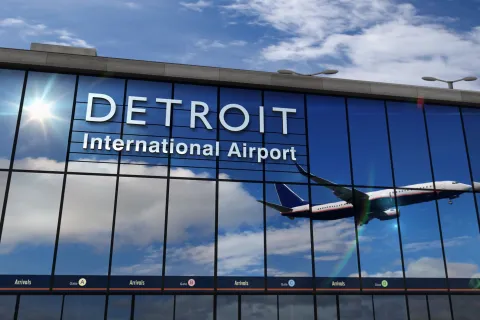
Detroit Airport Hikes Fees After Spirit Collapse
DETROIT, Mich. - Landing fees jump 10% and rental fees rise up to 13% at Detroit's main airport after Spirit's closure left empty gates and a major revenue hole.
Fans Launch Campaign to Resurrect Spirit Airlines
UNITED STATES - A grassroots movement aims to resurrect Spirit Airlines through crowdfunded public investment after the ultra-low-cost carrier's 2026 collapse.
Delta Flyer Gets $50 After Vomit Ruins Her Purse
Minneapolis, Minn. - A first class passenger on Delta flight 2488 found vomit deposited in her open purse while she slept, sparking questions about airline accountability for cabin incidents.
Budget Carrier Collapses as Oil Crisis Grounds Fleets
MIAMI, USA - Viral reports of Spirit Airlines shutting down and Magnicharters filing for bankruptcy due to a U.S.–Iran oil crisis do not align with verifiable airline industry timelines or real-world events.

About the Author

James Anthony
James Anthony specializes in redefining luxury for the next generation.