Stay current with our airline news coverage.
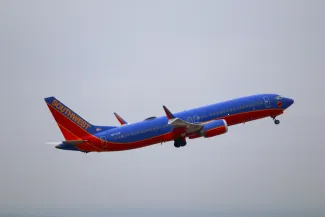
WASHINGTON — Southwest Airlines is publicly weighing bold changes that would reshape its familiar short-haul, single-class playbook, potentially introducing long-distance flights, airport lounges, and aircraft larger than the Boeing 737s on which the brand was built. Chief Executive Officer Bob Jordan floated the ideas during the U.S. Chamber of Commerce’s annual summit in Washington, where he told business leaders the carrier is “evaluating all aspects of developing a premium, long-haul network.”
Why Southwest Is Talking About Long-Haul Flying
For five decades, Southwest made its money flying point-to-point routes inside North America on a single fleet type. The model kept costs low, simplified maintenance, and allowed the Dallas-based airline to post profits for 47 consecutive years before the pandemic disrupted the streak. While rivals Delta Air Lines and United Airlines have since rebounded to record earnings, Southwest continues to search for its pre-COVID financial footing. Pressure intensified in 2024 when Elliott Investment Management acquired a significant stake and began prodding the company to mimic lucrative features of full-service carriers. Elliott’s influence is already visible: Southwest now lists fares in the Global Distribution System and is openly mulling assigned seating and checked-bag fees—two ideas once considered heresy inside the airline. Long-haul flying represents the biggest leap yet. Jordan’s remarks confirmed that leadership is studying routes beyond the United States that would tap demand for international leisure and corporate travel. The airline has recently inked interline agreements with Icelandair and China Airlines, allowing travelers to purchase single-itinerary tickets from Southwest cities to far-flung destinations served by those partners. Industry watchers consider the pacts a low-risk trial balloon for a broader global strategy.
Fleet Options: Stretching the 737 or Buying Bigger Metal
Any true long-haul program hinges on aircraft range. Southwest operates more than 800 Boeing 737s, including fuel-efficient MAX 8 and MAX 7 variants capable of flying much farther than earlier generations. Those jets could handle destinations such as Hawaii, northern South America, or Western Europe’s nearer gateways without requiring a new fleet type. Still, Jordan acknowledged that “a widebody could be in the cards in the distant future,” a statement that sent aviation forums buzzing. Twin-aisle models like the Boeing 787 and Airbus A330neo fly intercontinental missions with ease, but introducing even a small sub-fleet would erode Southwest’s single-type simplicity and add training, maintenance, and spare-parts costs. A narrower compromise exists in the Airbus A321XLR, the longest-range single-aisle jet now entering airline fleets. Yet Southwest has historically shunned Airbus orders, and analysts say operating a handful of A321XLRs alongside hundreds of 737s would be operationally inefficient.
What This Means for Travelers
- Network reach: Travelers loyal to Southwest could eventually book nonstop flights from Dallas Love Field, Denver, or Baltimore to Europe, South America, or Asia without changing carriers.
- Rewards value: New long-haul routes would unlock more places where Rapid Rewards points can be redeemed, giving frequent fliers higher-value redemption opportunities.
- Cabin experience: Jordan hinted at “premium” features, signaling the possibility of extra-legroom sections or even a true business-class product on transoceanic segments.
Lounges: A Door-to-Door Upgrade
For many road warriors, a lounge visit is the first signal that a trip has moved from chaotic to comfortable. Delta Sky Clubs, United Clubs, and American Admirals Clubs feed this expectation across the United States. Southwest, however, offers no proprietary lounges, leaving its passengers to fend for seats near the gate or pay for third-party access. Jordan suggested that it could change. A branded lounge network would elevate Southwest’s image and make its credit-card portfolio more attractive, just as United’s co-brand cards bundle club membership and priority boarding. Industry precedent shows how important lounges can be: JetBlue faced repeated criticism for launching its popular Mint business-class seat without a matching lounge product, prompting the carrier to start building Mint Lounges at New York JFK and Boston Logan.
Potential Locations
Southwest’s busiest bases—Baltimore/Washington International Thurgood Marshall, Dallas Love Field, Denver International, Las Vegas’ Harry Reid, Chicago Midway, and Phoenix Sky Harbor—would be logical first lounges. Each already handles heavy connecting traffic and carries a good number of Rapid Rewards elites.
The Elliott Effect: Imitation for Profit
Current market trends reward airlines that can charge premium fares, offer tiered loyalty perks, and operate global networks. Pure low-cost carriers, particularly those with all-economy cabins, have less pricing power when fuel or labor costs rise. Elliott Investment Management appears convinced Southwest must evolve or cede ground. Changes already on the table illustrate that shift:
- Participating in global distribution platforms so corporate travel agents can book Southwest flights alongside legacy options.
- Considering paid seat assignments—anathema to the airline’s free-for-all boarding heritage—but lucrative for airlines that sell preferred seats.
- Weighing the end of two free checked bags, one of Southwest’s most distinctive selling points.
Jordan’s summit comments show that management agrees that a revenue makeover is necessary. “We have to position the brand for where travelers are going, not where they were ten years ago,” he said at the Washington event.
Tips for Travelers
If you are a Southwest loyalist—or simply curious about how the carrier’s transformation might alter your trips—keep these practical pointers in mind:
- Watch for interline expansions. Even without its own airplanes on long-haul legs, Southwest-issued tickets to Asia or Europe could appear in the booking engine sooner than aircraft orders do.
- Monitor Rapid Rewards updates. New elite tiers or lounge-access partnerships could surface as the airline fine-tunes benefits to attract higher-spending customers.
- Track fleet announcements. Should Southwest commit to 787s, A330neos, or A321XLRs, delivery timelines will influence when—and from which cities—intercontinental routes launch.
- Factor in fees. If checked-bag charges become reality, compare total trip costs across carriers, especially for family travel or extended vacations.
Is Southwest definitely ordering widebody jets?
No. Jordan emphasized that widebodies are only under evaluation and would not arrive “soon.”
Could existing 737 MAX aircraft handle transatlantic flights?
Yes. The MAX 8’s range makes routes such as Baltimore to Dublin or Orlando to Keflavík technically feasible, though payload and seasonal winds could impose limits.
Will the airline introduce business-class cabins?
Jordan did not confirm seat configurations, but his remarks about a “premium” direction suggest Southwest is at least studying upgraded cabin products.
When might lounges open?
No timeline has been released. Construction schedules would depend on securing real estate at key airports, a process that can take years.
What is Southwest’s stock symbol and basic data?
The airline trades under the ticker LUV, carries the IATA code WN, began flying in 1967, and today operates from 11 published U.S. hubs.
The Bottom Line for Jet-Setters
Southwest’s public flirtation with long-haul routes, lounges, and larger aircraft signals a fundamental shift from its point-to-point, one-class DNA toward a model that looks decidedly more like those of legacy competitors. If the airline executes the plan, travelers could gain new nonstop choices, fresh ways to leverage Rapid Rewards points and a more comfortable pre-flight experience. The timeline remains murky, but Jordan’s Washington remarks confirm that the conversation has moved from speculation to serious study—news worth watching for anyone charting future trips. — as Jordan told attendees at the U.S. Chamber of Commerce summit.
More travel news
White House Targets Pregnant Foreign Travelers
WASHINGTON, D.C. - Justice Department enforcement campaign targets birth tourism fraud, sparking confusion among international families about travel rights during pregnancy.

T-Mobile ends free United Airlines Wi-Fi perk
United Airlines flights will no longer support T-Mobile's free Wi-Fi after July 13, 2026, ending a long-running carrier partnership as airlines pivot to Starlink and in-house loyalty benefits.

Mexico Lures Medical Tourists With Off Season Deals
PUERTO VALLARTA, Mexico - The resort city is turning its slow summer season into a medical tourism draw for U.S. and Canadian patients seeking affordable dental care and elective procedures.

Delta CEO predicts higher airfares are here to stay
ATLANTA, Ga. - Delta CEO Ed Bastian tells investors that U.S. airlines will hold the line on elevated ticket prices despite falling jet fuel costs, signaling a structural shift in industry pricing.
About the Author

Bob Vidra
Bob Vidra, based in scenic Tahoe, is an esteemed tech editor known for his deep understanding of the dynamic intersection of technology, travel, and the outdoors.