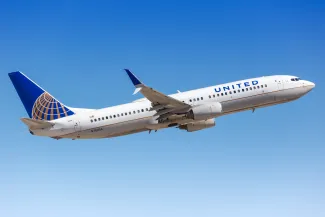
Stay current with our airline news coverage.
SALT LAKE CITY, United States - A 71-year-old Utah resident is preparing a civil complaint against United Airlines after alleging the carrier failed to adequately support his oxygen needs when his portable oxygen concentrator lost power during a flight from Salt Lake City to Houston.
Jaime Jesus Carvajal was traveling to Colombia because of his son’s health when the alleged incident occurred, according to Simple Flying. Carvajal says chronic obstructive sleep apnea and chronic obstructive asthma require him to use a breathing device during the day and at night.
Carvajal says he presented a medical certificate at check-in stating that he required oxygen throughout the flight. He also says United employees assured him that he could use his portable oxygen concentrator aboard the aircraft.
Two hours into the flight from Salt Lake City to Houston, the concentrator’s battery ran out, Carvajal told Simple Flying. A flight attendant then moved him to a business-class seat so the device could be connected to an outlet. Carvajal alleges that the connector worked only briefly before shutting off, leaving the concentrator without usable power.
His attorney, David Head, says neither outlet was working before the device’s battery was depleted. That point could become central to the planned complaint because United’s policy requires passengers to carry sufficient batteries and explicitly says the airline does not guarantee a seat with functioning in-seat power.
Passenger Says Health Worsened After Oxygen Device Lost Power
Carvajal says the loss of supplemental oxygen caused fear for his safety and worsened his health. Simple Flying reported that another airline provided the oxygen he needed after he reached Panama.
Intermountain Health records reportedly show that Carvajal has since been evaluated for increased headaches and kidney function, according to Simple Flying. The available reporting does not establish a medical or legal finding that the in-flight loss of oxygen caused those subsequent health concerns.
Head plans to file a civil complaint against United within the coming months. He estimates that a decision could take two to three years. United declined to comment on the matter, Simple Flying reported, and no court has determined fault or damages.
After Carvajal contacted the airline, United reportedly offered him a $150 flight credit. Carvajal and Head consider that response inadequate given the alleged medical risk and distress involved.
United’s Portable Oxygen Concentrator Policy
United permits passengers to use FAA-approved portable oxygen concentrators at no additional cost, according to the airline policy described by Simple Flying. Passengers must notify United at least 48 hours before travel and bring enough batteries to operate the device for 1.5 times the duration of the flight and any connections.
The airline does not guarantee that a passenger will receive a seat with in-seat power. Federal Aviation Administration rules also do not require airlines to provide oxygen service, and many carriers do not offer it, according to Simple Flying.
Those policies create a difficult division of responsibility. United can argue that travelers using portable oxygen concentrators must arrive with sufficient independent battery capacity. Carvajal’s position is that he disclosed the medical need, provided documentation and received assurances that the device could be used during the journey. His attorney also contends that the airline had opportunities to address the power problem before the battery was exhausted.
The planned complaint remains at the pre-litigation stage. At this point, the account is Carvajal’s allegation, supported by statements from his attorney and the reported medical records. United has not publicly provided its version of events.
Aircraft Power Is Not a Medical Backup Plan
For oxygen-dependent travelers, the hard lesson is that an aircraft outlet should not be treated as the primary power source or a dependable contingency. United’s own policy makes that plain by requiring battery capacity for 1.5 times the flight and connections while declining to guarantee functioning in-seat power.
That does not settle whether United employees handled Carvajal’s situation properly. A policy can place responsibility on the passenger while the airline still faces questions about what its employees said, when they learned the outlets were not working and what assistance was reasonably available. Those details will matter if Head files the complaint and the case moves forward.
Travelers who rely on a portable oxygen concentrator should review the operating carrier’s requirements before departure, not just at booking. For a United itinerary, that means providing notice at least 48 hours in advance and carrying the required independent battery supply for the flight and connections. Travelers should also retain medical documentation and records of communications with the airline, particularly when employees provide assurances about equipment use.
Connections deserve the same scrutiny as the main flight. Carvajal’s journey continued beyond Houston toward Colombia, so battery planning needed to account for the broader itinerary rather than only the Salt Lake City-to-Houston segment. United’s stated requirement expressly includes connections.
A Complaint With Wider Relevance for Medically Fragile Travelers
This dispute sits in the gap between formal compliance and practical care. Airline rules can authorize medical equipment, require advance notice and assign battery responsibility, yet a traveler can still face a serious problem when a device loses power at cruising altitude.
The $150 flight credit adds a customer-care issue to the potential legal dispute. It may satisfy an airline’s standard service-recovery process, but Carvajal alleges that the event involved the loss of essential supplemental oxygen, not an ordinary seating or entertainment problem.
Until a complaint is filed and United responds, there is no basis to declare the airline legally responsible. There is, however, enough here to reinforce a blunt rule for medically vulnerable passengers: permission to carry a device is not the same as guaranteed operational support. Independent battery capacity remains the most important safeguard when an airline will not guarantee that onboard power works.
More travel news
United Airlines has Starlink on just under 600 aircraft
United Airlines’ installed total spans regional and mainline aircraft; American Airlines plans to begin equipping more than 1,000 mainline aircraft in early 2027.

United Airlines plans two winter San Francisco-Barcelona round trips
Two planned Boeing 777-300ER round trips will operate Feb. 27-28 and March 3-4, 2027, around Mobile World Congress; they do not extend the route through winter.

United Airlines Plans Base Fares for Domestic First, Short-Haul Business
United Airlines plans Base tiers for domestic first class and eligible non-Polaris short-haul international business, with paid seat selection, one free bag and no changes; Business Base excludes United Club access.
American Airlines may adjust capacity if fuel prices stay high
American Airlines says persistently high fuel prices may force further capacity changes, while United Airlines has cut capacity roughly 5% and Southwest Airlines has modified schedules.
About the Author

Jeff Colhoun
Jeff Colhoun is a photographer and filmmaker whose work has appeared in The Wall Street Journal, the Los Angeles Times, Matador Network and Barron’s.