Stay current with our airline news coverage.
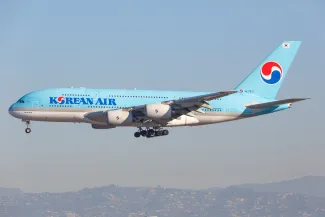
Korean Air’s new onboard perk doesn’t require a seat up front. The airline launched free Wi-Fi powered by SpaceX’s Starlink on selected flights Sept. 15, 2026, with access across every cabin on equipped aircraft, according to Travelweekly Asia. The publication describes Korean Air as the first full-service airline in East Asia to introduce the satellite-based service.
That’s welcome news, but “selected flights” is the part to keep in mind before booking. Travelweekly Asia reports that the launch covers four retrofitted aircraft, not the entire fleet. For now, getting the new connection depends on which aircraft operates your flight, rather than which cabin you book.
Which Korean Air aircraft have Starlink?
The initial installation covers three Airbus A350-900s and one Boeing 777-300ER, according to Travelweekly Asia. Those aircraft will mainly operate medium- and long-haul routes to the Americas, Europe and Southeast Asia, although they may also appear on selected shorter services.
That gives the rollout a broad geographic reach, but it isn’t a route-by-route commitment. A destination in one of those regions, or an itinerary showing an A350-900 or 777-300ER, isn’t enough by itself to establish that a particular departure will have Starlink.
The distinction matters more than the aircraft names might suggest. Travelweekly Asia identifies specific numbers of retrofitted planes, not every aircraft of those types. If connectivity is a deciding factor in your booking, the useful detail is whether your flight’s aircraft is equipped, not simply whether Korean Air serves the route with a wide-body jet.
Free Wi-Fi in every cabin
Travelweekly Asia reports that the service is free across all cabin classes on equipped aircraft. For passengers weighing an upgrade, that’s a straightforward distinction: a premium cabin isn’t necessary to receive this particular benefit.
The launch also goes beyond adding a connection for the cruise portion of a flight. According to One Mile at a Time, Korean Air’s Starlink service will operate gate to gate. That reported scope is a useful part of the offering, separate from the fact that passengers won’t pay for access.
Price, cabin eligibility and aircraft availability are different pieces of this announcement. The first two are simple: free service, all cabins. The third remains limited by the installation program. A free benefit is certainly appealing, but it only becomes part of your trip when the aircraft carrying you has it.
Streaming is supported; calls are restricted
One Mile at a Time describes Starlink as high-speed, low-latency broadband and reports that the service will support live streaming, gaming, e-commerce and productivity tasks, including high upload and download speeds. The intended use is considerably broader than basic messaging.
Those reported capabilities explain why this is a more substantial passenger-experience change than simply putting a Wi-Fi symbol next to an aircraft listing. Korean Air is introducing a connection intended to handle more demanding online activities.
There’s a cabin-etiquette boundary, too. One Mile at a Time reports that voice and video calls are restricted to preserve cabin comfort. Streaming video and making a video call are different activities under that policy; support for one shouldn’t be read as permission for the other.
For travelers hoping to work onboard, that distinction is worth noting. The reported productivity capabilities don’t remove the calling restriction. And for everyone seated nearby, limits on calls sound like a sensible part of an otherwise useful upgrade.
A broader rollout is targeted for 2027
This launch follows plans announced in late 2025, according to One Mile at a Time, which gives the activation date as Sept. 15, 2026. The four-aircraft introduction is the first operating stage of that previously announced program, rather than a completed fleetwide conversion.
Travelweekly Asia reports that Korean Air aims to extend Starlink to most of its operating fleet by the end of 2027 as it prepares to complete its merger with Asiana Airlines. That remains a target, not a statement that installations are already finished or that every upcoming flight will offer the service.
The reports differ on the eventual scope. One Mile at a Time describes plans for all Korean Air and former Asiana aircraft to have Starlink by the end of 2027; Travelweekly Asia uses the narrower description of most of the operating fleet. For booking purposes, the latter is the more cautious expectation, rather than treating universal coverage as assured.
The wider plans also extend beyond Korean Air. One Mile at a Time reports that Asiana Airlines, Jin Air, Air Busan and Air Seoul plan to introduce free Starlink Wi-Fi across their fleets. Those plans are distinct from the four Korean Air aircraft covered by this launch.
The welcome part of this launch is how broadly the benefit applies once you’re onboard an equipped plane: every cabin gets free access. The limitation is equally clear. Korean Air has started delivering Starlink, but a fleetwide rollout plan and a connection available on your particular departure aren’t yet the same thing.
More travel news
Frontier Goes Upmarket After Spirit Shutdown
DENVER, United States - Frontier Airlines is pairing low fares with first-class seats, faster Wi-Fi and loyalty perks after Spirit Airlines exited the market.
Southwest debuts Starlink Wi-Fi on Baltimore flight
Baltimore, Maryland - Southwest Airlines operated its inaugural Starlink Wi-Fi service on a Boeing 737-800 from BWI to Nashville, launching a phased rollout aimed at delivering streaming-quality connectivity across its entire fleet.

American Airlines Bringing Starlink to 500 Planes by 2027
Fort Worth, Texas - American Airlines commits to SpaceX's Starlink for more than 500 narrowbody jets, promising home-quality internet on domestic routes starting early 2027.
United Ditches Panasonic for Starlink WiFi
CHICAGO, United States - United Airlines faces mounting Wi-Fi failures on transpacific routes as Panasonic satellite capacity hits its ceiling, leaving long-haul passengers stranded offline during multi-hour flights while Starlink upgrades lag behind.
About the Author

Dana Lockwood
Dana Lockwood is a rising journalist who specializes in budget-friendly solo travel.