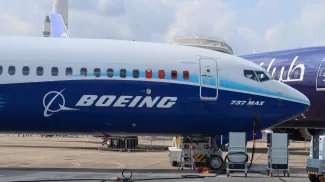
Stay current with our airline news coverage.
WASHINGTON, United States - Another Boeing 737 MAX inspection is coming, but this one needs a little context before anyone starts imagining a worldwide grounding.
The Federal Aviation Administration has adopted an airworthiness directive requiring operators to inspect 1,429 Boeing 737 MAX aircraft worldwide, including 471 aircraft in the United States, according to Simple Flying. The directive takes effect Sept. 10 and applies to the Boeing 737 MAX 8, MAX 9 and MAX 8200.
The concern involves potential cracking in a structure attached to the fuselage near the forward galley door. Such cracks could weaken an aircraft's ability to sustain limit loads, which is regulator-speak for a structural problem that can't simply be waved away and checked at the next convenient maintenance stop.
There is an important distinction, however: Boeing said it hasn't observed these cracks in the MAX fleet itself, Simple Flying reported. The inspection requirement was extended to the MAX because its design is similar to that of the older Boeing 737 NG, where cracks have been reported since 2019.
Why the FAA Is Inspecting the 737 MAX
The FAA issued the instructions as a preventive safety action rather than grounding the entire global MAX fleet. Operators must conduct targeted inspections and make any necessary repairs before an affected aircraft can return to commercial service.
The required visual inspection takes approximately one hour and carries an estimated cost of $85 per aircraft, according to Simple Flying. Those figures make this sound relatively modest compared with the lengthy maintenance events that can sideline an aircraft for days or weeks.
Still, the inspection's brevity doesn't make the underlying concern trivial. Structural reinforcements around doors and fuselage openings endure repeated pressurization cycles and localized loads. The FAA's action is intended to catch cracking before it can grow into damage capable of compromising structural integrity.
For passengers, the useful point is that this directive isn't evidence that cracks have suddenly been found throughout the MAX fleet. It is a requirement to look for a defect identified in a similar structure on an earlier generation of the 737. Preventive inspections are exactly how an airworthiness system is supposed to work, even if yet another MAX-related headline isn't likely to inspire warm, fuzzy feelings in the boarding area.
Another Layer of FAA Scrutiny
The crack inspection arrives while the FAA is already examining another issue involving the MAX. A separate proposal dated July 27, 2026, covers 453 U.S.-registered Boeing 737 MAX aircraft with passenger seats that may have been improperly installed, according to Simple Flying.
Under that proposed seat directive, airlines could be required to inspect up to 69 seat assemblies on each affected aircraft. The FAA estimated combined compliance costs of around $2.66 million for U.S. operators.
The two actions deal with different parts of the airplane and shouldn't be blended into one mechanical problem. One concerns structural reinforcements near a door and the fuselage; the other concerns passenger-seat installation. Taken together, though, they illustrate the volume and detail of the FAA's continuing oversight of the MAX.
That oversight matters because the MAX is operating at considerable scale. Boeing delivered 279 737 MAX aircraft during the first seven months of 2026, out of 367 total jets delivered during that period, Simple Flying reported. An inspection directive covering multiple MAX variants therefore reaches a substantial portion of the active and growing narrowbody fleet.
Should Travelers Change Their Plans?
My read is that this isn't a reason to avoid booking a flight simply because the aircraft is listed as a 737 MAX. The FAA hasn't ordered a blanket grounding, Boeing hasn't observed the cracks in the MAX fleet, and the required visual inspection takes approximately one hour. Those details point to a focused preventive check, not an immediate fleetwide crisis.
Could inspections still complicate an airline's day? Any mandatory maintenance requirement can force an operator to move aircraft around while the work is completed. But with the information available, there is no basis for assuming widespread cancellations, fare increases or route cuts. Travelers should monitor their reservations and airline notifications as usual, particularly once the directive takes effect Sept. 10, rather than making speculative changes now.
It is also worth separating confidence from complacency. Passengers are reasonable to ask why the MAX keeps appearing in safety and quality-control news. At the same time, finding a potential vulnerability through the older 737 NG design and ordering inspections of related MAX structures is a more reassuring regulatory response than waiting for cracks to appear in the newer fleet.
The inspection itself may be quick and comparatively inexpensive. The longer job belongs to Boeing and regulators: understanding why cracks developed in the related structure, ensuring repairs are effective where needed, and keeping a close eye on aircraft that spend their working lives cycling between pressurized flight and the ground. For travelers, that less glamorous maintenance work is the part that really counts.
More travel news
Trump Plans Air Traffic Control Software Announcement
The planned announcement is part of the FAA’s broader air traffic control modernization effort, which aims to reduce delays but is not expected to be completed until 2028.
United Flight Attendants Can Refuse ICE Questions
Washington, United States - United flight attendants were told they may remain silent when ICE asks about passengers or coworkers as airport arrests increase nationwide.
Airlines Put Elite Status on a Higher Price Tag
NEW YORK, United States - Delta, United and other major airlines are raising elite status hurdles, leaving frequent flyers on discounted fares with less credit.

Carnival Rewards Sets Sail With Spending Based Status
Carnival Rewards ties cruise status to eligible spending while keeping separate recognition for lifetime sailing days.

About the Author

Dana Lockwood
Dana Lockwood is a rising journalist who specializes in budget-friendly solo travel.