Stay current with our airline news coverage.
Since late February 2026, the collapse of the central Middle East air corridor has forced a fundamental restructuring of how travelers move between Europe and Asia. Iranian, Iraqi, Kuwaiti, Bahraini, Qatari, and UAE airspace closures or heavy restrictions have eliminated the Gulf hub model that defined long-haul routing for two decades. The numbers tell the immediate story: more than 30% of typical Gulf hub traffic has been displaced, most Europe-Asia flights now squeeze through narrow Caucasus paths north of Iran or reroute south via Egypt and Saudi Arabia, and travelers booking April through August itineraries face flights adding two to four hours, suspended services to major hubs, and fare increases driven by added fuel costs averaging $15,000 to $30,000 per flight.
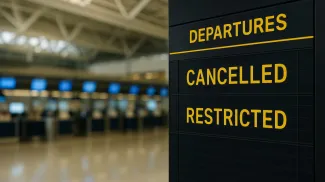
This isn't a temporary hiccup to wait out. Even with partial airspace reopenings underway in late April, the operational reality at check-in counters right now shows a network still running on contingency routing, unpredictable schedules, and significantly degraded connectivity through the region that once served as the world's most efficient intercontinental bridge.
Who's Flying, Who's Not: Carrier-by-Carrier Reality Check
The Gulf carriers that built global networks on geographic advantage now operate at 40% to 50% below pre-conflict capacity. Qatar Airways, which suspended most operations in early March when Qatari airspace closed, is gradually ramping up daily flights with a target of restoring service to over 120 destinations by mid-May 2026, but schedules remain significantly reduced. In the crisis's early weeks, the airline operated at just 20% of pre-February 28 capacity, with aircraft stored and only limited service to select long-haul routes like Johannesburg, New York JFK, Bangkok, London, and Perth.
Emirates has recovered to nearly three-quarters of pre-conflict capacity as of late April, according to Flightradar24 tracking data, but that still means hundreds of canceled or rerouted flights daily. The airline started cautious resumption in early March with limited operations, prioritizing rebooked passengers and warning travelers against showing up without confirmed bookings.
Etihad Airways serves around 80 cities globally but at roughly half its standard schedule following a March 6, 2026 restart of commercial flights to key European, Russian, and Middle East destinations. The airline offered free rebooking for tickets issued before February 28, extending flexibility through May 15, a tacit acknowledgment that normal operations remain months away.
European and Asian carriers show even more dramatic pullbacks. Air France and KLM suspended all service to Dubai, Riyadh, and Tel Aviv through at least early May. Lufthansa Group extended suspensions into late May or October depending on destination. Cathay Pacific canceled Middle East routes through June. British Airways won't return until late May at earliest.
Air India faces a particularly brutal squeeze: already banned from Pakistani airspace since tensions there escalated years ago, the carrier now can't use the central Middle East corridor either, forcing long detours through the Caucasus that add significant time and cost to Europe routes. Qantas solved its Perth-London routing problem with a hybrid solution, refueling outbound flights in Singapore and attempting non-stop returns when operationally feasible.
The practical booking advice here is blunt: avoid complex multi-leg itineraries through Gulf hubs unless the airline explicitly confirms specific routing and can guarantee rebooking if airspace closes again. Direct Europe-Asia flights via carriers with established northern routes are the safer bet, even at higher fares.
The Caucasus Corridor: What 2-4 Extra Hours Actually Looks Like
Geography explains the bottleneck. With Russian airspace closed to Western carriers since 2022 and the central Middle East unusable, most Europe-Asia flights now funnel through a narrow corridor over Armenia, Georgia, and Azerbaijan. This isn't a wide-open alternative; it's a constrained path with limited capacity and ATC resources handling traffic volumes never intended for the route.
Partial reopenings don't restore normal efficiency. Kuwait's FIR opened April 24-26 but only for limited operations via specific Saudi routes, with no broad transit permissions yet. Iran's Tehran FIR allows some eastbound traffic above FL285 (28,500 feet) under strict procedures, but that's a fraction of the capacity needed and comes with routing constraints that negate most time savings.
The European Union Aviation Safety Agency extended its Conflict Zone Information Bulletin 2026-03 (CZIB-R7) through May 1, 2026, advising avoidance of affected Middle East airspace at all flight levels except limited high-altitude corridors above FL320 in southern Saudi Arabia and Oman. That advisory reflects the operational reality: aviation authorities consider these zones too risky for routine commercial use due to ongoing missile threats, meaning carriers won't use them even when airspace is technically "open."
Real-time flight tracking on Flightradar24 shows the result: vast empty corridors over Iran and Iraq where dozens of flights would normally cross simultaneously, replaced by dense traffic concentrations squeezing through tight Caucasus paths. A flight from Frankfurt to Bangkok that once overflew Tehran in a straight line now arcs north through Georgia and Kazakhstan or south through Egypt and the Arabian Sea.
For passengers, this translates to longer flight times ranging from 30-40 minutes on some Central Asian routes to two to eight hours on long-haul intercontinental journeys. Fuel stops become necessary on routes that previously flew direct; Qantas's Singapore refueling stop on Perth-London is one example, but similar patterns are emerging across carriers. Fares reflect the added operating costs, with increases of 15% to 25% typical for Europe-Asia routes, comparable to the disruption when Russian airspace first closed in 2022.
Emerging Hubs: Baku, Almaty, Tbilisi as Transit Alternatives
The geopolitical shifts reshaping routing have elevated three Caucasus and Central Asian airports into greater prominence, though calling them Gulf hub replacements oversells their current passenger connectivity. Baku, Almaty, and Tbilisi are gaining traffic, but they serve different roles in the evolving network.
Almaty International Airport in Kazakhstan is emerging as the most developed alternative. The airport is part of a 2030 hub strategy with planned capacity to handle 40 million passengers annually upon full master plan completion. In early 2026, Air Astana reported total transit traffic exceeding 137,000 passengers, including more than 48,000 international transits, a 65% year-over-year increase. The airline reallocated capacity from suspended Middle East routes to high-demand Asian and European links like Seoul, Bangkok, Phuket, Istanbul, Delhi, Tashkent, and Tbilisi.
New and resumed services from May 2026 include direct flights to Busan twice weekly, seasonal routes to Turkish resort cities, and increased frequencies to Beijing, Istanbul, Urumqi, Tbilisi, and Tashkent. Kazakhstan's airspace handled 216,616 flights in the first half of 2025, with 161,029 involving foreign transit or landings across 124 air traffic routes totaling 113,530 kilometers. That infrastructure positions Almaty as a genuine Eurasian crossroads, though primarily for cargo and regional connections rather than long-haul intercontinental passenger flows.
Baku's Heydar Aliyev International Airport demonstrated strong transit growth with 72,000-plus transit passengers in January through March 2024, up 82.7% year-over-year, as part of total traffic reaching 1.464 million passengers. The airport functions as a strategic cargo crossroads with modern infrastructure, benefiting from July 2024 agreements that boosted freight links between Zhengzhou and Baku, establishing a Europe hub role for Asian goods moving west.
Tbilisi International Airport handled 430,034 passengers in January 2026 alone, part of Georgia's 613,933 total across all airports, up 16% year-over-year. The airport surpassed five million passengers in 2025 with 13% growth, contributing to a national record of 8.49 million passengers, 38,218 flights (up 17.5%), and 38,578 tonnes of cargo (up 50%). Increased Almaty frequencies via Air Astana bolster bidirectional transit for Central Asia-Europe routes.
The practical reality for travelers: these airports work well for understanding the economics of route restructuring and for cargo shippers finding new paths, but they offer limited utility for typical tourist itineraries. Travelers willing to piece together unconventional routings with separate Europe-Caucasus and Caucasus-Asia segments may find fare advantages, but expect longer total journey times, fewer amenities than Gulf hubs provided, and schedules that don't offer the seamless connectivity Dubai or Doha once guaranteed.
Booking Through Summer: Strategic Moves for April-August Travel
Travelers booking May through August itineraries need to act now, understanding that restrictions continue evolving daily and full restoration of central corridors has no confirmed timeline. The immediate seasonal window demands specific strategic choices.
Choose non-stop or single-connection routes that avoid Gulf hubs entirely. European and Asian carriers with established northern routes, bypassing both Russian and Middle Eastern airspace, offer the most reliable operations right now. According to current Google Flights data, a roundtrip from New York JFK to Dubai in late May runs around $873 on Air France and Emirates with average duration of 15 hours 28 minutes, while a comparable trip to Bangkok costs $1,509 on Asiana, Cathay Pacific, EVA Air, or Etihad averaging 21 hours 40 minutes. Those fare differences reflect both routing complexity and carrier reliability in the current environment.
Budget for fare increases of 15% to 25% on Europe-Asia routes due to added fuel and time costs. The $15,000 to $30,000 in extra operating expenses per flight gets passed to passengers one way or another, whether through higher base fares, reduced award seat availability, or eliminated discounted fare classes.
Flexibility matters more than usual. Book refundable fares or comprehensive travel insurance covering geopolitical disruptions if your budget allows. Airline policies vary significantly on rerouting compensation; some carriers offer free changes for tickets issued before certain dates, others charge full change fees even when they initiate the route modification.
Real-time monitoring is essential, not optional. Check Flightradar24 for actual routing of specific flights, not just airline schedule claims. Lebanese airspace showed as open on April 26, demonstrating how quickly status can change. The EASA Conflict Zone Information Bulletins get updated frequently; CZIB 2026-03-R7 extends only through May 1 and could be revised earlier if conditions change.
Consider the Caucasus countries themselves as alternative destinations. Armenia, Georgia, and Azerbaijan offer uncrowded spring and summer travel with improving connectivity, and current hotel rates remain reasonable. Based on current rates, Dubai hotels for late May range from $61 to $183 per night with a median around $75, while Bangkok options run $43 to $138 with a median near $56. The Caucasus destinations often come in below both, with the added advantage that you're not transiting unstable airspace to reach them.
What Comes Next
Partial reopenings are underway, but no credible timeline exists for restored central corridors operating at pre-conflict capacity. Even as restrictions ease in coming weeks or months, airlines may maintain alternative routes due to insurance protocols, safety margins, and the operational reality that airspace can close again with hours of notice.
This represents a fundamental routing shift requiring active itinerary management, not a temporary inconvenience to wait out. Chinese carriers are adding roughly 2,350 flights from March through October 2026 on Europe routes, leveraging Russian overflight access denied to Western competitors. That competitive advantage reshapes market dynamics in ways that persist beyond any individual conflict resolution.
Travelers transiting or visiting the Middle East need daily situational awareness. Monitor aviation safety bulletins from EASA and national authorities, check airline-specific advisories before every flight segment, and use real-time tracking tools to verify actual operations. The gap between scheduled flights and operated flights remains significant, and that operational uncertainty defines travel through this region for the foreseeable future.
More travel news
American Airlines Disrupts Loyalty With $35 Upgrades
FORT WORTH, Texas - American Airlines' ultra-cheap last-minute upgrade offers are sparking debate over whether the carrier is undermining its own loyalty program to fill empty premium seats.
Airline Wi-Fi Crashes Under Surge in Passenger Use
Several major U.S. airlines' Wi-Fi provider has acknowledged sluggish service and outages on long-haul flights as passenger usage surges.

LaGuardia Pilots Warned of Missile Threat During Landing
NEW YORK, N.Y. - Pilots approaching LaGuardia received an unusual warning about a possible shoulder-fired missile threat, prompting a brief security investigation.
Boeing MAX 8s Scrapped After Just Six Months of Flight
São Paulo, Brazil - Two Boeing 737 MAX 8 aircraft retired after just six months in service with GOL Linhas Aéreas are now being dismantled, highlighting ongoing quality control concerns.
About the Author

Jeff Colhoun
Jeff Colhoun is an acclaimed travel writer, photographer, and filmmaker, whose work is respected both in the United States and internationally.