Stay current with our cruise news coverage.
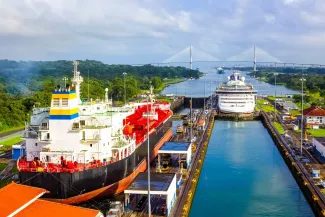
There's a bidding war happening in Panama, and it's not for real estate. Businesses are shelling out as much as $4 million to skip the line at the Panama Canal, a jaw-dropping sum that underscores just how thoroughly the Iran war has scrambled global shipping routes. The Panama Canal Authority reports these eye-watering prices for last-minute passage, driven by companies desperate to avoid the chaos unfolding around the Strait of Hormuz. With that critical waterway effectively shut down by the conflict, shippers are scrambling for alternatives; and the canal linking the Atlantic and Pacific has become the hottest ticket in maritime logistics.
How the Auction System Works
Here's the thing about the Panama Canal: you can't just show up and expect to cruise through. Under normal circumstances, companies book passage in advance at a flat rate. According to Nwaonline, that standard price runs between $300,000 and $400,000 depending on vessel size. But what if you don't have a reservation? That's where the auction comes in. The canal operates a bidding system for companies without bookings, awarding transit slots to whoever's willing to pay the most. The alternative is sitting in the queue for days or weeks, watching cargo deadlines slip past and costs pile up. Before the war, getting an earlier crossing meant ponying up an extra $250,000 to $300,000 on top of the base rate. Expensive, sure, but manageable for time-sensitive shipments. In recent weeks, though, that additional premium has jumped to around $425,000 on average, Nwaonline reported. And the top bids? They've hit $4 million.
Why Companies Are Paying These Prices
"With all the bombings, the missiles, the drones ... companies are saying it's safer and less expensive to cross through the Panama Canal," said Rodrigo Noriega, according to Nwaonline. That calculation tells you everything about the situation near Iran. When paying a $4 million premium starts looking like the economical choice, you know the alternative routes have become genuinely untenable. The Strait of Hormuz normally handles about a fifth of the world's oil shipments and countless container vessels; with missiles and drones turning those waters into a war zone, companies are concluding that even astronomical canal fees beat the risk. Normally, about 6% of global trade flows through the Panama Canal, Nwaonline reported. That percentage is almost certainly climbing as shipping companies reroute everything they can away from the Middle East. Every vessel that would typically sail through Hormuz and can physically fit through the canal's locks is now competing for those limited daily transit slots.
The Ripple Effects on Shipping Costs
These million-dollar premiums don't exist in a vacuum. They're getting passed along the supply chain, which means higher costs for pretty much everything that moves by container ship. Grain, electronics, automobiles, industrial components; if it crosses an ocean, it's getting more expensive to transport. The really striking thing is how quickly this shifted. A few weeks ago, that extra $250,000 to $300,000 premium was the norm. Now it's nearly doubled on average, with outlier bids reaching multiples of that. The speed of the increase suggests companies are genuinely panicked about alternative routes, willing to absorb costs that would've seemed absurd just months ago.
Where This Leaves Shippers
If you're wondering whether this affects you as a consumer or traveler, the honest answer is: probably, eventually. These kinds of shipping disruptions take time to work through the system, but they do work through. Products shipped via routes that now cost millions more to navigate will cost more at retail. Companies eating these transportation premiums today will look to recover them in pricing down the line. For business travelers whose companies move physical goods, the implications are more immediate. Logistics managers are likely pulling their hair out right now, trying to balance delivery commitments against exploding transit costs. The calculus around air freight versus ocean shipping just got a lot more complicated when ocean routes that used to cost a few hundred thousand now routinely top a million. The Panama Canal has always been critical infrastructure, but it's rarely been this valuable on a per-crossing basis. When a single transit slot commands the same price as a nice house in many U.S. cities, you're witnessing a fundamental disruption in how global trade moves. How long this lasts depends entirely on what happens in the Middle East; but for now, the canal has become the most expensive shortcut in the world.
More travel news
Panama quake temporarily shuts airport; buildings damaged
Reports conflict on the earthquake's magnitude, but building damage and a temporary closure of Panama's main airport were reported; canal operations continued.
Jet Fuel Prices Have Doubled Since January
Jet fuel prices have doubled since January, and Leeham News is modeling potential ticket and cargo price effects if the increase persists.
Gulf Airlines Suspend Flights Amid Military Tensions
Dubai, United Arab Emirates - Air Astana halts UAE services and Gulf carriers issue advisories after renewed US-Iran strikes collapse ceasefire, forcing airlines to reroute and rebooking across the region.
Flight Costs Stay High Despite New US-Iran Agreement
WASHINGTON - The preliminary U.S.-Iranian framework deal could ease fuel prices, but airlines warn fare relief may take months or never materialize.

About the Author

Bob Vidra
Bob Vidra is News Editor at Jetsetter Guide, covering airlines, airports and the travel industry since 2023.