Stay current with our airline news coverage.
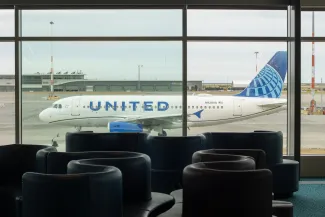
A disabled United Airlines passenger says she was locked alone in a jet bridge after arriving in Canada, without a wheelchair or anywhere to sit. Her account, reported by USA Today on Sept. 16, describes a breakdown between the assistance she expected when leaving the aircraft and the help available to get her through the airport.
United gave a different account of the wait. The airline told USA Today that its Vancouver team responded once it learned the passenger needed assistance and that an agent checked on her frequently while an escort was being arranged.
The timing matters: Sept. 16 was the report’s publication date, not the date of the flight. United identified the trip as Sept. 9.
Wheelchair assistance expected, but not waiting
The traveler, identified by USA Today as TikTok user Birdie, described the experience in a series of videos and posts. She said she was traveling from the United States to Canada and that a flight attendant had told her a wheelchair should be waiting when she arrived.
According to her account in USA Today, a gate agent subsequently told her there was no wheelchair request on her booking. The passenger said she had already received wheelchair assistance earlier in the trip, so she had not believed there was a problem with that part of her reservation.
That is the first unresolved point in the sequence: the assistance the passenger said she had already received did not match what she said the arrival gate agent found on her booking. USA Today’s report does not establish why those accounts differed or whether the arrival request had been recorded.
The traveler said the flight attendants offered to help but were not allowed to accompany her through the airport’s secured area, according to USA Today. She described the crew eventually leaving together while she continued to wait in the jet bridge.
In her account, someone at the top of the jet bridge then said she would have to be locked inside. The passenger said she initially was not sure the person was addressing her. After several minutes passed without anyone returning, she called out.
A disputed account of the wait in Vancouver
The passenger estimated that she was alone for 20 to 30 minutes, according to USA Today. She described being beside a closed aircraft, without a seat, and unsure whether anyone would return to help. Her posts also conveyed fear that no one else knew she was there.
United’s statement to USA Today said an agent checked on the passenger frequently while the team waited for someone who could escort her through the airport. The airline also said it took the needs of customers requiring wheelchairs seriously and had reached out to discuss her experience further.
Those accounts should not be flattened into a single, settled version of events. The passenger described being left alone; United described repeated checks. The airline’s statement did not directly confirm that she had been locked inside the jet bridge. USA Today did not independently establish the sequence, and the traveler did not immediately respond to the publication’s request for comment.
According to the passenger’s subsequent post, the wait ended when the gate agent returned with a man and a wheelchair. He then escorted her through customs, USA Today reported.
The experience changed her return plans
The consequences extended beyond the arrival delay. The traveler said in another post that she no longer felt comfortable flying home, according to USA Today.
Instead, she said a friend drove her to the border, where her husband and mother were picking her up. Her account describes a loss of confidence substantial enough to change how she returned, not simply dissatisfaction with the time it took to deliver a wheelchair.
The handoff is the central accessibility question
The operational issue here is specific: who was responsible for helping the passenger between leaving the aircraft and reaching the person able to escort her through the airport? In the traveler’s account, cabin crew offered help but could not accompany her farther, while the expected wheelchair was missing. United’s response focused on what its ground team did once it learned she needed assistance.
For travelers who depend on wheelchair assistance, that distinction matters. Help earlier in a journey and help after landing are separate parts of the experience, even when a passenger reasonably understands them as one continuous arrangement. This account illustrates that concern; it does not establish how often such failures occur across United’s operation.
The question raised by this report is not just whether a wheelchair eventually arrived. It is whether the passenger had a safe, clearly communicated handoff while she waited. On that point, the traveler’s account and United’s response remain materially different.
More travel news
United Airlines CEO Defends Fees for Window and Aisle Seats
Kirby said travelers who want a preferred seat should pay more. Charges vary with available seats, fares and status benefits; $70 was one non-frequent flyer's example.
United Airlines lowers economy food preorder threshold to 900 miles
United lowered its fresh-food preorder threshold from 1,190 to 900 miles, adding the option for economy passengers on 420 daily flights in North America and the Caribbean; orders close 24 hours before departure.
Boeing 737 MAX 10 FAA approval could come this week
FAA certification could come the week of Oct. 19, but some buyers reportedly will not accept 737 MAX 10s fitted with affected U14 or U14.1 software.
United Airlines launches Starlink flight tracker
Travelers can use United Airlines’ Starlink Tracker to check flight-level availability as the carrier works toward fleetwide installation by the end of 2027.
About the Author

Jeff Colhoun
Jeff Colhoun is a photographer and filmmaker whose work has appeared in The Wall Street Journal, the Los Angeles Times, Matador Network and Barron’s.