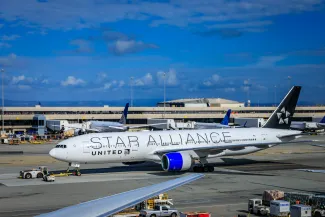
Stay current with our airline news coverage.
United Airlines CEO Scott Kirby defended charging passengers more to avoid middle seats after a New York Times reporter raised a $70 seat-selection price for a traveler without frequent flyer status. His position was straightforward: passengers who want a more desirable seat should pay for it, according to Simple Flying, which covered the interview on Oct. 20.
The exchange puts United’s pricing strategy under a useful spotlight. Kirby was defending the separation of the price of transportation from the price of choosing a preferred seat. The reported $70 should not be read as a new fee across United’s network.
That distinction matters. The reported amount came from the reporter’s flight. Travelers should read the interview as a defense of United’s approach to seat charges, not as a new rule determining what every aisle or window seat costs.
What the $70 United seat charge actually describes
According to Simple Flying, Times reporter Jordyn Holman said avoiding a middle seat on her upcoming United flight would cost $70 as a non-frequent flyer. The publication also reported, citing Men’s Journal, that she accepted a middle seat on a flight to Chicago rather than pay the additional charge.
Live and Let’s Fly specifically cautioned against treating that example as a requirement that every United passenger pay $70 to avoid the middle. Available seats, fares, status benefits and charges vary, the publication noted. The interview does not establish a universal price or a complete eligibility rule for avoiding that charge.
For someone booking a flight, the useful number is therefore the seat-selection price attached to the actual reservation. The reported $70 illustrates how much choosing a seat can add in a particular case; it does not establish either a guaranteed charge or a networkwide ceiling.
Kirby’s argument: different prices for different priorities
Kirby described two customer priorities: getting from one place to another at the lowest possible price, and paying more for a particular seat or a better experience. According to Live and Let’s Fly, he argued that charging separately for the products and services passengers want allows United to serve those different preferences.
He also rejected the suggestion that this approach creates a divide between frequent flyers and everyone else. His explanation, as reported by Simple Flying, was that customers who pay more receive more.
There is a commercial logic to that position. A passenger who values an aisle or window differently from someone willing to take a middle seat presents an airline with an opportunity to charge different prices. The dispute is less about whether those preferences exist than about how Kirby explained the cost of satisfying them.
A more desirable seat is not necessarily more expensive to provide
Live and Let’s Fly drew a distinction between charging for something passengers value and claiming that an ordinary window or aisle seat costs more to deliver. Its analysis noted that assigning a standard window seat instead of a standard middle seat does not require installing another seat, providing additional legroom or loading more catering.
The publication contrasted that with extra-legroom seating and lie-flat business-class seats, which consume more cabin space. Its criticism was not that all seats should have the same price. It was that willingness to pay is a clearer explanation for ordinary seat-selection fees than a higher cost of providing the seat.
One Mile at a Time offered a more sympathetic reading. It argued that charging more to avoid a middle seat can also be understood as charging less to accept one. The publication defended customer segmentation as part of how legacy airlines support their business while offering lower-priced transportation.
Those perspectives address different questions. One examines why a seat commands a premium; the other examines how different prices support an airline’s business. Neither turns the $70 example into a standard charge for every traveler.
Cabin improvements were part of Kirby’s defense
Kirby also pointed to investments intended to benefit passengers throughout the aircraft, rather than only those buying premium seats. Simple Flying reported that he cited fast, free Starlink Wi-Fi and seatback entertainment for every customer.
His language was forward-looking: “We’re going to have fast, free Starlink,” he said in the interview, as reproduced by DNYUZ. Those comments should not be treated as confirmation that every United flight already has those features. His broader argument was that United’s passenger-experience spending extends beyond premium cabins, even while seat selection remains something the airline can charge for separately.
Live and Let’s Fly acknowledged the value of those cabin investments while maintaining its criticism of the seat-fee explanation. Both points can stand: better onboard amenities can improve an economy flight without resolving a passenger’s objection to paying extra for a preferred position in the row.
Compare the ticket and the seat together
The debate comes amid higher airfares. The New York Times reported that nationwide fares rose more than 22% in September from a year earlier. Kirby countered that fares remained below 2019 levels after adjusting for inflation, according to the Times.
For travelers, the relevant comparison is narrower than that economic argument: what does the flight cost with the seat they actually want? Given the variation in fares, availability and status benefits described by Live and Let’s Fly, comparing the ticket price and seat-selection charge together is more useful than assuming the headline fare covers that preference.
Kirby’s interview makes United’s position clear. The airline considers preferred seating something worth charging for. Travelers should assess that price as part of the purchase, without mistaking one reporter’s $70 choice for a fee that applies to everyone.
More travel news
United Airlines lowers economy food preorder threshold to 900 miles
United lowered its fresh-food preorder threshold from 1,190 to 900 miles, adding the option for economy passengers on 420 daily flights in North America and the Caribbean; orders close 24 hours before departure.
Boeing 737 MAX 10 FAA approval could come this week
FAA certification could come the week of Oct. 19, but some buyers reportedly will not accept 737 MAX 10s fitted with affected U14 or U14.1 software.
United Airlines launches Starlink flight tracker
Travelers can use United Airlines’ Starlink Tracker to check flight-level availability as the carrier works toward fleetwide installation by the end of 2027.
United Airlines has Starlink on just under 600 aircraft
United Airlines’ installed total spans regional and mainline aircraft; American Airlines plans to begin equipping more than 1,000 mainline aircraft in early 2027.
About the Author

Jeff Colhoun
Jeff Colhoun is a photographer and filmmaker whose work has appeared in The Wall Street Journal, the Los Angeles Times, Matador Network and Barron’s.