Stay current with our airline news coverage.
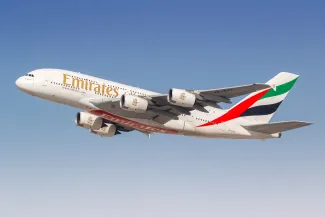
DUBAI, United Arab Emirates — Power-hungry travelers who rely on portable chargers will soon need to rethink their in-flight habits. Emirates has confirmed it will ban flyers from using power banks on planes from 1 October, ushering in six hard-line rules aimed at mitigating lithium battery fires that can break out in the sky.
Why Emirates Is Pulling the Plug
The Dubai-based carrier announced the policy shift after a far-reaching safety review that focused on “battery fires” linked to consumer electronics. According to aviation safety investigators, lithium-ion and lithium-polymer batteries can enter a dangerous state known as thermal runaway when damaged, over-charged or exposed to high temperatures. The chain reaction can escalate into smoke, fire or a small explosion inside the cabin—an event no traveler wants mid-flight.
“There has been a significant growth in customers using power banks in recent years, resulting in an increasing number of lithium battery-related incidents onboard flights across the wider aviation industry,” an Emirates spokesperson said in a statement.
While Emirates is not the first airline to restrict battery packs, its blanket ban on using the devices—rather than simply carrying them—sets a new global benchmark. The carrier believes eliminating in-flight charging will allow crew members to identify and remove an overheating power bank more quickly, because the unit must be stored where it is readily accessible rather than tucked into a crowded overhead bin.
The Six New Rules—Verbatim from Emirates
Travelers on Emirates flights should familiarize themselves with the carrier’s exact language, as any deviation could lead to confiscation at the gate or on board. The policy reads:
- Emirates customers can only carry one power bank that is under 100 Watt Hours.
- Power banks cannot be used to charge any personal devices while onboard.
- Charging a power bank using the aircraft’s power supply is banned.
- All power banks must have capacity rating information available.
- Power banks cannot be placed in the overhead stowage bin onboard the aircraft. It must be placed in the seat pocket or in a bag under the seat in front of you.
- Power banks are not permitted in checked luggage (existing rule).
Context From the Wider Industry
Battery-related incidents are on the radar well beyond Emirates. The new language in the carrier’s policy echoes concerns voiced by American counterparts. As the source report notes, “Delta, United and American Airlines all raise fears of longer security wait times with ‘chaotic’ TSA change.” Although those U.S. airlines have not announced identical in-flight bans, they continue to flag lithium batteries as an emerging risk point for both the security checkpoint and the cabin.
Regulators have also tightened the leash. The International Civil Aviation Organization (ICAO) already prohibits spare lithium batteries in checked luggage, and the Federal Aviation Administration (FAA) limits external batteries to a maximum capacity of 160 Watt Hours in carry-on bags when prior approval is granted. Emirates’ under-100-Wh ceiling therefore registers as one of the more conservative thresholds among global airlines.
What Travelers Should Know Before Boarding
For many passengers, a power bank is as essential as a passport. To avoid running afoul of the new rules—and to keep your smartphone alive for boarding passes, WhatsApp messages and airport ride-share pickups—consider these traveler-centric strategies:
- Downsize your battery. If your existing power bank exceeds 100 Watt Hours (roughly 27,000 mAh at 3.7 V), you will need to purchase a smaller model or leave it at home.
- Print or photograph the rating. Emirates requires the Wh capacity to be “printed clearly.” If your device only lists milliamp-hours (mAh), convert the rating to Wh (mAh × 3.7 ÷ 1,000) and carry documentation in case gate agents ask.
- Charge up on the ground. Because you cannot use the pack in-flight, top off your devices in the airport lounge or at the gate. Dubai International Airport (DXB) as well as many Emirates outstations provide USB-C and AC outlets near most boarding areas.
- Use the seat-back USB sparingly. Emirates has not banned plugging a phone directly into the aircraft’s built-in USB port, but power output is often limited to 5 V/0.5 A—enough to maintain battery level, not to charge rapidly.
- Keep the pack within reach. Cabin crew will scan seat pockets and under-seat zones, so stow your power bank exactly where the policy dictates.
Expert Insight Into Thermal Runaway
Industry safety specialists point to a simple physics lesson: lithium-ion cells store a tremendous amount of energy in a small, flammable package. When that energy is released uncontrollably, temperatures can soar past 1,000 degrees Fahrenheit in seconds. Aluminum casings can melt, and the electrolyte can ignite adjacent materials—including seat cushions and carpeting.
The source report cites unnamed “Experts” who warn that thermal runaway “can cause a fire or even an explosion.” In past incidents, overheated batteries have forced pilots to divert flights and make emergency landings, costing airlines millions of dollars and stranding passengers for hours.
Comparing Airline Policies
Emirates is not alone, but its outright ban on usage is notable. Here is how other major carriers approach the issue today:
- Qatar Airways: Allows power banks under 100 Wh for in-flight charging, but forbids placing them in checked baggage.
- Singapore Airlines: Limits portable batteries to 100 Wh and prohibits usage if the rating is unreadable.
- Lufthansa: Permits two spare batteries up to 100 Wh each but bans charging the battery itself on board.
Emirates’ upcoming rule set goes a step further by banning charging of any personal device via a power bank, not just the pack itself.
Tips for Travelers Planning Long-Haul Itineraries
Emirates’ network spans ultra-long-haul routes—Dubai to Auckland clocks in at over 17 hours. A powerless phone on such journeys is more than an inconvenience; it can complicate immigration procedures that now rely on QR codes, mobile visas and digital customs declarations. To stay connected without violating the new policy:
- Pack a second phone. Older models can act as a spare and may hold charge longer if used solely for documents.
- Switch to low-power mode. Disable Bluetooth, lower screen brightness and turn off background app refresh once airborne.
- Bring a laptop USB-C cable. If you must juice up, many Emirates wide-body aircraft offer universal AC outlets at each seat.
- Download offline content. Emirates’ ICE entertainment system is robust, but having offline maps and guides ensures you hit the ground running in case of delays.
The Bottom Line
From 1 October onward, Emirates passengers will still be able to carry a compliant power bank, but using it to charge phones, tablets, laptops or cameras will be strictly off-limits. The six new rules—highlighted above word for word—underscore how seriously the airline views lithium battery risks. For travelers, the message is clear: arrive charged, label your gear, and keep that portable battery within arm’s reach but out of use.
By sharpening your charging strategy before wheels-up, you can fly Emirates without unexpected confiscations—or worse, seat-row pyrotechnics—in the months ahead.
Explore more Middle East travel →
More travel news
Emirates considers Denver for nonstop Dubai flights
Emirates President Tim Clark identified Denver as one of three U.S. candidates for nonstop Dubai service, with no route, aircraft or launch date confirmed.
Airlines Turn F1 Races Into Elite Jet-Set Getaways
MONACO - Private aviation and premium carriers transform Grand Prix weekends into six-figure travel experiences, positioning Monaco and other circuits as luxury lifestyle destinations.
Emirates Plans Private Bathrooms for First Class
Dubai, United Arab Emirates - Emirates is exploring dedicated private bathrooms for every first-class passenger, a radical leap beyond its current A380 shower spas.
Airlines Ground AirPods in Checked Bags Over Fire Risk
GLOBAL — Airlines clamp down on popular wireless earbuds in checked luggage as lithium battery fire concerns prompt new travel restrictions.
About the Author

Dana Lockwood
Dana Lockwood is a Travel Writer at Jetsetter Guide covering budget solo travel from her base in Denver, Colorado.