Stay current with our airline news coverage.
What Happened at Shanghai Hongqiao
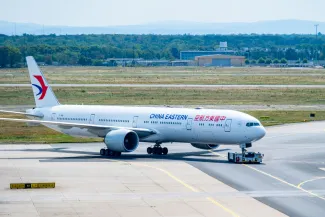
Flight MU5406, a routine 1,033-mile hop from Chengdu to Shanghai, was wrapping up what should have been an uneventful domestic run at around 11:40 a.m. local time. The five-year-old China Eastern Airbus A350-900, registered as B-324W, was taxiing toward its assigned gate when things went sideways. Or more accurately, straight ahead when they absolutely shouldn't have. Video footage shows the jet failing to stop as it approached the gate. Instead of gently easing into position, the aircraft's left engine and wing slammed directly into the jet bridge. Then, in what has to be one of the stranger pilot decisions in recent memory, the crew activated reverse thrust to back away from the bridge. The plane reversed, all right. And then promptly hit the jet bridge again. It wasn't until the engines were shut down completely that the aircraft finally stopped moving. "This has to be one of the most unusual airport accidents we've seen in a long time. You'd assume this is an AI video, or something, because of how strange it is, but it's confirmed to be real," according to One Mile at a Time.The Damage and Passenger Experience
The left engine and wing took significant damage, as did the jet bridge itself. Photos from the scene show obvious structural harm to both the aircraft and the ground equipment; this wasn't a gentle tap. All passengers deplaned safely, though understandably rattled. One passenger posted to Sina Weibo during the ordeal: "Very scared, I can't get off the plane now." China Eastern eventually compensated each passenger 300 yuan, roughly $43.94, for their trouble. Not exactly generous by Western standards, but standard protocol for Chinese carriers dealing with operational hiccups. China Eastern issued a statement attributing the crash to mechanical failure. "A mechanical malfunction occurred as the flight from Chengdu was taxiing slowly towards its gate and the aircraft hit the bridge," the airline said. The cause remains under investigation, but the company insists all safety procedures were followed and everyone exited the plane in an orderly fashion.The Mystery of the Second Impact
The first collision is easy enough to explain, at least in theory: brake failure. If the brakes simply didn't work, the aircraft would have rolled right into whatever was in front of it. Unfortunate, but mechanically straightforward. The second impact? That's where things get weird. Why would the crew use reverse thrust to back away from an obstacle when the brakes had already failed once? Reverse thrust is powerful, sure, but it's not exactly a precision tool for parking maneuvers. And why didn't they shut down the engines immediately after the first impact to prevent any further movement? Aviation commentators have raised these questions, and they're fair ones. The A350 is packed with redundant safety systems, and modern pilots train extensively for all kinds of mechanical failures. A scenario where a crew backs into the same object twice suggests either catastrophic system failure across multiple redundancies or a breakdown in decision-making under pressure. Neither is a comforting thought.Shanghai Hongqiao's Role in the Puzzle
Shanghai Hongqiao isn't some sleepy regional outpost. It handled 43.7 million passengers in 2024, making it one of China's busiest airports and a critical hub for domestic travel. China Eastern operates 30 A350s, and this incident pulled one of them out of service at a facility where gate and aircraft availability can get tight fast. The airport's rapid turnaround demands and high traffic volume mean even a minor operational hiccup can ripple outward. A damaged jet bridge doesn't just ground one plane; it potentially disrupts the entire gate's schedule until repairs are complete.Where This Leaves Travelers
If you're booked on China Eastern in the coming weeks, particularly through Shanghai, don't panic. One damaged A350 out of a 30-plane fleet isn't going to crater the airline's operations. But it's worth keeping an eye on your flight status if you're connecting through SHA, especially during peak travel windows. Gate reassignments and minor delays wouldn't be surprising while the airport sorts out bridge repairs and investigators do their work. Mechanical failures happen; that's why aviation has so many backup systems. What's unusual here is how the failure played out. Modern aircraft are designed to fail gracefully, with pilots trained to recognize problems and respond calmly. When something goes wrong not once but twice in rapid succession, it raises questions about what those backup systems missed and whether crew training scenarios need updating. For now, the investigation will sort through flight data, cockpit voice recordings, and maintenance logs to figure out what broke and when. China Eastern will likely face scrutiny from regulators, and the A350's manufacturer, Airbus, will want answers too. No one likes seeing their flagship wide-body repeatedly ramming ground equipment on camera. In the meantime, passengers on MU5406 have a story they'll be telling for years, even if they only got about $44 out of the deal.More travel news
Typhoon Dolphin Grounds Hundreds of Flights in China
SHANGHAI, China - Nearly 1,000 flights cancelled and public transport suspended as Typhoon Dolphin's rain bands continue disrupting China's eastern travel corridor after Sunday's double landfall.
Unruly Passenger Forces United 777 to Divert to Tokyo
Tokyo, Japan - A United Boeing 777 bound for San Francisco made an unscheduled landing in Narita after cabin chaos escalated, with police removing a passenger and maintenance delaying the flight nearly five hours.
China Opens Borders Beyond Tourist Appeal
SHANGHAI, China — New visa-free transit rules and payment system integration mark China's most ambitious tourism infrastructure overhaul since pandemic reopening.

China Airlines okays $8B A350/777X order, retires 747s
Taipei, Taiwan — China Airlines green-lights up to 18 new A350 and 777X jets and retires its last 747 freighters, reshaping the carrier’s long-haul network for travelers.
About the Author

Andy Wang
Andy Wang is Asia Editor at Jetsetter Guide, covering Southeast Asian travel and food from his base in Singapore. A first-generation American, he brings a dual perspective to the region.