Stay current with our airline news coverage.
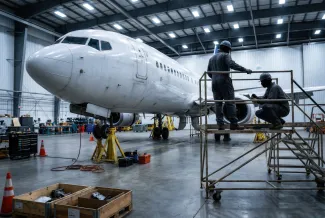
Unwanted nose-up and nose-down movement in flight has prompted a mandatory tail inspection order for 1,987 U.S.-registered Boeing 737 Next Generation aircraft. The FAA is targeting looseness in the mechanisms that position the horizontal stabilizer, warning that excessive movement could lead to a loss of control if left unaddressed, according to Simple Flying.
For passengers, there’s an important distinction: This is an inspection mandate, not a blanket grounding. It also does not apply to the Boeing 737 MAX.
The directive, AD 2026-20-14, was published Oct. 19, 2026, and takes effect Nov. 23, 2026, according to AeroTime. Inspections are due under the compliance schedule incorporated into the rule; the effective date is not a single deadline for finishing every aircraft’s checks.
Which Boeing 737 aircraft need inspections?
The order covers specified aircraft in the 737-600, 737-700, 737-700C, 737-800, 737-900 and 737-900ER families. Applicability is tied to aircraft identified in the FAA’s referenced Boeing service information, according to Aerospace Global News.
That makes the full aircraft designation more useful than the familiar “737” label. The NG models are covered by this directive; the newer MAX family is not. Nor should the FAA’s estimate of 1,987 U.S.-registered aircraft be read as a worldwide total, Aerospace Global News reported.
The model remains widely used beyond the United States. Simple Flying, citing ch-aviation data, reported over 5,160 active 737NG aircraft worldwide. Authorities in other countries will decide whether to mandate the same checks for aircraft registered in their jurisdictions, according to the publication. The FAA order itself applies to the U.S.-registered fleet.
Why the horizontal stabilizer is under scrutiny
The horizontal stabilizer is the movable horizontal surface at the tail that helps control an aircraft’s nose-up or nose-down attitude. On the 737, it pivots on two hinges, while a jackscrew moves it into position, Simple Flying explained.
The problem is excessive freeplay, essentially unwanted looseness within those mechanical connections. As the parts wear, that movement can increase. The directive follows reports of pitch oscillations linked to excessive stabilizer freeplay, according to Simple Flying.
A little mechanical movement and excessive movement are not the same thing. Aerospace Global News explained that some movement is expected in mechanical systems, but too much can change how components respond to aerodynamic forces. Flutter occurs when those forces and structural movement reinforce each other, potentially producing increasingly severe oscillations.
That is the hazard behind the FAA’s action, rather than simply an uncomfortable ride. The regulator warned that uncorrected excessive freeplay could allow flutter and potentially result in loss of control, Simple Flying reported. The FAA did not specify how many pitch oscillation incidents had occurred, when they happened or which airlines were involved.
What airlines must check and fix
Operators must measure freeplay at both the left and right horizontal stabilizer pivot hinges and at the jackscrew. Depending on the measurements, the work can lead to repeat checks, repairs or replacement of worn components, according to Simple Flying.
The measurement procedures come from Boeing Alert Requirements Bulletin 737-55A1104 RB, dated June 12, 2025, Aerospace Global News reported. The directive incorporates that service information rather than leaving operators to choose their own measurement approach.
And this is not necessarily a one-time inspection. Aerospace Global News reported that subsequent requirements depend on the measurements and the aircraft’s condition. Installing replacement components does not automatically eliminate later inspections; the FAA’s concern includes excessive freeplay developing in replacement parts as well as original ones.
For maintenance teams, that distinction matters. Replacing a worn component addresses the finding, but it does not, by itself, remove the aircraft from the rule’s continuing inspection requirements.
Airlines sought flexibility; the FAA kept its schedule
The final rule follows a proposal published in January 2026, according to AeroTime. During the comment process, operators asked for changes that would make the work easier to fit into maintenance schedules.
United Airlines, which has over 300 affected aircraft, requested longer intervals between repeat inspections and credit for checks already completed, Simple Flying reported. AeroTime specified that United sought longer repeat intervals for aircraft fitted with replacement hinge bearings compared with aircraft retaining original parts.
Canadian North asked to extend the initial inspection threshold from 12 months to 36 months so the work could coincide with heavy maintenance visits, according to AeroTime. Alaska Airlines asked to repair worn parts immediately rather than perform interim freeplay checks, Simple Flying reported.
The FAA rejected those requests, according to Simple Flying, maintaining that the intervals were needed to monitor excessive freeplay in both original and replacement components. There is still a route for individual alternatives: AeroTime reported that the agency would consider extension requests supported by sufficient evidence that a different schedule would maintain safety. That is conditional approval, not an across-the-board extension.
Inspection costs are only the starting point
The FAA estimates six work-hours and $510 per aircraft for the measurement, according to Simple Flying. Its reported fleetwide inspection estimate exceeds $1 million before replacement parts.
AeroTime reported that the calculation uses an assumed labor rate of $85 an hour. Additional inspections and repairs would increase the bill; the FAA could not determine how many aircraft would need replacement components or provide definitive prices for the worn parts.
The distinction is straightforward: The estimate covers measuring the problem, not necessarily all the work needed to correct it.
No blanket grounding, but maintenance findings matter
The directive does not ground the affected fleet, Aerospace Global News reported. Airlines must incorporate the checks into their maintenance programs and meet the required deadlines. Individual aircraft may need additional maintenance before continuing to operate, depending on the findings and applicable requirements.
For travelers, the useful dividing line is between a fleetwide inspection requirement and an aircraft-specific repair. The FAA has mandated checks across a substantial fleet; the results determine what happens next for each jet. Nov. 23 starts the rule’s legal effect, not a blanket shutdown of 737NG flying.
More travel news
Nationwide FAA Ground Stop Ends; Cancellations Continue
The nationwide FAA stop was lifted Friday, but cancellations persisted; Southwest's waiver covers customers ticketed for Nov. 13-16, while Delta's covers flights scheduled for Nov. 13-14.
Copa Airlines and UPS planes collide at Miami International Airport
Two Copa passengers were treated at the scene and did not need hospital care; other flights used alternate taxiways after the collision.
FAA ground stop ended; schedule recovery forecast for Nov. 15
A telecom upgrade triggered the Nov. 13 halt. Under U.S. rules, travelers facing cancellations or delays of three hours domestically or six internationally must be offered alternative travel or a full refund if they do not fly.

Boeing 737 MAX 10 FAA approval could come this week
FAA certification could come the week of Oct. 19, but some buyers reportedly will not accept 737 MAX 10s fitted with affected U14 or U14.1 software.
About the Author

Dana Lockwood
Dana Lockwood is a Travel Writer at Jetsetter Guide covering budget solo travel from her base in Denver, Colorado.