
Stay current with our airline news coverage.
Six New Departures for the 2027-2028 Season
Atlas has scheduled six departures across the two expedition styles for the 2027-2028 Antarctic season. Four Drake Express departures are set for November 28, 2027; December 5, 2027; February 12, 2028; and February 19, 2028. Two Drake Fly and Sail departures are scheduled for November 19, 2027 and February 3, 2028. Limited space remained on two additional Drake Express departures in December 2026, on the 7th and 14th, according to PR Newswire. Atlas said the expansion responds to strong demand and increases choices for travelers planning Antarctica trips. The fly-cruise model reduces the traditional two-day Drake Passage crossing, a stretch of water notorious for its rough conditions and unpredictable weather, to a two-hour private charter flight. For travelers who are time-constrained or sensitive to motion sickness, the shift represents a fundamental change in accessibility to the Antarctic Peninsula.The Drake Passage Calculus
The Drake Passage has long been the price of admission to Antarctica for ship-based travelers. The 600-mile stretch of open ocean between Cape Horn and the South Shetland Islands can be calm and glassy or a churning gauntlet of 30-foot swells. It is both a rite of passage and a barrier, and for decades, expedition operators have navigated the trade-off between authentic southern ocean experience and the appeal of maximizing time on the ice. Atlas's expanded fly-cruise program tilts the balance decisively toward convenience and efficiency. The Drake Express program eliminates the passage entirely, delivering travelers directly to King George Island and the threshold of the Antarctic Peninsula. The Drake Fly and Sail option offers a middle path, allowing travelers to experience the passage in one direction while avoiding it on the return. For operators, the model also reduces scheduling risk; weather delays on the Drake can cascade through itineraries, and flights offer a measure of predictability. The expansion reflects broader momentum in the luxury expedition sector, where operators are packaging convenience as a premium feature. Private charter flights, flexible itineraries, and shorter voyages appeal to affluent travelers who want Antarctica but cannot commit to the traditional 10- to 14-day round-trip voyages from Ushuaia or Punta Arenas. The fly-cruise model compresses the experience without sacrificing time on the peninsula itself, where Zodiac landings, wildlife encounters, and shore excursions take place.What Travelers Planning Antarctic Trips Should Know
The 2027-2028 season is still more than a year away, but inventory on high-demand polar departures tends to fill early. Travelers considering the fly-cruise option should weigh the trade-offs carefully. The Drake Express eliminates the passage entirely, but it also removes a defining element of the Antarctic voyage; the slow approach by sea, the albatross trailing the ship, the first iceberg on the horizon. These are not trivial losses for travelers who value the journey as much as the destination. The Drake Fly and Sail option preserves the passage in one direction, which may be the right compromise for those who want the experience without doubling down on it. Either way, the expansion increases flexibility and choice, which is a meaningful shift in a region where logistical constraints have historically dictated options. For conservation-minded travelers, the rise of fly-cruise models also raises questions about capacity and impact. Shorter voyages and more frequent departures can increase the number of visitors to the Antarctic Peninsula in a given season, concentrating pressure on landing sites and wildlife areas. The International Association of Antarctica Tour Operators regulates visitor numbers and site usage, but the balance between access and protection remains a live issue in polar tourism. Atlas Ocean Voyages has positioned the expansion as a response to demand, and the scheduling reflects confidence in the market. Six departures for 2027-2028, plus limited availability on two December 2026 voyages, suggest the operator expects strong uptake. Travelers planning ahead should book early, confirm flight logistics, and clarify what is included in the charter arrangements. Weather in Antarctica remains unpredictable, and even private flights are subject to conditions on King George Island. The Antarctic season is short, the window narrow, and the stakes high. The fly-cruise model opens that window wider, but it does not change the fundamental realities of polar travel. Flexibility, patience, and a willingness to adapt remain essential. For those who choose to fly the Drake, the trade-off is clear: less time at sea, more time on the ice, and a faster path to one of the planet's last great wildernesses.More travel news
A 28 Day Private Jet Odyssey Across Seven Continents
MIAMI, United States - Abercrombie & Kent unveils a 28-day, seven-continent journey by private Boeing 757, combining Antarctica, Uluru, the Maldives and Egypt.

US and Canada Raise Travel Alerts Across Key Hotspots
Washington, United States - Updated North American travel advisories sharpen warnings for Tanzania and South America, with localized risks requiring closer trip planning.

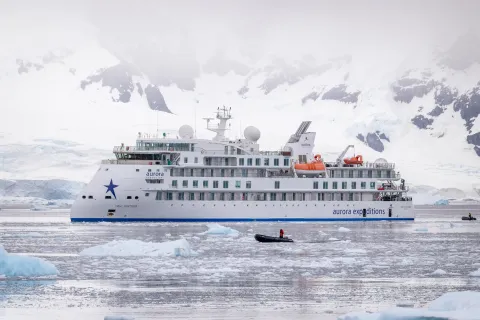
Aurora Expeditions Welcomes Kids on Remote Voyages
Sydney, Australia - Aurora Expeditions has lowered its minimum age requirement to six, bringing families with school-age children onto expedition ships bound for Antarctica, the Arctic and other remote regions.
Atlas Adds More Flight Options to Skip Drake Passage
Punta Arenas, Chile - Atlas Ocean Voyages adds six Antarctica departures for 2027-28 that replace the traditional two-day Drake Passage crossing with a two-hour flight.

About the Author

Jeff Colhoun
Jeff Colhoun is an acclaimed travel writer, photographer, and filmmaker, whose work is respected both in the United States and internationally.