Stay current with our cruise news coverage.
E-Fuel in the Field: What It Actually Means
For travelers booking Antarctic expeditions, this isn't greenwashing. It's tangible infrastructure deployed in one of the most logistically punishing environments on Earth. Zodiac landings are the operational backbone of Antarctic tourism. Guests don't stay aboard ship; they step off into landing craft multiple times per voyage to access penguin colonies, research stations, and ice formations. Those small boats burn fuel constantly, and until now, that fuel has been conventional gasoline with all the associated carbon output. Antarctica21's adoption of e-gasoline changes that equation without changing the hardware. The synthetic fuel, produced locally in Chilean Patagonia using wind energy, delivers the same performance as petroleum-based gasoline but with a significantly reduced carbon footprint. The Haru Oni plant, operational since 2022, captures atmospheric CO2 and combines it with green hydrogen to create a fuel that combusts cleanly and stores easily, critical factors in polar logistics where resupply is infrequent and environmental contamination is unacceptable. "By integrating e-fuels into our operations for a second consecutive season, we reaffirm our responsibility to protect one of the planet's most fragile ecosystems and to drive a real technological transformation within the maritime and tourism industries, rooted in Chile and reaching the world," said Verónica Peragallo, CEO at Antarctica21, according to Travel.Why This Partnership Matters Beyond Antarctica
The renewal signals more than environmental commitment; it demonstrates commercial viability. Companies don't renew experimental partnerships unless the first iteration worked. Antarctica21 ran an entire season on e-fuel without operational disruption, proving the concept under real-world conditions where failure isn't an option. That track record matters for an industry watching closely as International Maritime Organization greenhouse gas targets tighten and regulatory pressure mounts. HIF Global's involvement positions this initiative within a broader industrial strategy. The company isn't producing boutique fuel for a single operator; it's building scalable infrastructure capable of supplying hard-to-abate sectors where electrification isn't feasible. Aviation, shipping, and remote operations all face the same challenge: how to decarbonize without replacing entire fleets or building out charging networks in regions with no grid access. "This renewed collaboration is a sign of continuity and ambition. Today, our e-fuels represent a real solution to decarbonize hard-to-abate sectors. Supporting Antarctica21 once again allows us to demonstrate that regional tourism can be a driver of green innovation on a global scale," said Víctor Turpaud, CEO at HIF Latam, according to Travel.What This Means for Polar Expedition Travelers
Passengers won't notice operational differences. The Zodiacs perform identically; the landing schedules remain unchanged. But travelers increasingly booking based on sustainability credentials now have a clear differentiator. Antarctica21 is the first and only Antarctic tourism company to operate excursion boats with e-fuel, according to Travel. That distinction matters in a competitive market where operators compete on environmental impact as aggressively as they do on itineraries and onboard amenities. The company is also evaluating e-MGO for ship engines and e-SAF for flights, signaling intention to extend synthetic fuel adoption across the entire travel chain. If successful, that would address the full carbon spectrum of an Antarctic voyage: flight to embarkation port, ship transit through the Drake Passage, and Zodiac landings on the continent itself.Practical Realities and Industry Context
Cost remains the unspoken variable. E-fuels are more expensive than conventional petroleum, and those costs filter through to ticket prices or operational margins. Antarctica21 hasn't disclosed pricing impacts, but expedition cruises to Antarctica already command premium rates, typically ranging from $8,000 to $15,000 per passenger for a week-long voyage. Adding sustainable fuel costs may be easier to absorb in a high-margin segment than in mass-market cruise operations. The Punta Arenas production facility provides geographic advantage. Proximity to the embarkation port eliminates long-haul fuel transport, reducing both logistical complexity and the carbon footprint of fuel delivery. That regional integration, producing fuel where the winds blow strongest and using it where the ice is thickest, creates a closed-loop model difficult to replicate in other polar regions. Other expedition operators are watching. If Antarctica21 successfully scales e-fuel use without operational penalties or prohibitive costs, the model becomes exportable. Arctic operators, Greenland expeditions, and even sub-Antarctic island cruises face similar decarbonization pressures with limited alternatives. Battery-powered Zodiacs remain impractical for range and cold-weather performance; hydrogen infrastructure doesn't exist in remote ports. Drop-in synthetic fuels may be the only near-term solution that works. This partnership renewal isn't just about two companies extending a contract. It's field validation of a technology pathway that could redefine how polar tourism operates in a carbon-constrained future. The next test will be scale: whether HIF Global can produce enough e-fuel to supply more operators, and whether Antarctica21 can extend synthetic fuel use beyond Zodiacs to the entire expedition platform.More travel news
Aurora Expeditions Welcomes Kids on Remote Voyages
Sydney, Australia - Aurora Expeditions has lowered its minimum age requirement to six, bringing families with school-age children onto expedition ships bound for Antarctica, the Arctic and other remote regions.
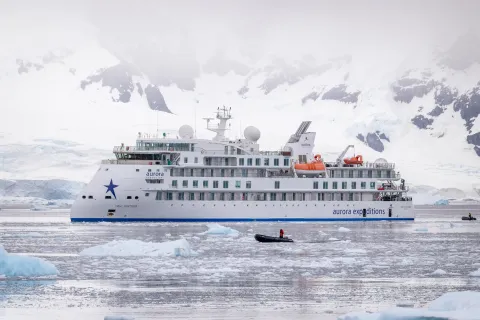
Atlas Adds More Flight Options to Skip Drake Passage
Punta Arenas, Chile - Atlas Ocean Voyages adds six Antarctica departures for 2027-28 that replace the traditional two-day Drake Passage crossing with a two-hour flight.
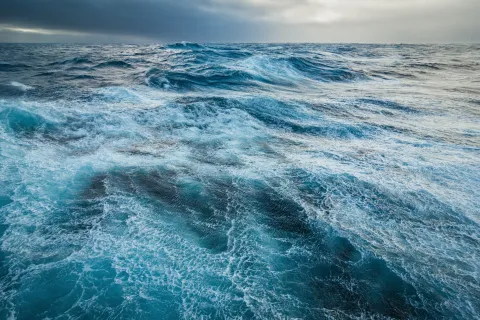
Atlas Ocean Voyages Launches Faster Antarctica Trips
PUNTA ARENAS, Chile - Atlas Ocean Voyages unveils expanded fly-cruise expeditions to Antarctica, introducing six new departures that trade Drake Passage crossings for private charter flights and more time exploring the ice.
Holland America Unveils Epic 26-Day Inca Coast Voyage
VANCOUVER, Canada — Holland America Line unveils a 26-day Pacific voyage connecting North and South America's cultural treasures, departing October 2027.
About the Author

Jeff Colhoun
Jeff Colhoun is an acclaimed travel writer, photographer, and filmmaker, whose work is respected both in the United States and internationally.