Stay current with our airline news coverage.
FORT WORTH, Texas — A fresh round of social-media chatter over airport attire has travelers in Fort Worth and beyond wondering whether their favorite hoodie or slogan tee might get them booted from a flight. While no federal regulation bans pajamas, slippers or political slogans in the terminal, each major U.S. airline maintains its own clothing rules and some are clearer than others.
American Airlines clothing policy: the fine print every flyer should know
American Airlines buries its dress code inside the “Complying with airline rules for safety” section of its Conditions of Carriage. The carrier’s guideline is short but direct: “Dress appropriately; bare feet or offensive clothing aren’t allowed,
” the document states. The same section reminds customers that failure to follow company policies can lead to temporary or even permanent loss of travel privileges.
The rule came under renewed scrutiny after U.S. Transportation Secretary Sean Duffy publicly urged passengers to ditch airport pajamas. “Let's try not to wear slippers and pajamas as we come to the airport,
” Duffy said at Newark Airport. Though the secretary’s appeal carried no legal force, it pushed flyers to dig through airlines’ carriage contracts to learn where comfort ends and conflict begins.
Can an “offensive” shirt really get you kicked off?
In theory, yes. If a crew member believes a T-shirt’s language or imagery is obscene, discriminatory or otherwise disruptive, the airline’s policy gives staff discretion to ask the traveler to cover up, change or leave the flight. The airline has not published an exhaustive list of banned slogans, leaving the final call to cabin crews and station managers.
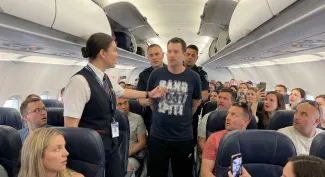
Recent online debate centered on an American passenger who claimed a flight attendant objected to a “I Stand With Charlie Kirk” tee on Flight #1628 from Dallas–Fort Worth to New York–JFK. The airline quickly replied on X that the garment did not violate policy and said it had “not received any complaints,” adding that the incident was still under review. The exchange underscored two realities: political messages are not automatically disallowed, and enforcement can vary from flight to flight.
How other U.S. airlines police passenger wardrobes
- United Airlines spells out its standards in Rule 21 of the Contract of Carriage. Section H, part 5 gives the carrier authority to refuse travel to “passengers who are barefoot, not properly clothed, or whose clothing is lewd, obscene or offensive.”
- Delta Air Lines does not list specific garments but notes that a customer can be removed if “attire, hygiene or odor creates an unreasonable risk of offense or annoyance to other passengers.”
- Southwest Airlines bans “lewd, obscene or patently offensive” apparel and has occasionally asked travelers to cover graphic slogans or revealing outfits before boarding.
- Hawaiian Airlines explicitly discourages swimsuits, stating that “clothing must cover the upper part of the torso” during flights.
Across the board, barefoot travelers are almost always asked to slip on shoes—even flip-flops—before they can step onto the aircraft. Carriers cite health codes and evacuation safety as reasons for the rule.
Why the definitions stay vague
Legal experts point out that precise wording could box airlines into confrontations or lawsuits. By keeping phrases like “offensive clothing” loosely defined, carriers retain flexibility to handle edge cases. The trade-off is uncertainty for passengers who may not learn a particular shirt is problematic until a flight attendant stands over their seat.
Tips for travelers
To keep your trip disruption-free, consider the following:
- Pack a backup layer. A lightweight sweater or plain tee can quickly cover controversial graphics if asked.
- Wear shoes through boarding. Even if you plan to fly in socks, slip-ons satisfy the “no bare feet” clause until you’re settled.
- Mind the cabin climate. Temperatures often swing from warm jetways to chilly cabins; dressing in layers solves both comfort and compliance concerns.
- Keep fragrances subtle. American Airlines’ policy also asks guests to ensure their “odour isn’t offensive” unless medically related; a strong perfume can be as problematic as body odor.
- Be prepared to compromise. If crew members make a request, civil dialogue usually resolves the issue faster than confrontation.
What happens if you refuse to change?
If a passenger declines to modify attire deemed unacceptable, flight crews can escalate the situation to gate agents or airport security. The best-case scenario is removal before pushback, allowing the traveler to adjust and catch a later flight. The worst-case scenario is a notation in the airline’s system that restricts or bans future bookings.
In extreme circumstances—such as profanity-laden shirts sparking mid-air altercations—pilots can divert or request law enforcement on arrival. While these cases are rare, they illustrate why airlines keep wardrobe control language in their contracts.
Will policies tighten after the secretary’s remarks?
So far, none of the major U.S. carriers has announced changes. Industry analysts note that adding specific garment lists could saddle employees with new enforcement headaches. For now, passengers flying out of Fort Worth, Dallas or any other U.S. hub should assume that comfort remains welcome—as long as it stays within the bounds of good taste and covered feet.
FAQ: American Airlines dress code for travelers
Does American Airlines ban pajamas?
No. Pajamas are not singled out in the policy, but crew members can flag sleepwear that appears inappropriate or overly revealing.
Can political slogans be worn on board?
Generally, yes, unless the language is obscene or discriminatory. The decision rests with the flight crew.
Is barefoot boarding ever allowed?
No. Shoes are required during boarding and deplaning for safety reasons.
What counts as “offensive”?
The airline has not published a detailed catalog. Anything containing hate speech, explicit sexual content or graphic imagery is likely to be challenged.
Could I be banned for a single violation?
Possibly. The Conditions of Carriage allow for temporary or permanent travel restrictions depending on the severity of the situation.
At the end of the day, dressing with a dash of decorum remains the easiest insurance policy for smooth sailing through security, boarding and the skies above.
More travel news
United Airlines plans two winter San Francisco-Barcelona round trips
Two planned Boeing 777-300ER round trips will operate Feb. 27-28 and March 3-4, 2027, around Mobile World Congress; they do not extend the route through winter.

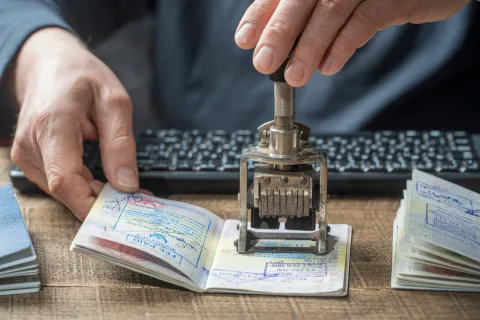
U.S. Customs and Border Protection to End Routine Passport Stamps
CBP announced routine passport stamping will end during primary inspection, with limited exceptions; foreign visitors can access admission and authorized-stay details through I-94 or CBP Link.
United Airlines Plans Base Fares for Domestic First, Short-Haul Business
United Airlines plans Base tiers for domestic first class and eligible non-Polaris short-haul international business, with paid seat selection, one free bag and no changes; Business Base excludes United Club access.
American Airlines may adjust capacity if fuel prices stay high
American Airlines says persistently high fuel prices may force further capacity changes, while United Airlines has cut capacity roughly 5% and Southwest Airlines has modified schedules.
About the Author

Jeff Colhoun
Jeff Colhoun is a photographer and filmmaker whose work has appeared in The Wall Street Journal, the Los Angeles Times, Matador Network and Barron’s.