Stay current with our airline news coverage.
FORT WORTH, Texas - Keep your shoes on, but don’t call it a newly announced ban.
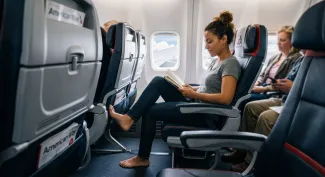
A claim circulating around American Airlines says the carrier implemented a systemwide prohibition on bare feet aboard its planes effective Aug. 14, 2026. The date sounds satisfyingly official. There’s just one problem: No verifiable public announcement, policy update or major aviation report establishes that American introduced a new footwear rule that day.
What American does have is language in its Contract of Carriage saying bare feet and offensive clothing aren’t allowed, according to an Aug. 14 roundup by View From The Wing. The roundup didn’t say when American adopted the provision.
That distinction matters. The airline has a rule covering bare feet; the available evidence doesn’t show that the rule was created or implemented Aug. 14.
An Existing American Airlines Dress Rule
Contracts of carriage spell out the conditions passengers accept when purchasing airline tickets. They cover plenty of territory, including passenger conduct and attire, although most travelers understandably don’t settle in with the document as their preflight reading.
American’s provision uses broad language to prohibit bare feet and offensive clothing. It gives the carrier a basis to address a barefoot passenger without needing a separate, highly publicized footwear campaign.
The Aug. 14 roundup also highlighted a traveler who publicly asked American whether it had considered requiring shoes on flights. That question suggests at least some customers don’t know the rule is already sitting in the carrier’s contract.
It does not, however, establish that “many passengers” are unaware. No survey, passenger count or other figure was provided to measure awareness. One public question can illustrate confusion; it can’t tell us how widespread that confusion is.
Why the Aug. 14 Date Doesn’t Hold Up
The supposed effective date doesn’t correspond with a verifiable footwear-policy announcement from American Airlines. Publicly documented American news around that period concerned very different issues.
On Aug. 12, Reuters reported a leadership shake-up as the airline faced investor pressure to close a profitability gap with competitors. That was a significant corporate development, but it had nothing to do with passenger footwear.
American was also making changes to its premium product strategy. Certain free upgrades to Flagship business class on specific routes are scheduled to end Aug. 25, according to Travel + Leisure. Again, that is a documented change with a stated effective date. The barefoot claim lacks comparable public documentation.
Operational events were drawing attention, too. An American Airlines Boeing 737 carrying 181 passengers suffered a bird strike and engine flames while departing Myrtle Beach on Aug. 10, according to CNN. A call-sign confusion incident involving two American flights near Phoenix drew air traffic control and safety attention on Aug. 14. Neither event was connected to attire rules.
Taken together, the record supports a much less dramatic explanation: An existing contract provision was highlighted on Aug. 14 and then interpreted as a new ban taking effect that day.
Policy Language and Cabin Enforcement Aren’t the Same Thing
Airline attire policies are often written broadly, leaving employees some discretion when dealing with conduct considered inappropriate or unsafe. A passenger may experience enforcement as new, especially if nobody mentioned the rule on previous trips. That doesn’t necessarily mean the contract changed.
There are several plausible ways the impression of a new ban could spread. Employees might begin applying an existing provision more consistently. Internal guidance could draw fresh attention to the issue without producing a public policy announcement. A social media post might also turn an isolated interaction into something that sounds systemwide.
None of those possibilities has been documented as the cause here. They simply fit the available information better than the assertion that American formally launched a new barefoot ban Aug. 14.
The Sensible Move for American Airlines Passengers
From a traveler’s perspective, debating whether the rule is “new” won’t help much at the boarding door. American’s Contract of Carriage says bare feet aren’t allowed. If an employee asks a passenger to put on shoes, pointing out that no Aug. 14 announcement exists is unlikely to change the underlying contract language.
I’d treat this as a reminder rather than a sweeping policy shift. Wear footwear when boarding and keep something available during the flight if you remove your shoes at your seat. That’s not an exciting booking strategy, granted, but it’s considerably easier than turning a pair of sandals into a contract dispute.
The episode also shows how quickly a long-standing airline rule can acquire a shiny new effective date online. American could reduce that confusion by making attire expectations easier to find and explaining whether enforcement guidance has changed. Until then, travelers are left with broad contract language and uneven public awareness.
So yes, American Airlines prohibits bare feet. No, the evidence provided doesn’t support calling Aug. 14, 2026, the launch date of a new systemwide ban. Sometimes the surprising airline news isn’t that a rule changed; it’s that passengers finally noticed it.
More travel news
U.S. Customs and Border Protection to End Routine Passport Stamps
CBP announced routine passport stamping will end during primary inspection, with limited exceptions; foreign visitors can access admission and authorized-stay details through I-94 or CBP Link.
American Airlines may adjust capacity if fuel prices stay high
American Airlines says persistently high fuel prices may force further capacity changes, while United Airlines has cut capacity roughly 5% and Southwest Airlines has modified schedules.
American Led Bag Mishandling Rates on Reportable Domestic Flights in Early 2026
For January through June 2026, the DOT data covers checked bags in airline custody on reportable domestic nonstop scheduled passenger flights; mishandled includes lost, delayed, damaged or pilfered bags.
United Flight Attendants Can Refuse ICE Questions
Washington, United States - United flight attendants were told they may remain silent when ICE asks about passengers or coworkers as airport arrests increase nationwide.
About the Author

Jennifer Wilmington
Jennifer Wilmington is Family Travel Editor at Jetsetter Guide, covering family and luxury travel from her base in Charleston, South Carolina.