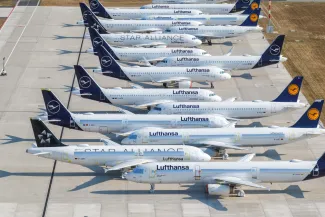
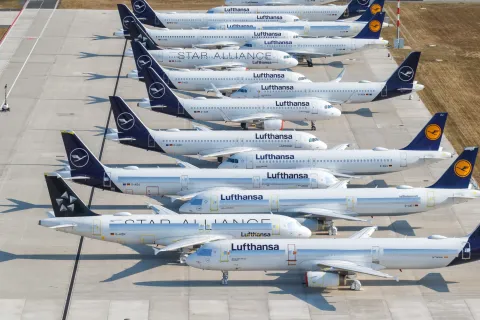
FRANKFURT, Germany — Lufthansa Group announced Tuesday it will cancel 20,000 short-haul flights through October and shutter its regional CityLine subsidiary entirely, marking the most significant capacity reduction by a major European carrier since fuel prices began their sharp climb following escalating conflict in Iran.
The cuts represent less than 1% of the group's total passenger capacity but signal a fundamental shift in how airlines are responding to what industry analysts are calling the most severe jet fuel supply crisis Europe has faced in years. For travelers, it means fewer options on regional routes, eliminated service to smaller cities, and ongoing uncertainty about summer schedules that were supposed to be locked in months ago.
What's Being Cut and Why
The German aviation giant is targeting its least profitable short-haul operations, primarily routes connecting smaller European cities to its major hubs in Frankfurt and Munich. According to the carrier's announcement, approximately 120 flights per day have already been canceled since Monday, with reductions continuing through May 31 before a revised summer schedule takes effect.
Several destinations have been dropped entirely from the network. Polish cities Bydgoszcz and Rzeszów are off the timetable, as is Stavanger, Norway. Lufthansa has not committed to when or whether these routes will return. Other affected services are being rerouted through alternative Lufthansa Group hubs across Europe, a move designed to consolidate passenger loads onto fuller aircraft burning less fuel per seat.
The company emphasized that long-haul flights and intercontinental connections remain largely intact. That's a critical distinction for North American travelers transiting through Frankfurt or Munich; your connection from Chicago or Toronto to Frankfurt shouldn't change, but your onward hop to a secondary European city might.
The Fuel Crisis Behind the Cuts
Jet fuel prices have more than doubled since the outbreak of hostilities involving Iran, a reality that's reshaping airline economics across the continent. Europe's dependence on Middle Eastern energy supplies makes it particularly vulnerable to supply chain disruptions, and carriers are now facing a dual threat: higher costs for the fuel they can secure, and genuine uncertainty about whether sufficient supplies will be available through peak summer travel season.
Lufthansa's decision to optimize its flight offering, as the company puts it, is a direct response to these pressures. Short-haul routes that were marginally profitable at $80 per barrel become unsustainable when fuel costs spike. Regional jets, which form the backbone of CityLine's operations, are particularly fuel-intensive relative to passenger capacity. Shuttering that unit makes financial sense even if it devastates connectivity for smaller airports that relied on those links.
This isn't a strike or a weather event or a temporary operational hiccup. It's a structural contraction driven by geopolitical realities that show no signs of improving in the near term.
What This Means for Travelers
If you have a ticket on one of the canceled flights, EU regulations require Lufthansa to offer either a full refund or rebooking on an alternative service. Compensation is a different matter. Airlines are generally exempt from paying cash compensation when cancellations result from extraordinary circumstances, a category that fuel shortages caused by war would likely fall under. Expect that argument to be tested as passengers push back.
For those traveling later in the summer, Lufthansa says revised schedules will be published in late April or early May. That's uncomfortably close to departure dates for many travelers who booked months ago expecting stable itineraries. If your plans involve connecting through Frankfurt or Munich to a smaller European destination, verify your booking regularly and have backup options ready.
The practical reality on the ground: Germany's summer travel landscape is becoming less predictable by the week. What looked like a routine connection in March might not exist in July. Regional airports that counted on multiple daily Lufthansa services may find themselves down to one flight, or none.
Broader Industry Implications
Lufthansa is the first major European carrier to announce cuts of this scale, but it's unlikely to be the last. If jet fuel imports to Europe don't increase significantly in the coming weeks, expect similar moves from other flag carriers facing the same cost pressures and supply uncertainties.
Airlines operate on thin margins even in good times. When a major input cost doubles while demand remains constant, something has to give. In this case, it's regional connectivity and the passengers who depend on it.
The closure of CityLine also represents a broader retreat from the hub-and-spoke model that defined European aviation for decades. Smaller cities that were brought into the network through regional feeder services are now being cut loose, left to rely on budget carriers or ground transport. For business travelers who counted on multiple daily frequencies to make same-day trips viable, that's a fundamental change in how Europe functions as a travel market.
What Comes Next
The fuel situation is tied directly to geopolitical developments in Iran and the broader Middle East, factors entirely outside the control of airlines or passengers. Resolution isn't on the horizon. That means the operating environment for European carriers will likely remain unstable through the remainder of 2024 and possibly beyond.
For travelers, the lesson is clear: build flexibility into your plans. Book refundable tickets if the premium is manageable. Monitor your reservations actively rather than assuming they'll hold. Consider alternative routings that don't rely on tight regional connections. And recognize that the summer travel season in Europe is going to look different than what we've grown accustomed to over the past decade.
Lufthansa's 20,000 canceled flights are a symptom, not the disease. The disease is a fragile fuel supply chain colliding with geopolitical instability. How long that lasts, and how much deeper the cuts go, depends on factors no airline can control.
More travel news
Major Airlines Battle Airspace Bans and Travel Chaos
TORONTO, Canada - Air Canada joins Delta, British Airways, Lufthansa, and other major carriers navigating Middle East airspace restrictions that threaten international route networks.
Middle East Tourism Collapses Amid Regional Conflict
DUBAI, United Arab Emirates - Iran joins Israel, Saudi Arabia, UAE, Qatar, Iraq, Bahrain, Jordan, Syria, Egypt, and neighboring countries in an unprecedented tourism collapse, losing $600 million daily as conflict reshapes the region's travel landscape.

Budget Carrier Collapses as Oil Crisis Grounds Fleets
MIAMI, USA - Viral reports of Spirit Airlines shutting down and Magnicharters filing for bankruptcy due to a U.S.–Iran oil crisis do not align with verifiable airline industry timelines or real-world events.
Lufthansa Cuts 25 Routes Amid Iran War Fuel Crisis
FRANKFURT, Germany - Lufthansa slashes 13% of its European flying as soaring jet fuel costs from the Iran war and the closure of its CityLine subsidiary force the carrier to rethink its short-haul network.
About the Author

Jeff Colhoun
Jeff Colhoun is an acclaimed travel writer, photographer, and filmmaker, whose work is respected both in the United States and internationally.