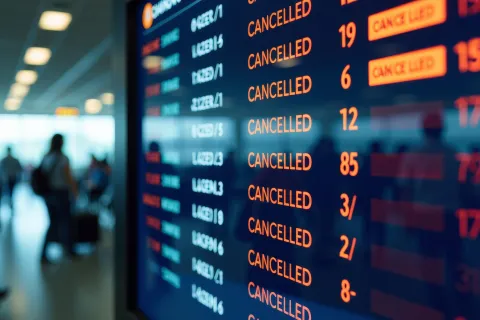
What Really Ails Spirit Airlines
The truth is more prosaic but no less significant for travelers. Spirit has faced mounting pressure from Pratt & Whitney GTF engine problems that grounded substantial portions of its A320neo fleet, a situation that has hobbled capacity and revenue across the ultra-low-cost sector. High fuel prices, which typically account for 20 to 30 percent of airline operating costs, have compounded those pressures. And in January 2024, a U.S. federal court blocked the JetBlue merger on antitrust grounds, leaving Spirit to navigate those headwinds as a standalone carrier with fewer options and thinner margins. Those are the verifiable facts. What they do not add up to is a complete shutdown triggered by a Middle East war scenario. Spirit continues to sell tickets, operate flights, and report to regulators. Its balance sheet is under stress, but it has not exited the market.Magnicharters and the Mexico City Mirage
The same disconnect applies to Magnicharters, the Mexican charter and leisure airline based at Mexico City International Airport. Founded in 1994 and operating mainly Boeing 737 aircraft, the carrier did face serious financial distress in the wake of the COVID-19 pandemic, including route cuts and mounting debt. Mexican media have chronicled those struggles in detail. What they have not documented is a specific bankruptcy filing in Mexico City that coincides with an alleged Spirit shutdown or an Iran-related oil shock. The timeline simply does not hold. While Magnicharters' troubles are real and its future uncertain, linking its distress to a geopolitical fuel crisis that did not occur in the manner described conflates separate narratives and risks spreading misinformation.The Hypothetical Kernel Worth Examining
Strip away the factual inaccuracies, and what remains is a plausible vulnerability. Small and ultra-low-cost carriers operate on razor-thin margins, with fuel representing one of the largest line items. A sudden, sustained spike in jet fuel prices, whether from Middle East conflict, supply chain disruption, or geopolitical shock, would indeed hit budget airlines hardest and fastest. Spirit and carriers like Magnicharters have limited pricing power, minimal hedging capacity, and scant balance-sheet cushion to absorb a doubling of fuel costs. Global jet fuel prices did roughly double between mid-2020 and mid-2022, according to IATA data, and that pressure contributed to the financial strain Spirit faces today. A hypothetical closure of the Strait of Hormuz or a sustained U.S.–Iran conflict could produce an even sharper shock. In that sense, the scenario is not entirely fanciful; it simply has not happened yet, and attributing real airline failures to imagined events undermines both accuracy and credibility.How to Read Airline Crisis Claims
For travelers planning trips or monitoring frequent-flyer programs, the lesson is straightforward: verify before you panic. Spirit Airlines is still flying. Magnicharters' woes are real but rooted in pandemic economics and competitive pressure, not an oil war. When dramatic shutdown stories surface, cross-check them against airline websites, financial filings, and established aviation outlets before changing plans or assuming the worst. The broader takeaway is more sobering. Budget carriers do face structural exposure to fuel volatility, engine groundings, and liquidity crises. Spirit's predicament, grounded planes and blocked merger included, illustrates how quickly margin compression can turn existential. Magnicharters' struggles underscore the fragility of smaller leisure airlines in emerging markets. Those vulnerabilities are worth understanding, but only when grounded in fact rather than speculative fiction. Africa-focused travelers accustomed to navigating charter operators and regional carriers in remote markets will recognize the pattern. The smallest airlines are always first to feel macro shocks, whether fuel spikes, currency swings, or sudden drops in leisure demand. In that context, the hypothetical Iran oil crisis scenario serves as a useful thought experiment, a reminder to diversify bookings, monitor news carefully, and maintain flexibility. But it should not be mistaken for journalism or treated as a real-world event until the facts support it. The research itself concludes that this scenario does not match verifiable real-world events and conflicts with publicly documented aviation and geopolitical timelines. Spirit Airlines filings and coverage discuss liquidity problems and cost pressures, but none mention an operational shutdown tied to a U.S.–Iran conflict or an early-May oil crisis. Until then, Spirit continues to fly, Magnicharters' troubles remain rooted in pandemic fallout, and the oil crisis that supposedly brought both down exists only in the imagination.More travel news
Trump Ends 50-Year National Park Vehicle Ban
WASHINGTON - President Trump reversed Executive Orders 11644 and 11989, lifting decades-old off-road vehicle restrictions on federal lands including areas in and around national parks.

Carnival Breach Exposes 6 Million Travelers Data
MIAMI, Florida - Carnival Corporation has confirmed a cybersecurity breach from April 2026 exposed sensitive data on nearly 6 million travelers, including passport numbers.
Middle East Tourism Collapses Amid Regional Conflict
DUBAI, United Arab Emirates - Iran joins Israel, Saudi Arabia, UAE, Qatar, Iraq, Bahrain, Jordan, Syria, Egypt, and neighboring countries in an unprecedented tourism collapse, losing $600 million daily as conflict reshapes the region's travel landscape.

Memorial Day Travel Surges Despite Higher Gas Prices
UNITED STATES - Record 45 million Americans to travel Memorial Day weekend despite gas averaging $4.52, with nearly 87% choosing road trips over air.

About the Author

Wilson Montgomery
Wilson Montgomery is a British-born travel writer who has carved a niche for himself with his compelling narratives about African travel and safari experiences.