
Best Time to Visit Alaska in 2027, and When to Cruise
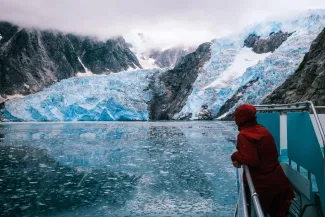
On a June Alaska cruise, the evening can stretch well beyond dinner, leaving plenty of light for watching mountains slide past the ship. By September, dusk arrives earlier, the air feels sharper, and that same stretch of railing may call for another layer rather than another lap.
Neither version is the wrong Alaska. But they’re different vacations, and the calendar does more itinerary planning than the brochure sometimes admits.
Alaska’s longest days, lowest fares, and strongest salmon-feeding bear opportunities don’t all arrive together. As January’s cruise offers compete for attention, the useful question isn’t simply when to go; it’s what you’d most regret missing.
For travelers exploring the best places to visit in North America, Alaska rewards that extra thought. Start with your priorities, then choose the month and route that actually deliver them.
The Best Time to Visit Alaska, and the Best Time to Cruise
Mid-June through mid-August is the strongest overall window for a first Alaska visit. For a straightforward first cruise, mid-June through July is a useful default, combining long days with broadly available summer excursions.
A land trip needs closer coordination of seasonal lodging, transportation, and park access. A cruise handles much of the moving around, but its exact itinerary and port hours still determine what you can do.
- June: Long daylight, mountain scenery, and a strong all-around cruise choice.
- July: Generally warm conditions and a broad menu of summer activities.
- July and August: Good candidates for many salmon-linked bear trips, provided you choose the right location.
- May and September: Potential value, with more seasonal compromises.
Those price patterns are tendencies, not promises. Early August can remain expensive, and a particular July sailing might undercut a May departure.
Winter aurora trips and snow-focused adventures have a different calendar entirely. Here, the focus is Alaska’s main May-through-September cruise and touring season.
Alaska From May to September: What Each Month Really Feels Like
Alaska doesn’t have one summer climate. Juneau is a coastal Southeast example; Anchorage represents Southcentral Alaska, not the warmer Interior or the Arctic. Conditions at an exposed glacier can feel considerably colder than those beside a downtown thermometer.
National Weather Service climate normals give some perspective: Juneau averages 3.51 inches of precipitation in May and 3.15 inches in June; July’s average high is 63.8°F. Anchorage’s September averages are 55.7°F for the high, 42.9°F for the low, and 3.10 inches of precipitation. These are long-term averages, not a 2027 forecast.
Quick month comparison
- May: Cool, rapidly lengthening days; lighter demand is possible; inland operations need careful checking.
- June: Near-solstice daylight; summer services expand; cruise demand builds.
- July: Generally warm, busy, and activity-rich; popular beds and excursions book early.
- August: Busy early, potentially quieter later; coastal rain increases and days shorten.
- September: Cooler, darker, and more seasonal; early-month touring differs substantially from late-month cruising.
Daylight also needs a location attached. Anchorage and Juneau don’t share identical sunrise-to-sunset hours, and lingering twilight isn’t the same as daylight. Check your actual ports and dates rather than relying on a statewide “hours of sun” claim.
May: Snowy Mountains and Shoulder-Season Possibilities
May brings rapidly lengthening days, snow still outlining the mountains, and migrating birds returning to feeding and nesting grounds. It can be a rewarding month for scenery without the fullest summer crowds. Cruise fares often look more inviting, too, although neither an empty ship nor a bargain is guaranteed.
The important distinction is early versus late May. A ship can operate while an inland lodge, rail departure, hiking route, or wildlife excursion hasn’t begun its full season. Don’t assume a cruise departure proves everything ashore is open.
For cruising, pack a waterproof outer layer and warm clothing for breezy decks. For land travel, confirm each operator’s 2027 dates before connecting reservations. Bear trips are particularly location-dependent; a May outing shouldn’t be sold to yourself as a substitute for a summer salmon-run visit.
June: The Long-Evening Sweet Spot
June is the month for travelers who want the day to keep going. Near the solstice, long evenings make scenic cruising especially appealing; there’s less pressure to squeeze every mountain view between breakfast and dinner.
Summer transportation and excursions generally become more widely available as the month progresses. Whale-watching trips are established parts of many coastal itineraries, while land travelers gain more options for combining rail travel, national parks, and lodge stays.
Demand builds around school vacations, so June isn’t automatically a value month. Southeast Alaska can also be wet during this otherwise favorable window. “Relatively drier” means exactly that; it doesn’t mean your rain jacket gets the week off.
For a first visit balancing scenery, daylight, and operational choice, June is hard to argue with.
July: Broad Choice, Peak Competition
July generally brings some of Alaska’s warmest conditions and strongest visitor demand. That makes it convenient rather than tropical; Juneau’s average high remains in the 60s, and wind near glaciers can make gloves a sensible accessory.
Long days support busy sightseeing schedules, with whale excursions widely offered and salmon-feeding bear opportunities developing at particular rivers. July is especially relevant for travelers hoping to see bears fishing at Brooks Falls, though getting there requires a separate plan.
The trade-off is competition. Reserve sought-after lodging, park transportation, and capacity-limited excursions early. A cruise cabin may still be available after the small-group outing you really wanted has sold out.
Land travelers should also leave breathing room between destinations. Alaska’s distances don’t shrink just because there’s enough daylight to keep driving.
August: Two Different Moods in One Month
Early August can feel much like July in both crowds and prices. Later departures may become quieter as school calendars change, but don’t assume the whole month belongs in the bargain column.
Coastal rainfall generally increases, while shortening days become more noticeable. Whale trips continue, and salmon-linked bear excursions can be productive where local runs align. Farther north or inland, the first autumn color may begin appearing before coastal travelers feel summer has ended.
For cruising, August remains a strong option if you’re comfortable with rain and flexible about weather-dependent excursions. For land travel, later August can suit travelers interested in changing tundra colors, provided their chosen transportation and lodging still operate.
Choose the experience first; “August wildlife” is too broad a promise to book around.
September: Fall Color and a Shortening Season
Early September can still support substantial touring. Late September is a different proposition, with fewer daylight hours, cooler conditions, and a greater chance that a seasonal business has closed.
Expect coastal rain and the possibility of inland snow, particularly at elevation. Fall color can be a major attraction inland, while some whale and bear excursions continue according to local conditions and operator schedules.
Cruise fares may soften, but check port hours and available excursions before celebrating. A lower fare offers less value if your essential outing isn’t running.
Land travelers need to confirm every link in the chain: lodge, train, bus, rental pickup, and tour. Once you know which animal, landscape, or experience matters most, these monthly averages become much easier to interpret.
Let Wildlife Set the Date, Within Reason
Humpback whales are a major draw during the May-through-September coastal season, with excursions broadly available from June through August. Orcas are possible, too. Neither species works to a passenger manifest, so treat sightings as opportunities rather than inclusions.
Bear viewing requires a place as well as a month. The National Park Service identifies July and September as particularly useful periods at Brooks Camp in Katmai, but the experience changes. July favors bears fishing at Brooks Falls; September activity often shifts toward the lower river as bears feed on dead and dying salmon.
That ecological detail matters more than a generic “peak bear season.” Salmon timing, water conditions, and feeding habitat influence where animals gather. Brooks Camp also isn’t a routine Inside Passage shore excursion; access requires separate arrangements.
Follow guides’ instructions and local wildlife rules. At Brooks Camp, visitors must attend a bear-safety orientation, and park guidance generally requires staying at least 50 yards from bears.
For northern lights, late August and September restore darker nights, especially useful on inland extensions. Clouds, auroral activity, latitude, and ship lighting all affect the odds. Consider a cruise sighting a bonus, not the booking rationale.
Cruise, Land Trip, or Both?
Choose a roughly weeklong cruise if coastal scenery and simpler logistics top your list. You unpack once, transportation happens around you, and port excursions provide manageable introductions to Southeast Alaska. The compromise is time; a port call isn’t the same as several days exploring independently.
Choose a land itinerary if your priorities include Denali, Fairbanks, longer hikes, or the freedom to stop when something catches your attention. You gain flexibility but take responsibility for distances, lodging, and transportation schedules.
Combine them if you have additional time and budget. An Inside Passage cruise does not deliver Denali or Fairbanks without a separate land component. A one-way Gulf itinerary can connect naturally with Anchorage, the Kenai Peninsula, or an Interior extension, but transfers and flights need coordination.
Seward and Whittier aren’t Anchorage cruise terminals with different names. Both require an onward journey, and a one-way vacation may mean flying into one city and home from another.
Denali planning note; November 4, 2026 baseline: Western Park Road access is expected to change following Pretty Rocks work, but don’t treat anticipated 2027 service as a guaranteed itinerary. Check the National Park Service’s official site for road access, then confirm actual bus destinations, operating dates, and reservations before paying for dependent arrangements.
Construction completion and passenger-service reopening are separate milestones. Don’t assume access to Eielson, Wonder Lake, or Kantishna, and don’t infer bus access from a lodge’s proximity to the park entrance.
The Best Alaska Cruise Starts With the Route and Departure Port
The best Alaska cruise is a fit decision, not a universal ship ranking. Compare scenic-cruising days, actual hours ashore, glacier destinations, land-extension possibilities, and the effort required to reach the ship.
Route and port comparison
- Seattle round-trip Inside Passage: Convenient U.S. flight options for many travelers and straightforward return logistics; inspect Canadian calls and exposed-water segments.
- Vancouver round-trip Inside Passage: Round-trip simplicity with the possibility of routing east of Vancouver Island; check the actual sailing track.
- Vancouver to Seward or Whittier: A northbound Gulf itinerary that can lead into an Alaska land trip; budget for the arrival-port transfer.
- Seward or Whittier to Vancouver: A southbound option for touring Alaska first, then cruising toward your flight home from Vancouver.
Seattle cruise departures work well when flight choice and round-trip simplicity matter. Typical foreign-flagged round trips include a Canadian call, often Victoria. Check its actual hours; an evening visit and a full sightseeing day aren’t interchangeable.
Vancouver cruise departures offer both round-trip and one-way choices. Some itineraries use more sheltered waters east of Vancouver Island, but departure city alone doesn’t guarantee that routing or smooth seas.
Seward’s cruise port can pair well with Kenai Fjords exploration. Whittier is a separate gateway associated with Prince William Sound. Both require planning for Anchorage connections; transfer availability, timing, and luggage arrangements matter.
Inside Passage sailings can include exposed-water sections, while Gulf itineraries add more open-water travel. If motion sensitivity matters, examine the route rather than trusting the itinerary label.
Glacier destinations also aren’t interchangeable. Glacier Bay offers a national park scenic-cruising experience; Hubbard Glacier and Tracy Arm or Endicott Arm are different places with different approaches. Glacier Bay must appear on your specific itinerary. Even then, weather and operating conditions can affect the day.
Check government entry guidance for your nationality and route, including Canada where relevant. A Seattle departure doesn’t automatically eliminate international-document requirements. Air travel into Canada and eligible closed-loop cruising can involve different rules.
What Alaska Cruises Cost in 2027: Compare Dated Sailings, Not Teaser Fares
An Alaska cruise price is useful only when attached to a departure, cabin, occupancy basis, and clear inclusion terms. A ship-page “from” fare isn’t enough to establish what your vacation will cost.
JetsetterGuide lists these specific 2027 southbound departures as useful itinerary starting points:
- Norwegian Jade, May 17: Seven nights from Whittier to Vancouver, arriving May 24; the listed itinerary highlights Hubbard Glacier and Skagway.
- Viking Venus, June 9: Ten nights from Seward to Vancouver, arriving June 19; the itinerary is Alaska & the Inside Passage.
Check current cabin availability and a complete quote before comparing either with a Seattle or Vancouver round trip. Different trip lengths and onboard inclusions can make an apparently cheaper sailing the more expensive vacation.
Airfare deserves its own comparison. According to Google Flights, the listed cheapest round-trip fares from JFK to Anchorage for these seven-night 2027 trips are:
- May 15–22: $688.
- July 17–24: $956.
- September 11–18: $613.
These are specific date-pair examples, not seasonal averages or guaranteed booking prices. They’re relevant to an Anchorage-based land trip or extension, not a substitute for pricing the airports your cruise actually needs.
For every cruise quote, record the observation date, ship, sailing date, nights, route, cabin category, and promotion conditions. Confirm whether the USD fare is per person based on double occupancy and whether mandatory taxes and fees are included. Solo travelers should obtain their actual single-occupancy total.
Then itemize flights, Alaska port transfers, pre-cruise hotel nights, gratuities or service charges, excursions, and optional drinks, dining, or Wi-Fi. Compare the final payable amounts for genuinely comparable trips. A handful of attractive departures can’t establish Alaska’s cheapest month, and one-way sailings aren’t automatically cheaper or dearer once transportation enters the picture.
What to Book in January, and What to Check Again Before Departure
January’s wave-season promotions can be worth shopping, but the biggest discount banner doesn’t necessarily identify the lowest price. Compare deposits, cancellation deadlines, final payment dates, and inclusions you’ll actually use. A drinks package has limited value if you mainly want coffee and an early night.
Secure the exact itinerary and cabin category first. Then coordinate flights, pre-cruise lodging, necessary Alaska transfers, and limited-capacity excursions. Allow an arrival buffer before sailing; a same-day flight turns an ordinary delay into a much larger problem.
If you use a cruise adviser, ask them to map the whole journey, including transfers and independent land arrangements. Also ask about fees and cruise-line commissions. A useful recommendation should survive scrutiny beyond the headline fare.
Before final payment and again before departure, check:
- Denali: Confirmed 2027 road access, bus destinations, and operating schedules.
- Seasonal services: Exact rail, lodge, and excursion dates.
- Glaciers: The named destination on your sailing, not a generic scenic-cruising promise.
- Excursions: Weather-cancellation policies and refund terms.
- Documents: Passport, visa, and entry requirements for every relevant country.
- Port operations: Updated arrival times and any itinerary changes.
Glacier Bay cruise access is managed through National Park Service authorizations, while Juneau arrival arrangements can affect scheduling. Check current NPS and city or port information when those details matter to your choice. Capacity controls don’t guarantee an uncrowded waterfront, and published schedules can still change.
Choose Your Alaska, Then Choose Your Month
Those long June evenings and quieter shoulder-season possibilities offer different rewards. June or July is the clearest starting point for a first cruise. May or September can suit travelers prioritizing potential value and accepting seasonal trade-offs. Add land time if your Alaska ambitions reach beyond the coast.
The practical sequence is simple: choose the experience, check its operating window, select the exact route, and compare dated prices. The cheapest sailing isn’t a bargain if it misses the reason you wanted to go.
Explore more North America travel →
About the Author

Jeff Colhoun
Jeff Colhoun is a photographer and filmmaker whose work has appeared in The Wall Street Journal, the Los Angeles Times, Matador Network and Barron’s.