
Best European River Cruises for 2027: Routes, Seasons and How to Choose
Budapest’s illuminated waterfront, a castle perched above the Rhine, vineyard terraces climbing out of Portugal’s Douro Valley; these aren’t interchangeable backdrops. They’re clues to three very different holidays, even when the brochures show remarkably similar ships and seven-night itineraries.
The differences become clearer ashore. One cruise might give you an evening in Vienna; another involves a long coach journey to Normandy’s landing beaches. A tempting fare might include the excursions you want, or leave several expensive decisions for later.
As January’s cruise booking season gets underway, the best European river cruises for 2027 deserve more than a countdown-clock comparison. Start with the places you want to explore, using our Europe travel guide for the wider picture. Then choose the river, season and line that fit. There’s no universal winner here; there is, however, a good chance one of these five rivers sounds considerably more like your holiday.
What our European cruise data can and can’t tell you
JetsetterGuide’s cruise index recorded 16,682 upcoming sailings on 363 routes across Europe’s cruise areas as of November 4, 2026. That’s Europe-wide inventory, not a river-only count or a count restricted to 2027.
Route-level 2027 counts and comparable nightly minimums aren’t available for this comparison. The quick guide below therefore separates useful route advice from pricing we can’t responsibly rank.
- Danube: Typically Budapest to Passau, or the reverse; best for capital-city culture. Start with May, June or September. Qualifying 2027 sailing count and lowest comparable nightly fare: unavailable.
- Rhine: Typically Basel to Amsterdam, or the reverse; best for castles and varied scenery. Consider spring, early summer or September. Qualifying count and nightly minimum: unavailable.
- Seine: Typically round-trip Paris; best for art, gardens and Normandy. Consider spring or early autumn. Qualifying count and nightly minimum: unavailable.
- Douro: Typically Porto-based itineraries into the vineyard valley; best for wine-country landscapes. Consider spring, September or early October. Qualifying count and nightly minimum: unavailable.
- Rhône/Saône: Typically Lyon to Arles, with itinerary-specific northern extensions; best for food, wine and Roman history. Consider April–May or September–October. Qualifying count and nightly minimum: unavailable.
A meaningful nightly comparison requires confirmed cruise nights, not advertised itinerary days; one currency; double occupancy; comparable cabins; and all mandatory charges. Hotel-and-flight packages belong in a separate comparison. Departures must also be deduplicated across sellers rather than counted once per cabin offer. Multi-river trips can belong to several route categories, so those totals shouldn’t be added together. And a listed departure isn’t proof that a cabin remains available.
Danube river cruises: Start with Budapest and Vienna
The Danube’s appeal is partly its changing scale. Budapest delivers a monumental waterfront. Vienna brings palaces, museums and musical associations. Then the Wachau Valley slows everything down with vineyard slopes, smaller settlements and abbeys above the river.
A typical upper-Danube itinerary connects Budapest, Bratislava and Vienna with Austrian stops and ports toward Passau or Regensburg. Direction and overnight arrangements vary. Standard weeklong cruises don’t automatically continue through the Main–Danube Canal; that belongs to longer, multi-river journeys.
Viking’s 2027 Danube Waltz is advertised as eight days between Budapest and Passau, calling at Bratislava, Vienna, Krems and Linz along the way. Its published core inclusions include an excursion in each port, meals, beer and wine with lunch and dinner, Wi-Fi, and port taxes and fees. Transfers depend on the air arrangement.
AmaWaterways is another useful comparison for this river, particularly if you’re interested in differing excursion choices and activity levels. Compare the exact 2027 itinerary rather than assuming every departure has identical stops or evening programming.
For a first Danube river cruise, I’d put hours in Budapest and Vienna above the number of countries on the cover. Ask where the ship docks and whether a concert is included, optional or simply suggested.
May, June and September are sensible starting points for sightseeing, not weather guarantees. Festive departures need a separate check against each city’s Christmas-market dates.
Adding time in Budapest? Consider Four Seasons Hotel Gresham Palace Budapest for an optional pre-cruise stay; arrange transport to the assigned berth rather than assuming waterfront means walkable embarkation.
Rhine river cruises: Castles, wine towns and an easy first choice
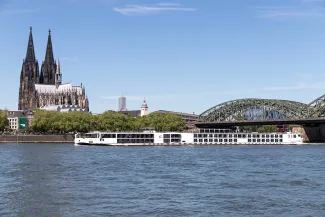
On the Rhine, the sailing itself can be the headline attraction. In the Middle Rhine Gorge, castles occupy the high ground while villages and vineyard slopes crowd the riverbanks. This is a stretch where you’ll want the daylight hours to line up with the cruising schedule.
A Basel–Amsterdam itinerary also makes a practical first river holiday. The usual mix includes Strasbourg, German wine towns, Cologne and Amsterdam, although not every itinerary visits all of them. Strasbourg is commonly reached from a nearby berth; Heidelberg is an excursion destination rather than a Rhine docking stop.
Viking’s eight-day Rhine Getaway and AmaWaterways’ seven-night Enchanting Rhine are useful starting comparisons, but their stops aren’t interchangeable. Ama’s published route includes Breisach, Strasbourg, Ludwigshafen for Heidelberg, Rüdesheim, Monheim and Utrecht before Amsterdam.
AmaStella’s published 2027 schedule includes March 14 and March 28 departures. Confirm current cabins and fares directly; don’t assume those sailings are wine-themed because another ship has a similarly dated wine departure. The applicable Ama fare description includes meals, specified drinks with meals, shore experiences and the Chef’s Table restaurant, while flights, transfers and optional land programs are separate.
Spring can mean cooler deck time; early summer offers longer evenings; September balances sightseeing with wine-country appeal. Christmas-market cruises trade some daylight for festive atmosphere. Dutch-waterway extensions are itinerary-specific additions, not a feature of every Rhine river cruise.
For an Amsterdam extension, Hotel De L’Europe Amsterdam is a lodging candidate, not a promise of accommodation beside your ship.
Seine river cruises: Paris, Monet and Normandy’s deeper stories
The Seine changes the mood. Castle spotting gives way to gardens, half-timbered streets and the emotional weight of Normandy’s wartime history. This is a river for travelers who want context as much as scenery.
Paris-based itineraries commonly serve Vernon for Giverny, Rouen and Normandy. The landing beaches are reached by road, not by cruising past them. Honfleur arrangements vary, and Le Havre isn’t a call you should assume appears on every departure.
Uniworld’s eight-day Paris & Normandy is a round-trip Paris program. Its published shore programming includes a full-day Normandy-beaches excursion with choices focused on different Allied sectors. That specificity matters if you have a family connection or a particular historical interest.
Compare it with Avalon’s Seine programs by looking at the actual excursion menu: which garden visits, historical tours and more active options appear on your date, and which carry supplements? Brand descriptions alone won’t tell you how much time you’ll spend on a coach.
Also examine the Paris schedule. Embarking in Paris doesn’t necessarily mean several unhurried days exploring it. A Normandy excursion can be a substantial day on the road; check duration, walking surfaces and opportunities to rest.
Spring and early autumn are appealing starting points, but match a garden-focused trip to Giverny’s official opening calendar. Combined Seine–Rhône holidays require an overland connection and usually a ship change; they aren’t one continuous Paris–Arles sailing.
For extra time in Paris, consider Hôtel d’Orsay. Check transfer time to the assigned berth separately.
Douro river cruises: Choose the vineyards, then choose the month
The Douro’s terraces provide the visual argument: rows of vines climbing steep valley sides, with the river threading below. Choose this route because you want a wine-country holiday, not because you’re trying to collect European capitals.
Typical Porto-based itineraries travel through Régua and Pinhão toward Barca d’Alva or Vega de Terrón. Salamanca, when included, is reached overland. That distinction is worth remembering before imagining a leisurely stroll from the gangway into the Spanish city.
Emerald, Scenic and CroisiEurope belong on the comparison list, but judge specific packages rather than brochure adjectives. On an Emerald departure, check the division between included excursions and optional activities. On Scenic, establish exactly which additional drinks, dining and shore experiences the quoted fare covers. With CroisiEurope, examine the excursion package, cabin category and onboard language arrangements for your sailing.
Across all three, ask how much time is spent tasting, touring estates or traveling by coach. “Wine country” can describe several quite different daily schedules.
Spring offers greener landscapes. September and early October bring harvest-season appeal, although harvest timing varies and participation isn’t guaranteed. Summer can be hot, especially during inland excursions. November is late season, not the main harvest window.
Winter and early-spring departures deserve an additional question about navigation locks. Check the official maintenance schedule and ask how the operator will deliver your particular itinerary during any closure; don’t assume one closure cancels every Douro holiday.
For a wine-focused extension, consider The Yeatman in Vila Nova de Gaia, with a transfer arranged to the correct river terminal.
Rhône river cruises: Lyon’s food scene meets Provence
If the Seine invites you into galleries and history, the Rhône encourages you to think about lunch. Lyon’s food culture leads naturally into Rhône wines, Roman sites and the markets of Provence. There’s plenty to see; choosing what to eat may take just as much concentration.
Rhône/Saône itineraries can serve Lyon, Vienne, Tournon, Viviers, Avignon and Arles. Some extend north toward Mâcon or Chalon-sur-Saône. Don’t assume every itinerary includes every stop, particularly when comparing a one-way Provence cruise with a longer Burgundy program.
Uniworld’s Burgundy & Provence aboard S.S. Catherine is an eight-day program, with an April 11, 2027 departure advertised from Arles to Lyon. Compare it with Avalon’s Rhône/Saône offerings through the daily schedule rather than a headline France fare, especially if the Avalon option includes another river or land extension.
The useful question is what happens beyond the included city walk. Is the winery visit included? Does the cooking experience cost extra? How long is the countryside transfer? Food-and-wine enthusiasts can get real value from specialist programming, but only if it’s something they actually want to do.
April and May are sensible sightseeing choices. September and October appeal to food-and-wine travelers, while July and August require more tolerance for heat. Wind and water conditions can alter operations. Lavender and harvest experiences need a matching place and date, not merely the word “Provence.”
For time in Lyon, consider InterContinental Lyon – Hotel Dieu as an optional pre-cruise stay; confirm your embarkation point before planning transfers.
The best season depends on what you’d regret missing
Instead of asking for the best month, ask what would disappoint you most. Missing Giverny? Spending the Rhine Gorge passage indoors because it’s cold? Arriving in wine country after the harvest activity you hoped to see?
- Spring: A good starting point for gardens, greener landscapes and walking-focused trips. Expect changeable weather and check seasonal opening dates.
- Summer: Long daylight helps with scenic sailing and evenings ashore. Heat and crowds are the trade-offs, particularly in Portugal and southern France.
- September–October: Worth considering for vineyards and food-focused itineraries. Harvest dates vary, daylight shortens, and these months aren’t automatically bargains.
- Late November–December: Selected Danube and Rhine itineraries emphasize festive markets. Match the sailing to local calendars rather than assuming every port’s stalls will be open.
For price, compare equivalent cabins on equivalent itineraries. A shoulder-season departure can cost more than a summer one if demand, promotions or remaining cabin categories differ.
Weather also affects navigation. Low water can restrict the draft available to ships. High water can create current and bridge-clearance problems. Lock maintenance adds another constraint. No river or month is disruption-proof.
Possible responses include altered berths, coach substitutions, ship swaps and revised sightseeing schedules. Ask how those changes would affect the experience you care about most. If the sailing through a particular landscape is the whole reason you’re going, a coach replacement isn’t an equivalent holiday, even if it reaches the same towns.
Choose the line by the holiday’s total cost, not the brochure adjective
Once you’ve narrowed the choice to two departures on the same river, the comparison becomes much more useful. Viking and AmaWaterways are sensible starting points for the Danube and Rhine; Avalon and Uniworld for France; Emerald, Scenic and CroisiEurope for the Douro. They’re examples, not an exhaustive ranking.
Request an itemized quote for the applicable 2027 fare, then work through this checklist:
- Excursions: Which specific outings are included, which require reservations, and which cost extra?
- Drinks and gratuities: Are drinks included only with meals? What tipping remains payable, including guides and drivers?
- Transfers and flights: Do transfers require operator-booked air, particular arrival times or travel on embarkation day?
- Wi-Fi: Is it included, and are there any usage limitations? Inclusion doesn’t guarantee uninterrupted reception.
- Cabin: Compare the same category, deck and window configuration, including any obstruction.
- Payment and cancellation: Check final-payment deadlines, cancellation penalties and the actual terms behind a small deposit.
A higher fare can produce a lower total spend if it includes excursions, drinks and tips you’d otherwise buy. Conversely, a cheaper sailing may suit someone who doesn’t want premium drinks or several optional activities. Paying for inclusions you won’t use isn’t a victory.
Solo travelers should request the total cabin price, not mentally double or halve a brochure number. Families need the operator’s minimum age and the particular sailing’s suitability. An eligible child and a happily occupied child aren’t necessarily the same thing.
For mobility needs, separate ship accessibility from holiday accessibility. Ask about accessible cabins, elevator coverage, gangway gradients, steps between rafted ships, cobblestones and coach boarding. Request walking distances and standing time for essential excursions.
A balcony also deserves scrutiny. A French balcony opens the room to the view but isn’t a place to sit outside. Adjacent ships can block views in port. Consider how much time you’ll actually spend in the cabin.
Recent reviews of the same ship and route can reveal questions worth asking, such as recurring coach journeys or inconvenient berths; they don’t establish universal service quality. An adviser can help price those compromises, but ask for specifics rather than reassurance.
Finally, get the operator’s disruption remedies in writing. Insurance coverage depends on the policy. Arriving before embarkation can reduce flight-delay stress, but budget for the hotel, meals and transfers, too.
Pick the river first. Let the deal come second.
Return to those opening images. Choose the Danube for capital-city culture; the Rhine for castles and varied scenery; the Seine for art and Normandy; the Douro for vineyard landscapes; and the Rhône/Saône for food, wine and Provence.
Then shortlist two travel windows and compare equivalent departures. Read the daily schedule, calculate the full fare and examine the disruption terms before paying a deposit. It’s less exciting than a flashing promotional banner, admittedly, but considerably more useful.
A dated inventory snapshot helps establish the choices; it can’t guarantee the lowest market-wide fare or unchanged availability. The right European river cruise isn’t necessarily the cheapest, the most inclusive or the one visiting the most countries. It’s the one whose days ashore and hours on the river resemble the holiday you were imagining in the first place.
About the Author

Bob Vidra
Bob Vidra is News Editor at Jetsetter Guide, covering airlines, airports and the travel industry since 2023.