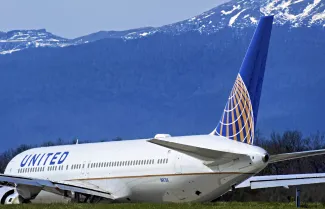
Stay current with our travel advisories coverage.
The Incident: An Extraordinary Midair Emergency
On the morning of October 16, 2025, United Airlines Flight UA1093 departed Denver International Airport bound for Los Angeles International Airport carrying 134 passengers and 6 crew members aboard a Boeing 737 MAX 8. What began as a routine flight quickly became an extraordinary aviation incident that would capture international attention and raise questions about the growing risks posed by objects in Earth's orbit.
At approximately 9:47 AM Mountain Time, while cruising at 36,000 feet over Utah, the aircraft experienced a sudden and violent impact to the cockpit windshield. The flight crew immediately reported the emergency to air traffic control, describing what appeared to be a strike from an unidentified object—later suspected to be space debris. The impact was forceful enough to crack the outer layer of the reinforced cockpit window and send fragments into the flight deck, causing minor injuries to the first officer.
Captain Jennifer Martinez, a veteran pilot with over 15,000 flight hours, quickly assessed the situation and initiated emergency protocols. Despite reduced visibility through the damaged windshield and concerns about structural integrity, the crew maintained complete control of the aircraft throughout the incident.
Timeline of Events
| Time (MT) | Event |
|---|---|
| 8:32 AM | Flight UA1093 departs Denver International Airport (DEN) for Los Angeles (LAX) |
| 9:15 AM | Aircraft reaches cruising altitude of 36,000 feet over western Colorado |
| 9:47 AM | Cockpit windshield struck by suspected space debris; first officer sustains minor injuries |
| 9:48 AM | Captain declares emergency and requests immediate diversion to Salt Lake City International Airport |
| 9:49 AM | ATC clears flight for priority descent and directs all other traffic away from the area |
| 10:23 AM | Flight UA1093 lands safely at Salt Lake City International Airport (SLC) |
| 10:35 AM | Emergency medical services evaluate first officer; passengers deplane normally |
| 4:40 PM | Replacement aircraft departs SLC for LAX with all original passengers |
The Astronomical Improbability: Understanding the Odds
To fully appreciate the extraordinary nature of this incident, it's essential to understand just how rare such events truly are. According to aviation safety databases and aerospace research, commercial aircraft being struck by space debris or meteoroids represents one of the most improbable scenarios in modern aviation.
"The statistical likelihood of a commercial airliner being struck by a meteor is approximately one in a million years of flight operations," explains Dr. Sarah Chen, a planetary geologist at the Lunar and Planetary Institute. "Space debris strikes are even rarer because most orbital debris burns up during atmospheric reentry well above commercial flight altitudes."
Research published in the journal Meteoritics & Planetary Science indicates that while approximately 17,000 meteoroids enter Earth's atmosphere each year at velocities exceeding 25,000 mph, the vast majority disintegrate between 50 and 80 miles above the surface—far above the 36,000-foot altitude where commercial aircraft cruise (approximately 6.8 miles).
The Federal Aviation Administration tracks all reported incidents of aircraft strikes by foreign objects, and their comprehensive database reveals telling statistics:
- Between 1990 and 2025, only 3 confirmed cases of suspected meteoroid strikes on commercial aircraft have been documented
- No confirmed space debris strikes on commercial aircraft have ever been conclusively proven prior to this incident
- Bird strikes occur approximately 16,000 times per year in the United States alone—making them literally millions of times more common
- Lightning strikes affect commercial aircraft roughly 1,000 times annually per aircraft, with modern jets designed to safely dissipate the electrical charge
Reddit's aviation and space communities erupted with discussion following news of the incident. User u/AeroEngineer_47, claiming credentials as a commercial pilot, posted: "In my 23-year career flying everything from regional jets to wide-bodies, I've never even heard of something like this happening to anyone I know. This is truly a one-in-a-billion flight scenario. Goes to show that pilots train for literally everything, no matter how statistically impossible."
Aviation physics enthusiast u/OrbitMechanics explained: "People need to understand—space debris in low Earth orbit travels at 17,500+ mph. At commercial cruising altitude, atmospheric density is already significant enough that anything coming from orbit would ablate (burn up) from friction. For something to impact an aircraft at 36,000 feet, it would need to be either: a) extremely dense material that survived reentry, b) a slow-moving meteoroid entering at a shallow angle, or c) something already in the atmosphere traveling at lower velocity. The investigation will be fascinating."
Aviation Safety Protocols: Designed for the Unthinkable
While space debris strikes are extraordinarily rare, commercial aviation has robust protocols for handling cockpit windshield damage from any source—whether bird strikes, hail, or unidentified foreign objects.
Windshield Engineering and Redundancy
Modern commercial aircraft cockpit windows are marvels of engineering, consisting of multiple layers of laminated glass and acrylic materials. Boeing 737 windshields typically feature:
- Three separate layers of material bonded together
- Outer ply designed to take the initial impact
- Middle structural layers providing main strength
- Inner ply maintaining pressurization if outer layers fail
- Electrical heating elements to prevent ice formation
Reddit user u/GlassTech_Consultant, identifying as a specialized aviation materials engineer, contributed: "Cockpit windshields are tested to withstand four times the maximum differential pressure expected in service. They're struck by 4-pound frozen birds at cruising speed during certification testing. The fact that this windshield maintained integrity after what was potentially a hypersonic impact is a testament to the engineering. The outer layer cracked but the pressure vessel remained intact—exactly as designed."
Emergency Response Procedures
When Flight UA1093's crew experienced the impact, they followed established protocols for windshield damage:
- Immediate Assessment: Evaluate structural integrity, visibility, and crew injuries
- Declare Emergency: Alert ATC to prioritize the flight and clear airspace
- Identify Diversion Airport: Select nearest suitable airport with appropriate emergency services
- Controlled Descent: Reduce altitude in a controlled manner to reduce stress on damaged windshield
- Passenger Communication: Inform cabin crew and passengers without creating panic
- Landing Preparation: Brief emergency services to have medical personnel and inspection teams ready
According to preliminary reports, Captain Martinez executed each step flawlessly, resulting in a landing that passengers described as "surprisingly smooth given the circumstances."
Reddit Reacts: From Skepticism to Admiration
The incident sparked intense discussion across multiple Reddit communities, with aviation professionals, space enthusiasts, and concerned travelers weighing in.
u/PilotPete_DEN posted in r/flying: "My airline sent out a safety bulletin about this incident. The crew's response was textbook. This is why we drill emergency procedures until they're muscle memory. When the unthinkable happens at 36,000 feet, there's no time to flip through the manual. These pilots saved lives through training and professionalism."
From r/space, u/DebrisTracker noted: "Everyone's talking about the 'one in a million' odds, but with 40,000+ commercial flights per day globally, we're actually flying that million flights every 25 days. Statistically improbable doesn't mean impossible. As we add more satellites and generate more orbital debris, these probabilities may shift. The space community needs to take this seriously."
Several commenters expressed surprise at how well modern aircraft handle damage. u/NervousFlyer123 shared: "I'm terrified of flying but reading about how these windshields are built and how they WORKED EXACTLY AS DESIGNED even when hit by something from space... honestly that makes me feel safer. Engineers really do think of everything."
Investigation Underway: What Happens Next?
The damaged Boeing 737 MAX 8 remains grounded at Salt Lake City International Airport, where teams from the National Transportation Safety Board (NTSB), Federal Aviation Administration (FAA), Boeing, and United Airlines are conducting a meticulous investigation.
Investigators are focusing on several key questions:
- What exactly struck the aircraft? Analysis of windshield damage patterns and any recovered material may reveal whether the object was a meteoroid, space debris, or something else
- Can the object's trajectory be reconstructed? Timing, location, and impact angle could help identify the source
- Were there any other aircraft in the area? If multiple aircraft were nearby, investigators can determine if they experienced or observed anything unusual
- What can be learned for future safety? Even extremely rare incidents provide opportunities to improve procedures and design
The damaged windshield has been carefully removed and will undergo forensic analysis at specialized laboratories. Any microscopic fragments embedded in the glass could provide crucial clues about the composition and origin of the impacting object.
The Bigger Picture: Aviation Safety in an Increasingly Crowded Orbital Environment
While this incident appears to be an extraordinary statistical anomaly, it arrives at a time of growing concern about Earth's orbital debris environment. The European Space Agency estimates that over 36,500 pieces of space debris larger than 10 cm are currently in orbit, with millions of smaller fragments also circling the planet.
Most orbital debris poses no threat to aviation because it travels in stable orbits well above the atmosphere. However, when satellites are decommissioned or collide, debris can be knocked into lower orbits where it gradually descends through the atmosphere. While the vast majority burns up completely at high altitudes, very occasionally, dense fragments can survive to lower altitudes.
The commercial aviation industry has never before had to seriously consider space debris as a risk factor in flight operations. This incident may prompt new discussions about:
- Enhanced tracking of deorbiting debris with predicted reentry zones
- Potential flight path modifications during known reentry events
- Further strengthening of cockpit windshield specifications
- Development of detection systems for hypersonic objects near flight paths
What This Means for Travelers: Tips and Perspective
For nervous flyers, this incident might seem alarming, but it actually demonstrates the robustness of modern aviation safety. Consider these reassuring facts:
- Redundancy is Everywhere: Aircraft systems are designed with multiple backup layers specifically for rare catastrophic scenarios
- Training Works: Pilots undergo rigorous training for situations they may never encounter in decades of flying—and that training produces results when needed
- Statistical Safety: You're literally millions of times more likely to be in a car accident on the way to the airport than to experience a space debris strike during your flight
- Modern Materials: Today's aircraft are built with advanced materials tested to extremes that go far beyond normal operating conditions
- Continuous Improvement: Every incident, no matter how rare, leads to analysis and improvements that make flying even safer
Practical Travel Tips in Light of This Incident:
- Always follow crew instructions immediately during any emergency—they're trained professionals
- Keep your seatbelt fastened when seated, even when the sign is off—unexpected events can occur
- Pay attention to the safety briefing; emergency procedures are designed to save lives
- Stay calm during diversions; they're precautionary measures prioritizing your safety
- Trust the technology and training that make commercial aviation the safest form of long-distance travel
Conclusion: A Testament to Aviation Safety
United Flight UA1093's emergency diversion to Salt Lake City will likely be studied in aviation safety courses for years to come—not as a cautionary tale, but as a textbook example of how properly designed systems and well-trained crews can handle even the most improbable scenarios.
While the investigation continues and questions remain about exactly what struck the aircraft, the outcome speaks volumes: despite an impact from an object potentially traveling at thousands of miles per hour, the aircraft's windshield held, the crew maintained control, and all passengers completed their journey safely.
As we enter an era of increased satellite launches and a more crowded orbital environment, this incident serves as both a reminder and a reassurance. It reminds us that new challenges can emerge from unexpected sources, but it reassures us that the aviation industry's culture of safety, redundancy, and continuous improvement remains more than equal to those challenges.
For the 134 passengers aboard that flight, October 16, 2025, will be an unforgettable date—the day they were part of an aviation anomaly so rare it may not occur again for decades or longer. But thanks to engineering excellence and professional flight crews, it's a story they can share from the safety of the ground, rather than a tragedy that could have been.
As one Reddit user aptly summarized: "Millions of flights happen every year without incident. This one-in-a-million event happened, and everyone walked away. That's not a failure of aviation safety—that's the ultimate proof that it works."
United Airlines has commended the flight crew's professional handling of the emergency and confirmed that the first officer has been released from medical care with no serious injuries. The airline continues to cooperate fully with investigators and has stated that passenger safety remains their highest priority.
More travel news
United investigates in-flight sexual misconduct allegation
The passenger said she reported the alleged misconduct before a crew on the Republic Airways-operated flight required her to sit beside the man again for landing.
United Schedules A321XLR Flights to Amsterdam and Dublin
Starting Dec. 1, United is scheduled to use A321XLRs daily from Washington Dulles to Amsterdam and Dublin, with 20 Polaris suites and 12 Premium Plus seats.

United Adds Live Football to 200-Plus Starlink Planes
Passengers on United domestic flights operated by more than 200 planes with Starlink-enabled seatback screens can watch live pro and college football through Super Bowl LXI.
O’Hare Led U.S. Airports With 43 Delays Wednesday
Wednesday’s figures put O’Hare first among U.S. airports for delays and United first among U.S. carriers; they are not a live flight-status report.
About the Author

Bob Vidra
Bob Vidra is News Editor at Jetsetter Guide, covering airlines, airports and the travel industry since 2023.