
Stay current with our hotel news coverage.
Constitutional Clash Over Who Controls Tourism
The Supreme Court sided with the regions. "The Court has declared null and void the single registration system for short-term rentals created by the central Government, a decision that directly affects holiday home owners operating through platforms such as Airbnb or Booking," according to Reuters. The legal reasoning hinged on Spain's division of powers. "The Supreme Court's central argument is one of competence: the exhaustive regulation of a national register that overlaps with existing regional registers exceeds the powers attributed to the State by the Spanish Constitution," a legal analysis by TempleCAMBRIA explained. In other words, the central government tried to impose a top-down registry in areas where autonomous communities already held exclusive regulatory authority. The court struck down the mandatory national registration process and the requirement to obtain a state-issued NRUA code from the Land Registry. However, it preserved the government's ability to operate a Single Digital Window, a technical platform for collecting and exchanging data in compliance with EU Regulation 2024/1028 and other European transparency rules. Practical control over tourist rentals now remains firmly with regional and local authorities, and existing regional licensing systems continue to apply.What Happens to Hundreds of Thousands of Listings
The annulled registry had substantial reach. More than 400,000 applications were submitted after the system launched last July. Roughly 20 to 22 percent were reportedly rejected, leading to the removal of over 100,000 non-compliant listings from platforms, according to secondary coverage. Those rejections and delistings are now tied to a legal framework the court has voided. For hosts who obtained a NRUA number, the situation is murky. The registry itself is gone, but that doesn't erase regional or municipal obligations. Cities and regions across Spain, Barcelona, Valencia, the Balearic and Canary Islands, maintain their own licensing, inspection, and registration requirements. In many cases, those rules are stricter than the national framework ever was. Hosts who thought they were compliant under the state system may find they still need regional permits, municipal licenses, or community board approvals. Platforms, meanwhile, are caught between the ruling and ongoing EU obligations. While they can no longer demand a state NRUA number, they must still provide detailed data on listings to authorities via the EU-mandated digital gateway. "The Supreme Court agreed, ruling the state lacked authority to impose a national registry on top of similar ones that already existed at the regional level," Reuters summarized. But that doesn't exempt platforms from data-sharing; it just shifts the coordination burden back to a patchwork of 17 regional systems.Where the Power Struggle Leaves Travelers
For anyone booking a short-term rental in Spain, this ruling doesn't simplify the landscape. If anything, it makes it more fragmented. Without a national registry, travelers have no single system to verify whether a property is legally registered or compliant. Regional rules vary widely: Barcelona has effectively banned new tourist apartments and is phasing out thousands of existing licenses by 2028; Madrid allows short-term rentals in most neighborhoods with minimal restrictions; Valencia and the Balearics have tightened rules in response to housing shortages and overtourism. The court's decision reinforces that local context matters. A legally compliant apartment in Seville may not meet the requirements in San Sebastián. Travelers booking last-minute city breaks or extended stays should verify not just that a listing exists on a platform, but that the host has the proper regional or municipal license. Check the listing description for license numbers, ask hosts directly, and cross-reference local tourism office databases where available. From a value perspective, this ruling is unlikely to flood the market with new inventory or drive down prices in the near term. Regional governments that have capped licenses or zoned out tourist rentals aren't going to reverse course just because Madrid's registry is gone. In fact, some cities may see this as a green light to tighten enforcement further. Barcelona, the Canaries, and the Balearics have all treated short-term rentals as a housing and overtourism issue, not just a regulatory one. Expect continued pressure on supply in high-demand areas, which keeps rates elevated and competition fierce.The Loyalty Play and Boutique Hotels
For travelers chasing luxury on a budget, the ruling may inadvertently strengthen the case for boutique hotels and aparthotels over peer-to-peer rentals. As regional crackdowns continue and compliance becomes more opaque, professionally managed properties with clear permits and consistent service start to look more reliable. Many Spanish cities have seen a surge in design-forward aparthotels and small guesthouses that blend the space and autonomy of a rental with the accountability of a licensed hotel. These properties often participate in loyalty programs or offer direct-booking perks, and they sidestep the legal uncertainty now hanging over many Airbnb listings. Spain remains one of Europe's most accessible destinations for city breaks, rail travel, and cultural deep dives. Tourism accounts for roughly 12.8 percent of the country's GDP and about 12 to 13 percent of employment. With some 85 million international arrivals in 2023, the market for short-term accommodation is enormous and won't disappear because of a court ruling. But the regulatory landscape is shifting from centralized to hyperlocal, and travelers should adjust their booking strategies accordingly. Verify licenses, book cancellable rates when possible, and don't assume that a listing's presence on a major platform guarantees compliance. The national safety net is gone; regional rules are all that matter now.More travel news
43% of surveyed travelers want to avoid overcrowded destinations
Of 32,500 global respondents, 43% want to avoid overcrowded destinations; Intrepid Travel separately named 10 less-visited places ready for tourism in 2027.
Italy and Spain Extend Reciprocal Border Checks
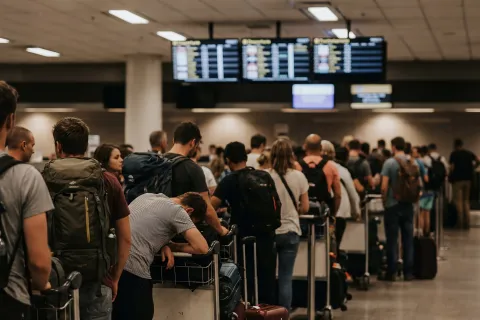
Passengers arriving in Italy from Spain may face random airport and seaport checks for 15 more days, while those entering Spain from Italy face checks through Oct. 8.

AI Hotel Mirage Masks Poorly Rated Vegas Stay
Las Vegas, United States - A Booking.com listing for Palette Las Vegas allegedly used altered images to direct guests to OYO Hotel and Casino Las Vegas.

Spain Warns Eclipse Chasers as Wildfire Danger Soars
MADRID, Spain - Authorities urge travelers heading to see Wednesday's total solar eclipse to avoid sparking wildfires as nearly half a million visitors converge on dry, fire-prone regions already scorched by a record season.

About the Author

James Anthony
James Anthony is a Travel Writer at Jetsetter Guide covering European city breaks and luxury travel on a budget.