Stay current with our airline news coverage.
The bomb threats have proved false; the disruption for passengers hasn’t. At least 35 flights across Europe were disrupted during the week covered by The Guardian’s Thursday report, with aircraft diverted, searched or escorted by fighter jets. Security authorities had found nothing suspicious in those incidents.
Fresh alerts followed Friday. According to CNN, police reported new threats involving air traffic at Copenhagen and Prague airports, while Hungary’s defense minister said fighter jets escorted three aircraft reporting threats in Hungarian airspace. A KLM flight from Prague to Amsterdam was searched after landing; Dutch authorities said no explosives were found.
For travelers, the week has produced very different outcomes: some aircraft reached their scheduled airports, others landed elsewhere, and some passengers continued on replacement planes. The reassuring search results haven’t eliminated the need for security checks.
Where Europe’s flight disruptions have hit
The Guardian’s account begins Monday, when a Wizz Air flight from London Luton to Sofia diverted to Budapest. By Thursday, threats had affected airports in London, Birmingham, Brussels, Bucharest, Madrid, Milan, Prague, Rome, Sofia and Warsaw, among others.
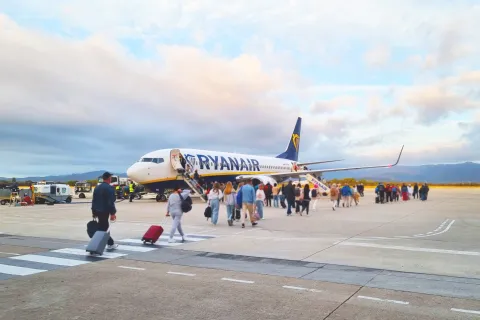
There was no clear pattern of airlines or airports being targeted, The Guardian reported, although a significant number of incidents involved Italian airports as an origin or destination. Sofia and Milan each recorded six incidents, Rome recorded five and Prague four. Ryanair had eight reported cases, the highest airline count in that report.
The Guardian also counted seven affected flights to or from the United Kingdom and four to or from Ireland. Those figures describe the incidents reported during the week, not a list of routes suspended or airports closed.
Rome-bound flights faced very different journeys
Two flights heading to Rome on Thursday illustrate how differently an alert can play out. Finnair’s Helsinki service reached its destination under military escort, while an Aer Lingus flight from Dublin diverted to the Evreux military air base in Normandy, according to The Associated Press.
The Finnair aircraft was first intercepted by a Croatian fighter jet in Croatian airspace before Italian jets took over, AP reported, citing the Croatian defense ministry and Italian air force. Finnair said the flight landed safely, passengers disembarked and nothing suspicious was found. Following inspection, the aircraft was to depart for Helsinki.
Finnair also reported a threat against its Helsinki-to-Vienna service, operated by Jettime. That aircraft landed safely at its intended destination and was expected to return to service after inspection, according to AP.
For the Aer Lingus passengers, the diversion meant landing in another country rather than reaching Rome. AP reported that no bomb was found on the aircraft, citing the regional prosecutor. The safe landing and negative search were welcome outcomes, but they weren’t the same thing as completing the booked journey.
Delays, replacement aircraft and onward transport
Other incidents show the practical consequences beyond the initial alert. According to CNN’s Thursday live coverage, a LOT Polish Airlines flight from Warsaw to Paris was taxiing when passengers were told it had been canceled for safety reasons. The journey eventually continued on a different aircraft. Passenger Matthew Bojarsky told CNN that travelers waited four hours in a hall.
In Bulgaria, two Ryanair flights from Madrid and Copenhagen landed safely at their intended destination, Sofia. Another Ryanair service from London diverted to Plovdiv, southeast of the capital, CNN reported. Bulgarian transport authorities said inspections identified no issues on the three aircraft.
Ryanair arranged transportation from Plovdiv to Sofia for the diverted passengers, according to CNN. Both airports were operating normally when the authorities provided that update. That distinction matters: an individual flight’s security response did not necessarily mean the entire airport had stopped operating.
Aegean Airlines, meanwhile, confirmed threats against its Thessaloniki-to-Milan and Athens-to-Vienna flights. AP reported that both aircraft subsequently departed Milan and Vienna after security procedures established that the threats were baseless.
How airlines decide whether to divert
Why can one aircraft continue while another diverts? The Guardian described an assessment process rather than an automatic, identical response to every warning. Joji Waites, director of flight safety at the British Airline Pilots’ Association, explained that airline assessors grade threats red for credible, amber for partly credible or green for not credible. Once an aircraft is airborne, only red or green classifications apply.
Waites told The Guardian that a threat involving an aircraft still on the ground will usually mean evacuation. In the air, the priority is landing as soon and as safely as possible. The newspaper noted that diversions are expensive and highly disruptive, but airlines have little choice when a threat has any credibility.
The Guardian also reported that Czech police considered the warnings involving four aircraft landing in Prague to have low relevance. Checks still took place; AP reported that searches of those aircraft found nothing suspicious.
A false alarm, in other words, is the result authorities establish after assessment and checks. It isn’t something passengers or airlines can simply assume at the outset.
What investigators know about the threats
Email has featured in several reported cases. The Guardian, citing Italian news agency Ansa, said an anonymous Italian-language message to Milan Malpensa claimed bombs were aboard flights from Thessaloniki and Porto. It included flight numbers, airline names and landing times. Threats involving Bulgaria, Italy, Poland and Spain were reportedly sent by email.
Responsibility remains unresolved. CNN reported that an email targeting Rome-bound flights purported to come from an anti-feminist group calling itself the Male State, but no European country had identified a group or state as responsible. EU transport commissioner Apostolos Tzitzikostas said Thursday that it was too early to determine whether the incidents were linked.
CNN’s Thursday coverage also reported that the EU activated its aviation-security information-sharing mechanism and was in contact with affected member states and the European Aviation Safety Agency.
The useful distinction for travelers is between a threat, a diversion and an airport shutdown. This week’s reporting documents different responses, including normal airport operations after inspections and onward transportation for diverted passengers. Searches have so far found no explosives, according to CNN’s follow-up report; the interruptions to individual journeys, however, have been real.
More travel news
Finnair Promotes UK and Ireland Links to Finnish Lapland
The planned schedule lists flights from Edinburgh, Dublin, Manchester and London Heathrow that feed onward Lapland connections via Helsinki.

Ryanair begins winter rollout with 45-plus new routes
The airline has announced at least 140 new winter 2026/27 routes, with launches staggered from Oct. 25 into December across the UK, Italy, Poland and Morocco.
UK Plans to End Family Seating Fees for Children Under 14
Parliament is considering rules for airlines operating in the UK that would seat children under 14 beside a parent or accompanying adult at no added cost and make simple booking name corrections free; paid seat selection would remain.

Ryanair Cuts German Winter Schedule, Will Close Berlin Base
Ryanair will remove 700,000 winter seats in Germany and close its Berlin base Oct. 24, halving capacity there but continuing flights to and from the capital.
About the Author

Bob Vidra
Bob Vidra is News Editor at Jetsetter Guide, covering airlines, airports and the travel industry since 2023.