Stay current with our airline news coverage.
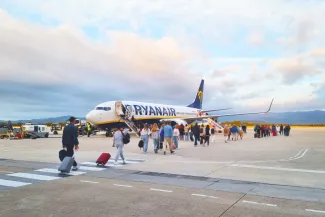
Ryanair isn’t leaving Berlin, but its winter schedule there is getting considerably smaller. The airline announced Oct. 8 that it will remove 700,000 seats from its German winter schedule, a 10% capacity reduction, and confirmed that its Berlin base will close Oct. 24, according to Business Travel News Europe.
The carrier blames high airport costs and Germany’s air traffic tax. For travelers, the immediate issue is less about the argument over charges than the flights left to book: Berlin will lose routes and frequencies, while Hamburg will also see a smaller Ryanair schedule.
Yet this isn’t a retreat from every German airport. Ryanair is expanding at Memmingen and Cologne, making the announcement a sharply uneven reshaping of its German network.
Berlin base closes Oct. 24, but flights continue
The Berlin closure was already in the works. Business Travel News Europe reported that Ryanair’s Oct. 8 announcement confirmed previously announced plans to shut its seven-aircraft base on Oct. 24. That distinction matters: the latest announcement brings the closure into the broader account of the airline’s German winter cuts, rather than introducing an entirely new Berlin decision.
According to Business Travel News Europe, the move will halve Ryanair’s capacity to and from the German capital. It will also result in the cancellation of 12 routes to destinations in France, Italy, Spain, Estonia and Lithuania. Frequencies on the remaining Berlin routes will be reduced, too.
Those are two different losses for passengers. Some routes will disappear from Ryanair’s Berlin network; routes that survive will have fewer flights. Keeping a destination on the map, in other words, doesn’t mean keeping the same range of departure choices.
A base closure can sound like a complete airport exit, but that isn’t what Ryanair has announced here. The carrier explicitly said it would continue flying to and from Berlin, Business Travel News Europe reported. The important distinction for anyone planning a trip is continued service with substantially less capacity, not the disappearance of Ryanair from the capital altogether.
Hamburg shrinks as Memmingen and Cologne grow
Hamburg faces a smaller reduction than Berlin. Business Travel News Europe reported that Ryanair’s capacity at Hamburg airport will fall 5%. The airline cited costs at both airports when explaining its decision to remove seats from Germany.
Elsewhere, the direction is reversed. According to the same report, Ryanair will expand capacity at Memmingen by 12% year over year and at Cologne by 10%. The airline said both airports are working to reduce their costs to increase connectivity.
The national 10% reduction therefore shouldn’t be read as a uniform cut across Ryanair’s German operations. Berlin bears a much steeper reduction, Hamburg loses some capacity, and the two growth airports gain it. For travelers, the airport-specific changes are more useful than the national headline alone.
That contrast also sits at the center of Ryanair’s argument: it says it is willing to expand where airport costs support growth, even as it cuts elsewhere. That is the carrier’s explanation for these decisions, rather than an independent assessment of the airports’ pricing.
Ryanair puts airport charges and taxes in the spotlight
Ryanair attributed the cuts to airport costs in Berlin and Hamburg and to Germany’s air traffic tax, according to Business Travel News Europe. Its criticism extended beyond those charges to security and air traffic control costs, which it said were pushing capacity, investment and jobs toward more competitive European markets.
“Germany is Europe’s largest air travel market with the worst recovery because the German government continues to ignore its air travel competitiveness crisis,” said Eddie Wilson, CEO at Ryanair, according to Business Travel News Europe.
The airline also said it has both the aircraft and the demand to grow in Germany. Its position is that operating costs are holding that growth back, not a lack of passengers or planes, Business Travel News Europe reported.
Ryanair called on the German federal government and Transport Minister Steffen Bilger to reduce air passenger duty and airport access costs. Those are policy demands from the airline; the reported schedule reductions are the concrete changes travelers face.
Wilson also warned that passengers would have less choice, weaker connectivity and higher fares, according to Business Travel News Europe. The fare warning deserves that attribution. It is Ryanair’s expectation, not a measured price increase established by the report.
For Berlin bookings, the route matters
The report does not identify the 12 canceled routes individually. That limits how precisely travelers can apply the announcement to an existing reservation or a planned trip; the country list alone doesn’t establish whether a particular flight is affected.
For anyone considering a Berlin booking, the useful next step is to check the specific route and available departures rather than assume either business as usual or a complete Ryanair withdrawal. Both readings would miss the announced changes.
And for routes that remain, the frequency cuts deserve attention alongside the cancellations. A destination can still be served while offering fewer departure choices. That’s the less dramatic part of this announcement, but for travelers trying to make a particular itinerary work, it can matter just as much.
More travel news
UK Plans to End Family Seating Fees for Children Under 14
Parliament is considering rules for airlines operating in the UK that would seat children under 14 beside a parent or accompanying adult at no added cost and make simple booking name corrections free; paid seat selection would remain.
Michelin Star Takes Flight in Discover Business Class
FRANKFURT, Germany - Discover Airlines is bringing Michelin-starred cooking to Business Class with a yearlong Egor Hopp menu from its Frankfurt and Munich hubs.
Rhine Hits Record Low as Cruises Grind to a Halt
KAUB, Germany - Record low water has effectively closed a critical Rhine passage, disrupting summer cruises and forcing travelers onto buses and replacement ships.

Ryanair Profits From Pain With Deliberate Discomfort
Dublin, Ireland - Europe's ultra-low-cost giant has turned cramped, rigid seating into a financial blueprint, becoming debt-free while making flying as uncomfortable as possible.
About the Author

Wilson Montgomery
Wilson Montgomery is a Travel Writer at Jetsetter Guide covering Africa and safari travel.