Stay current with our travel industry news coverage.
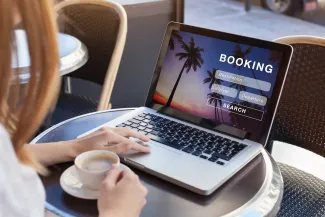
Holiday travel fraud is getting harder to dismiss as an obviously fake email. As fall break and the holiday travel season approach, a Sept. 30 report from Fox59 warns that scammers are expected to step up efforts to steal travelers’ money and personal information, with artificial intelligence making their pitches more convincing.
The warning covers reservation hijacking, fake flight cancellations, altered payment QR codes and lookalike public Wi-Fi networks. It describes an anticipated seasonal increase, not a measured surge in holiday fraud. The central concern is straightforward: a message can look legitimate, contain accurate travel details and still come from someone trying to collect your credit card information.
Fox59, citing Associated Press reporting on Federal Trade Commission figures, says Americans reported losing $3.5 billion last year to imposter scammers reaching victims through text, email, phone, social media and search engines. That is a broader imposter-fraud figure, not a total for travel scams or AI-enabled fraud.
Real hotel booking details can support a fake payment demand
Reservation hijacking attacks a weak point in how travelers judge whether a message is authentic: the sender knows about an actual booking.
According to Fox59’s account of the Associated Press warning, scammers may hack hotel systems and obtain real reservation information. They then contact the traveler, claim something is wrong with the reservation and say they need to run the credit card again over the phone.
The booking itself does not have to be fake. The fraud is in the follow-up contact and the request for payment information. That distinction matters for travelers who assume that successfully making a reservation ends the need to scrutinize messages about it.
Fox59 advises against giving credit card information over the phone to someone who initiated contact. Accurate reservation details should not override that boundary. In this scheme, those details are part of what makes the approach credible, not proof that the caller represents the hotel.
A separate report from CBS8 recommends that travelers who book through third-party websites contact the hotel directly to confirm the reservation appears in the property’s system. That checks whether the booking exists; it does not make every subsequent payment request legitimate.
A cancellation notice can be the start of the scam
Fox59 also describes fake flight-cancellation schemes in which a hacker contacts a traveler, says the flight has been canceled and offers to arrange a replacement for an additional cost.
The supposed service and the demand for money arrive together. The traveler is being asked to accept both the cancellation and the paid solution from the same unsolicited source. Treating that offer as routine rebooking would mean accepting the scammer’s premise before establishing whether the disruption is real.
Fox59 points to this scheme as a reason not to post photographs of plane tickets or other travel documents on social media. Its warning applies to what travelers share before departure, not just to messages they receive afterward.
AI makes fraudulent booking pitches look more credible
The AI element is not limited to a new kind of scam. It can improve the presentation of familiar ones. CBS8 reports that scammers use fake social media advertisements, phishing emails and text messages, with AI helping make the wording and appearance seem legitimate.
That reporting gives travelers a reason not to rely on awkward language as their main fraud filter. A polished message is still only a message; it does not establish who sent it or where a payment will go.
According to CBS8, a Locals Insider survey of more than 1,000 Americans found that 22% of respondents admitted clicking a travel advertisement or sponsored search result that later proved fraudulent. That figure describes exposure through a click, not the percentage who lost money.
AAA officials told CBS8 they were seeing a growing number of fraudulent travel websites mimicking legitimate booking services. AAA spokesperson Kandace Redd warned that fake sites can appear among sponsored results at the top of a search page. Scammers also make subtle changes to website addresses and use deeply discounted prices to draw people in, CBS8 reported.
Search placement, professional wording and a low price are not independent confirmation that a seller is genuine. CBS8’s reporting also flags high-pressure sales tactics that push travelers toward an immediate purchase without time to research it.
Payment risks continue after arrival
The Fox59 warning extends beyond booking. Public payment QR codes, including those used for meals or parking, can be covered with a scammer’s replacement code. The replacement directs the traveler to a copycat website designed to collect information.
The physical setting can make the transaction seem routine. But the risk described by Fox59 is the destination of the code, not whether QR payments are inherently fraudulent. A code displayed where payment is expected can still have been altered.
Public Wi-Fi presents a different impersonation problem. According to Fox59, cybercriminals can set up networks with names very similar to legitimate networks at airports or in downtown areas. Connecting to the imitation can put a traveler’s information or device at risk.
For purchases, CBS8 recommends paying by credit card whenever possible because card companies often provide fraud protection and may help recover lost funds. That is a potential recovery tool, not a guarantee. The stronger booking discipline is to separate a convincing presentation from verification: confirm third-party hotel reservations directly, do not hand card details to unsolicited callers, and do not let an urgent payment demand substitute for checking the claim.
More travel news
France Travel Advisory Stays at Level 2 After Update
Travelers to France remain under a Level 2 advisory and should avoid demonstrations and significant police activity because of unrest and terrorism risks.

Alexis 420 Guide Maps Cannabis Purchase Rules for Tourists
It says eligible out-of-state visitors 21 and older can buy recreational cannabis in 23 states, while qualifying medical patients have options in 10 states and Washington, D.C.
Iraq Travel Advisory Remains at Level 4 Do Not Travel
The Oct. 23 update did not change Iraq’s warning level: U.S. citizens are advised not to travel, while those there should prepare independent departure plans.

Booking.com Faces EU Probe Into Scams and Paid Listings
Proceedings opened Oct. 21 under the Digital Services Act examine fake listings, phishing safeguards and whether paid search boosts are clearly labeled as ads; no violation has been found.
About the Author

Jennifer Wilmington
Jennifer Wilmington is Family Travel Editor at Jetsetter Guide, covering family and luxury travel from her base in Charleston, South Carolina.