Stay current with our cruise news coverage.
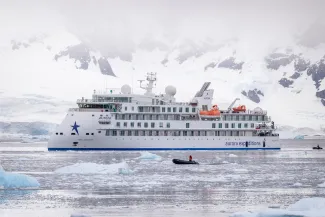
Aurora Expeditions has expanded its partnership with ocean technology company CounterCurrent after an Antarctic trial indicated that AI-powered ocean forecasting could reduce fuel consumption. Upgraded sensors are now deployed aboard Douglas Mawson, Sylvia Earle and Greg Mortimer, according to Breaking Travel News in its Oct. 28 report.
TravelPulse also reported the partnership expansion Oct. 28 under the Aurora Expeditions name, describing testing aboard the same ship, during the same period, and the same three-ship sensor deployment.
The development is a move from testing aboard Douglas Mawson to upgraded equipment across the fleet. It is not yet proof of sustained fuel savings on every Antarctic departure. Breaking Travel News explicitly describes the findings as preliminary, with further testing needed to validate longer-term performance.
What the Antarctic AI trial established
The trial ran between December 2025 and March 2026 across five Antarctic voyages. CounterCurrent worked with the bridge team aboard Douglas Mawson, generating 39 route recommendations and collecting more than 5,600 environmental observations over 126 days of operation, according to Breaking Travel News.
Those numbers describe the scale of the test, not a count of route changes actually made. The report identifies recommendations produced by the system; final routing decisions remained with the captains and bridge teams.
Breaking Travel News reports early sea-trial fuel savings of more than 2% to 5% over 24 hours. Separately, Cruise & Ferry reported Oct. 27 that AE achieved savings of 2% to 5% over a 24-hour operational period. Both accounts describe a limited operational window, not a verified reduction across an entire Antarctic season.
The larger potential savings belong in a different category. Cruise & Ferry reports preliminary modeling suggesting savings between 5% and 15% in suitable conditions, depending on vessel type, operating speed and route. That is modeled potential, not the measured outcome of the full trial. For travelers weighing environmental claims, keeping those two categories separate matters more than the largest percentage in the announcement.
How CounterCurrent uses ocean currents
The technology combines AI-driven forecasting, ship-mounted sensors and real-time ocean observations to identify more efficient routes through changing currents, according to Breaking Travel News. Observations gathered directly from vessels help refine forecasts and make recommendations more locally informed.
The operating principle is straightforward: identify favorable currents and recommend small route adjustments that avoid unfavorable conditions. The system aims to reduce fuel consumption without necessarily increasing journey times, Breaking Travel News reports. That qualification matters. The announcement describes an efficiency objective, not a guarantee that every recommended route will save fuel while preserving exactly the same schedule.
This is decision support for the bridge, not autonomous command. According to Breaking Travel News, crew feedback helped CounterCurrent refine the technology to account for sea ice, swell, passenger comfort and expedition schedules. Captains and bridge teams retain the final decision.
For expedition passengers, those operational constraints are important. Fuel efficiency is being evaluated alongside comfort and the expedition schedule, rather than described as the system’s only consideration. A favorable current is useful information, but the captain remains responsible for the route.
Hardware built for difficult operating conditions
The Antarctic test also exposed the equipment to demanding conditions. Sensors operated in temperatures as low as minus 30 degrees Celsius and winds reaching 120 kilometers per hour, according to Breaking Travel News.
“Working with AE Expeditions has given us access to an extraordinary real-world testing environment, helping us understand how our technology performs in extreme conditions and how it can support experienced maritime crews,” said Professor Shane Keating, founder at CounterCurrent, according to Breaking Travel News.
The upgraded Mark 3 Triton sensors incorporate lessons from Douglas Mawson’s trial. Breaking Travel News reports improved solar generation for high-latitude environments, eight times greater battery capacity, and expanded onboard processing and storage. Those changes are intended to support more reliable data collection in remote regions, including periods without sunlight or satellite connectivity.
These are practical equipment changes, not just a new forecasting label. The stated improvements address how the system gathers and retains observations when power generation and connectivity are constrained. TravelPulse likewise reports that upgraded sensors have been installed aboard all three purpose-built expedition ships.
Fleet-wide equipment, forecasting still in development
The sensor rollout is complete according to the reports, but the next forecasting capabilities remain under exploration. Breaking Travel News says the partnership will examine fleet-wide forecasting, allowing observations collected by one vessel to improve forecasts and route recommendations for other ships operating in the same region.
The companies are also developing onboard forecasting capabilities that could reduce reliance on cloud-based processing, according to Breaking Travel News. Expanded onboard processing hardware and fully developed onboard forecasting are distinct steps; the announcement describes progress on the former and continued development of the latter.
For travelers comparing Antarctic departures, the supported distinction is operational: this technology is now installed across the three named ships, rather than confined to the original test vessel.
The sensible reading is narrower than a sweeping sustainability claim. CounterCurrent has collected real Antarctic operating data, received bridge-team feedback and upgraded its equipment. The next test is whether those early fuel-efficiency indications hold over longer periods and different operating conditions. Until then, the strongest evidence is the trial itself and the concrete hardware rollout, not the upper end of a modeled savings range.
More travel news
Aurora Plans 27 Antarctic Voyages for 2026-27
The planned three-ship season includes nine- to 34-day itineraries and up to 130 travelers per polar departure; researchers are scheduled on 11 of 27 voyages.
Villa Vie Odyssey suspends world voyage in Cambodia
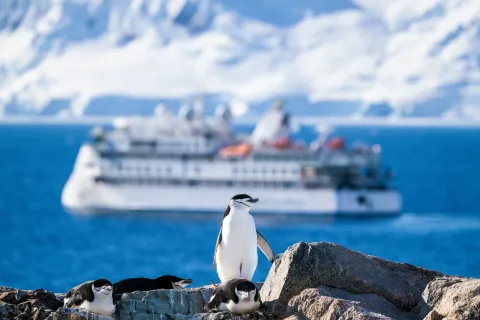
Villa Vie Odyssey residents were ordered ashore in Sihanoukville after rising fuel costs suspended the world voyage; the operator plans 60 days of restructuring, with no assured outcome.
Carnival Cruise Line Plans Dynamic Drink and Wi-Fi Pricing From Dec. 1, 2026
Carnival Cruise Line will use sailing length, itinerary and season to price individual beverage and Wi-Fi packages from Dec. 1, 2026; confirmed purchase prices will remain locked in.
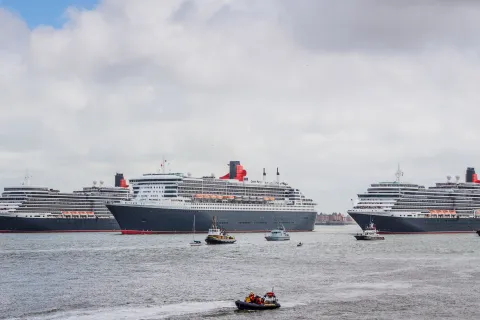
Cunard adds Liverpool boarding to Queen Mary 2’s 500th crossing
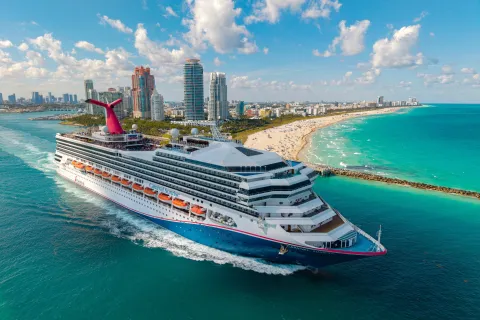
Cunard World Club members can book the 2028-29 program from Nov. 3, 2026; general sales open Nov. 4, including Liverpool boarding for the 500th crossing.
About the Author

Jeff Colhoun
Jeff Colhoun is a photographer and filmmaker whose work has appeared in The Wall Street Journal, the Los Angeles Times, Matador Network and Barron’s.