Stay current with our airline news coverage.
LAS VEGAS, United States - Putting a plane full of cybersecurity conference attendees on the same flight was always going to produce a few raised eyebrows. On Delta Air Lines Flight 591, it also produced an unauthorized Wi-Fi network and a federal investigation.
The Boeing 757 was traveling from Las Vegas to Atlanta after the DEF CON cybersecurity conference ended in Las Vegas, according to Bloomberg. Delta said the unauthorized network appeared onboard for a short time; the cabin crew responded by disabling the aircraft’s passenger Wi-Fi for about 30 minutes.
Crucially, Delta said the incident didn’t reach the airline’s systems or the aircraft’s operating systems. Air traffic control didn’t declare an emergency, and there was no reported diversion or injury.
“there was no hack of any Delta system,” said Morgan Durrant, spokesperson at Delta Air Lines, according to Bloomberg.
What Happened Aboard Delta Flight 591
Flight 591 departed Las Vegas at 8:30 a.m. Monday, 17 hours and 42 minutes late, according to Reuters. The flight reached Atlanta at 3:05 p.m. Eastern time.
About one hour after takeoff, the crew reported a suspicious network named “Delta WiFi Fast,” Reuters reported. The crew believed the network was intended to scam passengers. A follow-up ACARS message was sent 17 minutes after the initial report; the crew said passengers connected to a cybersecurity conference had been able to disrupt the onboard Wi-Fi and broadcast another signal.
That timing, just after DEF CON, is why this otherwise contained internet disruption attracted so much attention. The flight carried 199 passengers and six crew members, according to Bloomberg. A large gathering of security researchers had just wrapped up in Las Vegas, and now a network mimicking Delta’s Wi-Fi was appearing in the cabin. Subtle, it wasn’t.
Delta is working with federal law enforcement and aviation regulators while it investigates. The airline’s stated position remains that flight safety was never in question and no aircraft operating systems were affected.
Delta is “fully investigating to gather a complete set of facts,” said Morgan Durrant, spokesperson at Delta Air Lines, according to Bloomberg.
A Rogue Hotspot Is Not an Aircraft Systems Breach
The distinction matters. A fake hotspot that imitates a trusted network is commonly described as an “evil twin.” Such a network can be used to present a fake login page or attempt to capture credentials. Forged disconnection messages can also make a legitimate Wi-Fi network unusable.
None of that necessarily indicates access to the systems used to operate an aircraft. Based on Delta’s account, this incident remained confined to the passenger connectivity side of the flight. The airline shut that service down temporarily while the crew assessed what was happening.
Cybersecurity-focused coverage has treated the episode as possible Wi-Fi spoofing or jamming that could have been used to scam passengers. Travel-oriented coverage has emphasized the more reassuring side of the story: There was an onboard internet disruption, but no operational crisis, emergency declaration or reported injury.
There are also limits to what has been established. Reuters reported that unconfirmed online claims described the use of specialized Wi-Fi equipment, a cloned Delta network and a phishing page. Those specific claims weren’t independently confirmed. For now, the verified core is narrower: An unauthorized network appeared, the passenger Wi-Fi was disabled, and Delta says its systems weren’t hacked.
How Travelers Should Handle Suspicious In-Flight Wi-Fi
From a traveler’s perspective, the sensible response is refreshingly low-tech. If a network name looks unfamiliar, unexpectedly promises faster service or appears alongside the airline’s normal connection, don’t join it. Wait for instructions from the crew or confirm the correct network through the airline’s onboard materials.
I’d also avoid entering account credentials when an in-flight login page behaves differently than expected. Airplane Wi-Fi can be finicky on a perfectly ordinary day, so a failed connection isn’t proof that something malicious is happening. Still, a little skepticism is free, and at 30,000 feet you’re not exactly desperate for another place to type your password.
If the crew switches off Wi-Fi, let them do their job. In this case, the shutdown lasted about 30 minutes, according to Bloomberg. That’s inconvenient, especially on a cross-country flight, but it’s a measured response when the authenticity of a network is in doubt.
This Was a Security Scare, Not a Flight Safety Event
The most useful way to read this incident is to separate two ideas that tend to get mashed together in dramatic headlines: hacking passenger Wi-Fi and hacking an airplane aren’t the same thing.
Delta’s investigation still matters. A rogue network in a sealed cabin could expose passengers to privacy or credential risks, and airlines need clear procedures for identifying and shutting down suspicious signals. The involvement of federal law enforcement and aviation regulators suggests the episode won’t be brushed aside as a prank.
But there’s no verified reason here for travelers to rethink flying Delta, avoid the Boeing 757 or change a booking. There was no reported compromise of flight-critical systems, no diversion and no emergency declaration. The inconvenience was real; the evidence of danger to the aircraft was not.
For passengers, the lasting lesson is simple: Treat onboard Wi-Fi with the same caution you’d use at an airport, hotel or coffee shop. And if you’re flying out of Las Vegas immediately after one of the world’s best-known hacker conventions, maybe double-check that network name before tapping “connect.”
More travel news
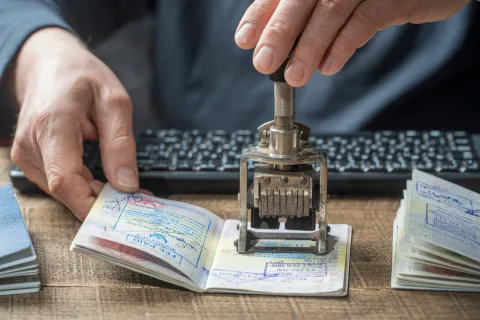
U.S. Customs and Border Protection to End Routine Passport Stamps
CBP announced routine passport stamping will end during primary inspection, with limited exceptions; foreign visitors can access admission and authorized-stay details through I-94 or CBP Link.
United Resumes Twice-Daily Newark–Tel Aviv Flights
United’s Newark–Tel Aviv route is operating twice daily, and Delta’s JFK service has returned; United plans Chicago and Washington flights from October.

United Flight Attendants Can Refuse ICE Questions
Washington, United States - United flight attendants were told they may remain silent when ICE asks about passengers or coworkers as airport arrests increase nationwide.
Airlines Put Elite Status on a Higher Price Tag
NEW YORK, United States - Delta, United and other major airlines are raising elite status hurdles, leaving frequent flyers on discounted fares with less credit.
About the Author

Bob Vidra
Bob Vidra is News Editor at Jetsetter Guide, covering airlines, airports and the travel industry since 2023.