Stay current with our airline news coverage.
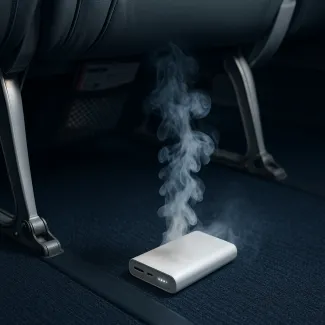
A wave of airlines worldwide is banning or restricting lithium-ion devices like power banks and smart luggage after a string of fires forced emergency evacuations. U.S. travelers may soon feel the impact.
Why Airlines Are Suddenly Nervous
Lithium-ion batteries are everywhere: in phones, tablets, laptops, e-cigarettes, and portable chargers. But regulators warn they can overheat and ignite in a process known as thermal runaway. The Federal Aviation Administration (FAA) recently reminded airlines that lithium battery fires are “extremely difficult to extinguish” and urged carriers to review their safety protocols.
Aviation safety experts point to several incidents:
In South Korea, an Air Busan Airbus A321 was destroyed after a power bank overheated in an overhead bin, forcing a full evacuation.
On a Batik Air flight bound for Bangkok, passengers panicked as thick white smoke filled the cabin from a smoldering spare battery pack.
Both incidents ended without injuries, but they rattled airlines.
Who’s Banning What
Asian Airlines – Carriers including Korean Air, Asiana, Thai Airways, EVA Air, and China Airlines now forbid power banks and e-cigarettes from being stored in overhead bins. Some, like AirAsia, ban in-flight use of power banks entirely. Thai Airways has told passengers power banks may no longer be used or charged on board.
Middle Eastern & European Airlines – Emirates will enforce a new rule starting October 1 limiting each passenger to one power bank under 100Wh, which cannot be placed in overhead storage. Lufthansa and Eurowings now ban passengers from plugging power banks into seat power ports; any power bank in use must remain visible and within reach.
U.S. Airlines – Most still allow power banks, but Southwest Airlines recently became the first major U.S. carrier to tighten rules. It now requires that any power bank in use be kept out of bags and in plain sight, with an explicit warning: do not charge devices in the overhead bin.
Smart Luggage – Airlines worldwide have enforced restrictions since 2018: smart suitcases with built-in batteries are only allowed if the battery can be removed. If the bag is checked at the gate, the battery must come out and travel with the passenger in the cabin.
Will the Restrictions Spread?
The FAA hasn’t mandated new rules yet, but after issuing a September safety bulletin, industry watchers expect more U.S. carriers to follow international peers. European safety regulators are also weighing stricter guidance.
An aviation risk consultant noted that airlines prefer “over-correction to catastrophe.” The bans are easier to enforce than relying on passengers to self-police risky charging practices.
What This Means for Travelers
For now, U.S. travelers will mostly feel the changes when flying foreign airlines or connecting abroad. A portable charger that’s fine on United or Delta may not be allowed on Thai Airways or Emirates. Travelers risk confiscation—or at minimum, being told to stop using devices mid-flight.
Smart luggage remains a common trip-spoiler: if the battery can’t be removed, expect the bag to be refused at check-in.
How to Stay Out of Trouble
Check your airline’s battery policy before departure. Rules differ widely by carrier.
Never pack spare batteries or power banks in checked luggage—that’s banned worldwide.
Keep batteries visible and never charge them in an overhead bin.
Bring high-quality, certified devices and avoid cheap knock-offs more prone to failure.
Ensure smart luggage batteries are removable before you travel.
The Bottom Line
Lithium-ion devices have made modern travel possible, but they also pose one of aviation’s most stubborn safety hazards. Airlines are moving fast to limit the risk, and U.S. passengers should be prepared for new restrictions to land stateside soon. A drained phone battery might be inconvenient—but it’s a small price to pay compared with a cabin fire at 38,000 feet.
More travel news
Lufthansa Bars Fitness Influencer Over Revealing Gym Wear
BERLIN, Germany - A Lufthansa gate agent told a 24-year-old passenger her sports bra and cycling shorts were too revealing to board, sparking debate over airline dress code enforcement and gender bias.

Donate Miles to Help Preserve US National Parks
FORT WORTH, Texas - American Airlines asks loyalty members to turn miles into conservation currency as the country approaches its 250th birthday, directing donations to national park preservation through its first official partnership with the National Park Foundation.

United Rewards Passenger 98K Miles for Flight Delay
BOSTON, Mass. - One traveler's six-figure mile haul at Boston Logan shows the hidden power of overbooking auctions for passengers who play their cards right.
Global Travel Crisis Strands Millions Across Continents
LONDON, United Kingdom - A convergence of severe flight disruptions, record heat across Europe, UK airport chaos, and tightening visa regulations created a sustained travel crisis through late June 2026, upending summer holiday plans.
About the Author

Bob Vidra
Bob Vidra, based in scenic Tahoe, is an esteemed tech editor known for his deep understanding of the dynamic intersection of technology, travel, and the outdoors.