Stay current with our airline news coverage.
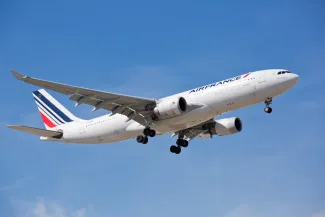
After more than two decades of service, Air France's Airbus A330-200 fleet is heading for retirement. According to data published by AeroRoutes and reported by Simple Flying, the French carrier plans to fully retire its A330-200 aircraft by the first quarter of 2027. The retirement won't happen overnight. Over the next year, Air France will gradually replace several A330 routes with Boeing 787-9 and Airbus A350-900 aircraft, according to Simple Flying. It's a fleet shuffle that'll affect everything from Caribbean beach runs to African business routes.
What's Replacing the A330-200s
The Boeing 787-9 and Airbus A350-900 aren't just newer; they're fundamentally different aircraft. The 787-9 seats 276 passengers compared to the A330-200's 224, a 23% capacity bump that matters when you're trying to make thin routes work financially. Fuel efficiency is about 20-25% better too, which adds up quickly on long-haul operations. The A350-900 brings even more capacity to the table, depending on configuration. Air France operates versions with anywhere from 292 to 324 seats, a 30-45% increase over the outgoing A330-200s. That's not just about cramming more people on planes; it's about serving growing markets without adding flights. The A330-200 currently operates with 224 seats split across three cabins: 167 in economy, 21 in premium economy, and 36 in business class. It's a decent setup, but the cabin itself feels dated compared to what you'll find on the 787 or A350.
Where You'll Notice the Change
Air France's A330-200s have spent recent years working routes to Africa and the Caribbean from Paris Charles de Gaulle. St. Maarten sees the most action, with up to 10 weekly flights. Douala gets six weekly services, while Lome, Luanda, and Pointe-Noire round out the regular rotation. According to Simple Flying, Air France has already started mixing in A350s and 787-9s on some of these routes. The Lome service, for instance, has reportedly seen more frequent A350 appearances since January. It's the kind of gradual transition that minimizes disruption; passengers might not even realize they're on a different aircraft type unless they're paying attention. The fleet currently includes six active A330-200s with an average age of 22.9 years. That's ancient in airline years, especially for widebody aircraft working international routes. Two more sit parked in Paris, and one's undergoing maintenance in Kuala Lumpur. The final scheduled flights are set for March 27, 2027.
The Financial Logic Behind the Move
This isn't purely about having shiny new planes. Older aircraft cost more to maintain, drink more fuel, and break down more often. Air France stands to save approximately EUR 100 million annually in fuel and maintenance costs once the A330-200s are gone. That's real money that can go toward other things, whether it's network expansion, premium cabin upgrades, or just improving the bottom line. The airline's broader fleet renewal plan runs through 2030 with a EUR 15 billion investment, and retiring the A330-200s is a key piece of that puzzle. Once the transition is complete, Air France's long-haul fleet will center around three aircraft families: Boeing 777s, Airbus A350-900s, and Boeing 787-9s. It's a simpler lineup that should make crew training, parts inventory, and maintenance scheduling more straightforward.
How This Changes Your Flight
If you're booked on one of these routes in 2026 or early 2027, there's a decent chance you'll end up on a 787 or A350 instead of an A330-200. That's generally good news. Both replacement aircraft feature larger windows, higher cabin humidity, and updated interiors. The 787's composite fuselage allows for higher cabin pressure too, which some passengers find reduces jet lag. The capacity increases open up interesting possibilities. Routes that were marginal on a 224-seat A330-200 might become profitable on a 276-seat 787-9. That could mean more frequencies down the line, or it could enable Air France to add new destinations that wouldn't have worked with smaller aircraft. Johannesburg is one example where capacity growth is already happening; the route went from seven weekly flights to ten thanks to the larger aircraft. St. Maarten's ten weekly services might stay at that level but with more seats available per flight, making award availability and last-minute bookings a bit easier. The flip side? If Air France chooses to maintain current seat counts but reduce frequencies, some departure times might disappear. The airline will likely optimize based on demand patterns, which means popular travel days could get bigger planes while shoulder days see frequency cuts. For frequent flyers, the A330-200's retirement simplifies things. You'll know what to expect on Air France long-haul: a modern widebody with updated amenities. No more wondering if you'll get stuck on the older plane with the tired seats and dim lighting. That consistency matters when you're planning trips or burning miles.
More travel news
Major Airlines Cancel 19 Heathrow Flights to US Europe
LONDON, United Kingdom - British Airways, Virgin Atlantic, KLM, and Air France cancelled 19 flights at Heathrow, stranding passengers headed to Chicago, New York, Amsterdam, and other major hubs.
Europe's 193 Million Face Deadly Heat Emergency
PARIS, France — A historic heatwave grips 193 million Europeans with record temperatures in Denmark and Germany as The Economist warns of catastrophic mortality rates.

Europe Grinds to Halt With Nearly 2000 Flights Delayed
BERLIN, Germany - Budget travelers face widespread disruptions as France, Norway, Switzerland delay 1,927 flights and cancel 70 more, hitting Eurowings, KLM, and Ryanair.
Three French Palace Hotels Stripped of Elite Status
PARIS, France - Park Hyatt Paris-Vendome, Mandarin Oriental Paris, and Hotel du Palais in Biarritz lost their elite Palace designation, the first withdrawals since the label began in 2010.

About the Author

Bob Vidra
Bob Vidra is News Editor at Jetsetter Guide, covering airlines, airports and the travel industry since 2023.