
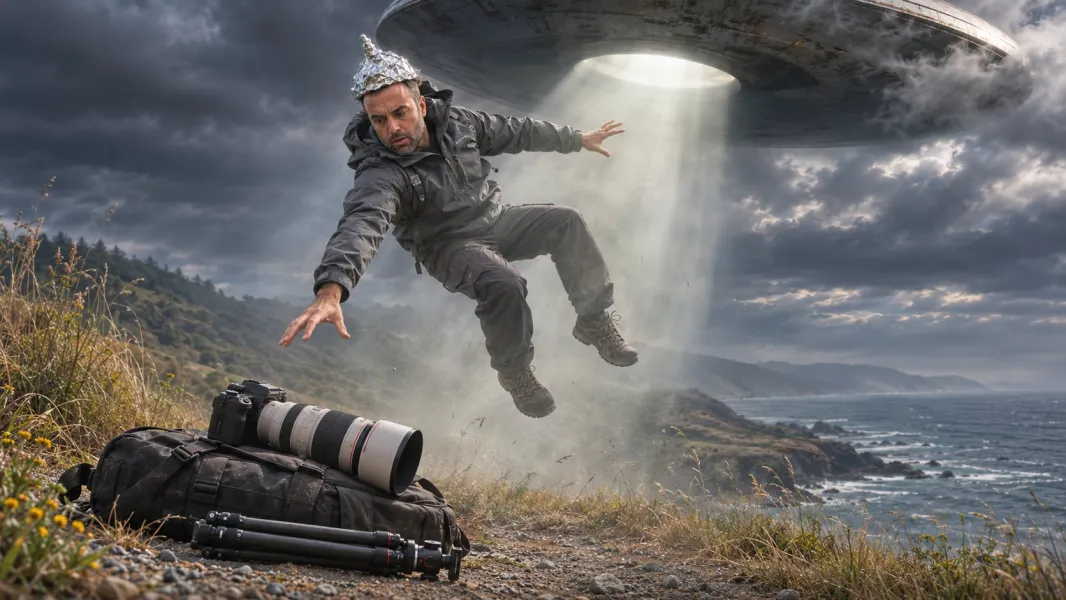
It’s 2026. UFOs are everywhere, at least according to the internet. You have 72 hours of food, bottled water, and enough emergency batteries to illuminate a small Costco. But when something inexplicable drifts over the neighborhood, are you ready to photograph it?
Because another shaking, overexposed dot accompanied by “bro, bro, BRO” is doing humanity no favors.
Here’s the kit we’d assemble for clearer UFO photos, with a few comforts in case your evening outside becomes an unscheduled trip off planet.
The Canon camera and lens
My go-to setup is the Canon EOS R5 Mark II paired with the Canon RF100–500mm F4.5–7.1 L IS USM. The zoom range lets you locate an object at 100mm, then tighten the framing toward 500mm.
Set the camera to Servo AF, Canon’s continuous autofocus mode. Start with Flexible Zone AF or a single AF point and enable Whole area tracking Servo AF. Put the focus area over the object so the camera has something to follow. If autofocus hunts against an empty sky, switch to manual focus and check sharpness with a magnified view.
For a moving subject in daylight, try Tv mode at 1/1000 second, use Auto ISO, and shoot short bursts in RAW. Adjust for the object’s apparent speed and available light. At night, a longer exposure may turn movement into a streak. Stabilization helps with camera shake; it cannot freeze the subject.
Practice on aircraft before the mothership arrives.
The Nikon superzoom option
The Nikon COOLPIX P1100 puts a 24–3000mm equivalent optical zoom into one camera. That is substantial reach without shopping for separate lenses.
Start wide, find your subject, and zoom in gradually. Going straight to maximum magnification is an excellent way to photograph a completely different patch of sky.
Given its small sensor and f/8 maximum aperture at full zoom, we’d favor it for use in good light. Extreme reach alone does not guarantee detailed nighttime pictures.

Phones for unexpected sightings
A phone is often the camera you can get into action fastest. For this assignment, we like models with a dedicated telephoto camera.
The Apple iPhone 18 Pro has a 48MP telephoto camera with a 100mm equivalent lens, labeled 4x. Its 8x “optical-quality” setting uses a crop from that sensor. Start at 4x for distant subjects when the light allows, and take a wider frame for context.
The Samsung Galaxy S26 Ultra offers dedicated 3x and 5x telephoto cameras, including a 50MP sensor behind the 5x lens. That makes it an appealing Android choice for distant subjects. Its 100x Space Zoom also uses digital and AI processing. The number is impressive; it is not a 100x optical lens.
Already own a capable phone? Learn its controls before replacing it. Panic remains compatible with every operating system.
Optical zoom and digital zoom
Optical zoom changes the lens’s focal length, making the subject larger on the sensor before the image is recorded. That is what the Canon 100–500mm and Nikon’s built-in zoom do.
Digital zoom crops and enlarges the captured image, often with additional processing. It can help you frame a subject, but it does not give the lens extra optical reach. A 100x button does not turn a phone into a telescope.
Phones also switch between separate cameras and use sensor crops marketed as “optical-quality” zoom. Those crops can be useful, but they are different from adding a longer lens.
Also, “5x zoom” describes a ratio, not a universal amount of reach. The Canon’s 100–500mm lens is a 5x zoom, but its 500mm end frames much tighter than a phone’s 5x telephoto. Compare equivalent focal lengths.
Use the phone’s actual telephoto camera when conditions allow, and keep digital enlargement modest. If the object occupies only a few pixels, enlarging it mostly gives you a larger mystery.
How to focus your phone
First, clean the camera glass, turn off the flash, and brace the phone against something solid. Flash will not illuminate an object halfway across the sky.
iPhone
- Open Camera and tap the object to focus.
- Once it looks sharp, touch and hold that spot until AE/AF Lock appears.
- Drag the exposure control beside the focus box downward if the light looks like a featureless white blob.
- Tap the screen again to unlock and refocus when needed.
Those are Apple’s focus and exposure controls. Locking focus keeps the acquired setting; it does not fix a blurry subject.
Android
On many Samsung Galaxy phones, tap the subject, then touch and hold until the AF/AE lock frame appears. Adjust the brightness control to keep bright lights from washing out. Controls and availability vary by model and shooting mode.
On Google Pixel phones, tap the subject, then tap Lock at the top right.
If the object is too small for autofocus, try focusing on a sharply defined, very distant landmark, lock that focus, and reframe without switching cameras. Check the result. Release the lock if the subject changes distance significantly.
For moving objects, avoid multi-second night exposures. Take several ordinary photos and a steady video.
Camera support and backup power
The Manfrotto Befree GT PRO 3-Way Carbon Tripod includes a fluid head for smooth panning and tilting. That helps you follow something across the sky without making your footage resemble a washing machine cycle. With the Canon telephoto, attach through the lens’s tripod collar for better balance. A tripod steadies the camera; you still need an appropriate shutter speed.
The Petzl ACTIK CORE gives you hands-free light for changing batteries and locating the lens cap you dropped. Its red-light mode is useful around other skywatchers. Keep the beam directed at your equipment.
Pack a charged Canon LP-E6P spare battery for the R5 Mark II. For the phone, the Anker 10K Fusion Power Bank with built-in USB-C cable keeps charging simple. Check that your memory card and phone have space available.
“Storage full” would be a remarkably stupid final message from Earth.
What to wear for a possible abduction
Dress for standing outside longer than planned: comfortable trousers, a warm layer, and footwear suited to the ground.
The Vuori Sunday Performance Jogger offers stretch and zip pockets for keeping small essentials close. Add a Patagonia Better Sweater Fleece Jacket when temperatures drop. Nobody knows how aggressively the mothership runs its air conditioning.
For paved overlooks and long waits, our comfort pick is the cushioned HOKA Bondi 9. Choose a pair that fits your feet well; even a premium shoe cannot negotiate with a blister.
For backyard surveillance, Crocs Classic Clogs bring lightweight comfort and pivoting heel straps. Put them in sport mode before boarding.
An advanced civilization may have conquered interstellar travel. It still deserves the opportunity to judge your footwear.
A chair and the obligatory foil hat
The NEMO Stargaze EVO-X Folding Camp Chair reclines and has a padded headrest, making it a sensible place to wait while watching the sky. Keep the camera on its own support when shooting; the chair’s swinging motion will not improve your telephoto technique.
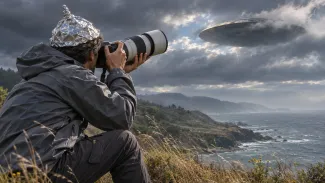
Finally, Reynolds Wrap Heavy Duty Aluminum Foil. For the ceremonial hat. Its role here is entirely aesthetic, although the leftover roll can wrap your sandwiches.
If we’re making first contact in Crocs, we might as well commit to the outfit.
Capturing a useful photograph
When something appears, capture a wide frame with the horizon or a landmark, then move closer with optical zoom. Record a steady video as well as stills, note the time and location, and keep the original files before editing or sharing.
The aliens can keep their secrets. We should at least get them in focus.\
Affiliate disclosure: This article contains affiliate links.