Stay current with our travel industry news coverage.
A Panama earthquake initially reported at magnitude 7.6 on Oct. 9 raised tsunami fears and questions about tourism safety. According to eTurboNews, the U.S. Geological Survey downgraded the earthquake to 5.8 after 45 minutes, and no specific damage information had been reported when the publication issued its update.
That account comes with a significant complication: other reporting describes a magnitude 7.7 earthquake, damaged buildings and transportation disruptions. The supplied reports do not establish a reconciled sequence of magnitude revisions. Travelers should not read the reported downgrade as confirmation that Panama escaped damage or that transportation is operating normally.
The distinction matters for anyone arriving by air, staying along the Pacific coast or connecting with a boat excursion. A revised magnitude, an official tsunami assessment and an airport’s operating status answer different questions. None substitutes for the others.
Panama earthquake magnitude reports conflict
eTurboNews identified the earthquake as USGS event us6000u18k. Its opening update reported the reduction from 7.6 to 5.8, but much of the remaining article continued to discuss the potential consequences of a magnitude 7.6 earthquake. It said independently verified casualty figures and widespread tourism infrastructure damage were unavailable at publication.
The Associated Press reported a different revision history: an initial USGS magnitude of 8, followed by 7.6 and then 7.7. AP described a second earthquake measuring 6.6 and multiple aftershocks, including one measuring 5.8. Those figures cannot be treated as confirmation of the downgrade described by eTurboNews.
According to AP, the earlier earthquake was centered about 10 kilometers southwest of Pitaloza Arriba, in Herrera province, at a depth of 10 kilometers. CNN also reported a preliminary magnitude of 7.7, citing the USGS.
The defensible reading is narrow: eTurboNews reported a downgrade, while AP and CNN reported a stronger earthquake and specific consequences. Without a reconciled official record in the source material, presenting either magnitude sequence as the undisputed final account would overstate what is established.
Damage reports go beyond the initial tourism concerns
The absence of damage information in the eTurboNews update is not equivalent to a finding that no damage occurred. Its article explicitly characterized Panama City, David, Santiago, Santa Catalina and Pedasí as destinations requiring assessment, not confirmed damage sites.
AP supplied more specific reporting. Omar Smith of Panama’s National Civil Protection Service said damage was concentrated in Veraguas, Herrera and Los Santos, according to AP. He reported no damage in the capital at that point, but described injuries and damage elsewhere.
In Penonomé, AP reported a partial collapse and cracks at the cathedral, along with damage to the governor’s office building and the Dos Continentes hotel. CNN separately reported that footage it verified showed damaged buildings in Penonomé, including a church with a partially collapsed steeple.
CNN also reported that a multistory building collapsed in the resort town of Playa Venao, crushing cars beneath it. Officials reported several minor injuries and no fatalities at the time of CNN’s account.
For accommodation decisions, those location-specific reports are more useful than treating the entire country as either unaffected or uniformly damaged. A destination appearing on a precautionary watch list is not the same as a hotel or building being identified in a damage report.
Tsunami concerns and coastal excursions
eTurboNews discussed tsunami hazards as a possibility requiring official assessment, rather than reporting a confirmed wave. It explained that earthquake magnitude alone does not establish whether a tsunami has formed; the relevant geological conditions must also be present.
CNN provided a specific warning-status report: the U.S. Tsunami Warning System warned of possible waves along some coasts before saying there was no longer a threat. That report should remain separate from the disputed magnitude downgrade. CNN did not attribute the end of the threat to a reduction to 5.8.
For marine tourism, eTurboNews identified Santa Catalina and Coiba National Park as destinations dependent on boat transfers, diving excursions and other water-based activities. It also flagged fishing and island excursions around the Azuero Peninsula as operations that could be affected by coastal restrictions. These were potential consequences, not confirmed excursion cancellations.
Its safety guidance was direct: people near the coast who experience strong or prolonged shaking should move inland or to higher ground rather than wait for a formal warning. Evacuation orders should remain in effect until the responsible authorities issue an all-clear, according to eTurboNews.
Airport disruption, but canal operations continued
Transportation reporting also differs materially. eTurboNews said it had no independently verified confirmation that Tocumen International Airport, the Panama Canal or major cruise terminals had suspended operations because of the earthquake.
CNN, citing the civil aviation authority, reported that Panama’s main international airport temporarily closed as a precaution and flights were diverted to other airports. It also reported that Panama City’s public transit system suspended service on two metro lines and evacuated passengers from some stations.
The canal’s authority said operations were continuing normally while staff inspected facilities for possible damage, according to CNN. An airport closure therefore should not be extended into a claim that canal traffic also stopped.
eTurboNews noted that Tocumen’s role as an international connecting hub makes operational restrictions relevant even to passengers whose final destination is outside Panama. Its recommendation for travelers with immediate plans was to check official emergency guidance and confirm flights, accommodation and excursions directly with providers.
That is the appropriate booking response to these reports: establish the status of the service you actually need. The reported downgrade is not a sufficient basis for an all-clear, and the initial magnitude is not a substitute for confirmed local conditions. For travelers, the strongest available information is specific: reported building damage, an airport interruption, a tsunami threat reported as ended and canal operations reported as continuing.
More travel news
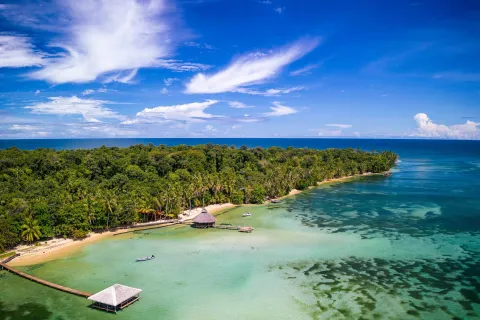
Casa Cayuco Tops World's Best Family Hotels List
BOCAS DEL TORO, Panama - A small-scale jungle lodge in Panama has claimed Tripadvisor's #1 spot for family-friendly hotels worldwide, beating thousands of competitors.
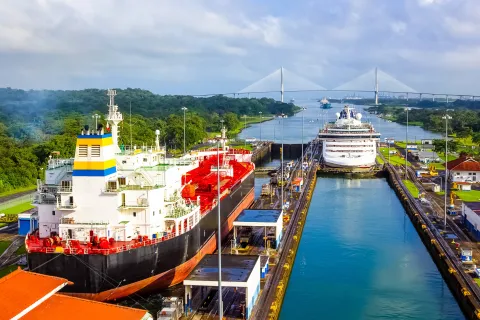
Panama Canal Fees Hit $4M as Iran Conflict Reroutes Ships
PANAMA CITY, Panama - The Iran war's closure of the Strait of Hormuz has triggered bidding wars for Panama Canal slots, with last-minute auction prices soaring to $4 million per vessel.
Copa Airlines still flying to Venezuela despite US ban
Despite a US ban on flights to Venezuela, Panama’s Copa Airlines maintains routes to Caracas and other cities, citing safety measures and service continuity.

WestJet, Copa forge deal to expand Latin American links
Calgary-based WestJet inks interline deal with Copa Airlines, promising Canadian travelers smoother connections across Latin America via Panama City.

About the Author

Jeff Colhoun
Jeff Colhoun is a photographer and filmmaker whose work has appeared in The Wall Street Journal, the Los Angeles Times, Matador Network and Barron’s.