Stay current with our travel industry news coverage.
Grand Canyon National Park is entering one of its most inviting seasonal windows for hiking. October typically brings low precipitation, low humidity and South Rim daytime highs in the 60s after the summer monsoon fades, according to Weather.com. For travelers whose priority is time on the trail, rather than a summer vacation calendar, that combination gives fall a compelling advantage.
Weather.com’s Sept. 29 assessment describes October as one of the driest and most stable stretches of the year on the rim, with abundant clear-sky days and reliable sunshine. It also places that favorable weather after the summer vacation crowds have thinned. The appeal is not simply cooler air; it is the convergence of mild daytime conditions, less moisture and a quieter period for visiting.
This is a seasonal assessment, however, not a dated forecast for a particular hike. It is best used to choose a travel window, rather than as a promise of conditions on a reserved departure date.
Why October favors Grand Canyon hiking
The transition out of monsoon season is central to October’s appeal. Weather.com says the summer monsoon fades in September, leaving October with drier skies and low humidity. Its description of mild South Rim afternoons is paired with an important counterpoint: nights become crisp after sunset.
That day-to-night distinction matters when shaping an itinerary. An afternoon walk and an outing that extends beyond sunset should not be treated as the same weather experience. For families and multigenerational groups, I would use the mild daytime window as the organizing principle, rather than assuming the whole day will feel equally comfortable.
The seasonal context is reinforced by PSS West Coast, whose month-by-month guide identifies spring and fall as the best times to visit for comfortable rim temperatures and reduced crowds compared with summer. The guide places the monsoon window from July through early September and associates it with afternoon lightning, downpours and flash-flood risk. October’s favorable assessment follows that stormier summer period; it should not be read as an assurance that weather no longer requires attention.
The South Rim forecast is not a canyon-wide temperature
The most useful precision in Weather.com’s report is its location: the daytime highs in the 60s apply to the South Rim. They do not describe every elevation or every portion of a hike into the canyon.
PSS West Coast illustrates the distinction with its summer averages. The guide lists an average July temperature of 106°F at Phantom Ranch in the inner canyon, compared with 84°F at the South Rim. Those are July figures, not October predictions, but they demonstrate why a rim temperature should not be substituted for conditions below it.
For planning purposes, I would separate two decisions: whether October is an appealing month to visit, and whether a particular route suits everyone traveling. The seasonal evidence supports the first. It does not, by itself, resolve the second. Mild weather is an advantage for an itinerary, not a measure of a trail’s difficulty or accessibility.
Thinner crowds, but different access rules at each rim
Weather.com reports that summer vacation crowds have thinned by this fall period. PSS West Coast likewise identifies October among the months offering mild rim weather and manageable crowds. Neither description means an empty park; the supported advantage is a reduction from the summer peak.
Access deserves separate consideration. According to PSS West Coast, the South Rim is open 24 hours a day, 365 days a year. That makes it the more straightforward foundation for an October visit when compared with the North Rim’s narrower operating season.
The same guide describes the North Rim’s season as roughly May 15 to mid-October. It reports that the North Rim reopened May 15 in 2026 for day use only, with no overnight lodging inside the park. Travelers should therefore not interpret favorable October weather as evidence that both rims offer equivalent access or accommodation choices.
For a family coordinating rooms and activities around one base, that distinction deserves attention before choosing lodging. A South Rim-centered trip and a North Rim visit involve different operating constraints, even within the same national park.
Build the trip around the seasonal advantage
My recommendation is to treat October’s weather as an opportunity for a well-paced South Rim visit, not a reason to make the itinerary more ambitious. Weather.com’s combination of mild afternoons, crisp nights and reduced summer crowds supports a trip organized around comfortable daytime exploration.
The strongest case for October is also the simplest: the monsoon has typically faded, the rim is experiencing one of its drier seasonal stretches, and summer’s visitor peak has passed, according to Weather.com. Keep that weather advantage distinct from route selection and rim access, and it becomes genuinely useful information for planning a fall Grand Canyon trip.
More travel news
Deadly Floods Cripple Grand Canyon Water Supply
Grand Canyon, Arizona - Flash flooding killed two people, left another missing and severed a critical waterline, forcing major lodging closures across the park.
Dragon Bravo Fire Shuts North Rim, Tourism Reroutes South
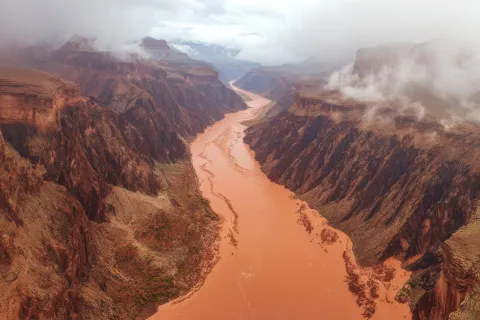
Grand Canyon, Arizona travelers face North Rim closure after Dragon Bravo Fire; South Rim, alternate trails and lodging remain open for 2025 trips.
Booking.com Faces EU Probe Into Scams and Paid Listings
Proceedings opened Oct. 21 under the Digital Services Act examine fake listings, phishing safeguards and whether paid search boosts are clearly labeled as ads; no violation has been found.

Mainland China advisory restores wrongful detention alert
The Oct. 19 update reinstates the D risk indicator for Americans visiting mainland China; the overall Level 2 advisory is unchanged.

About the Author

Jennifer Wilmington
Jennifer Wilmington is Family Travel Editor at Jetsetter Guide, covering family and luxury travel from her base in Charleston, South Carolina.