Stay current with our travel industry news coverage.
Canada has strengthened its travel guidance for France ahead of demonstrations planned for Oct. 31 and Nov. 5, warning travelers about heightened security, possible curfews and disruption to transportation and tourist sites. The Oct. 28, 2026, update keeps France at the existing exercise a high degree of caution level, according to Thetraveler.
That distinction matters. This is more detailed guidance about civil unrest, not a new recommendation to avoid nonessential travel. Canada has not asked travelers to cancel France trips, Thetraveler reports. The immediate concern is how demonstrations and the police response can affect access to particular neighborhoods, transport connections and attractions.
What Canada changed in its France travel advisory
The updated advisory says large-scale demonstrations have taken place across France since late September, with further protests planned in several cities on Oct. 31 and Nov. 5. Additional gatherings may be announced at short notice, according to Thetraveler.
Travelweek, reporting on the same update, says France’s overall caution level remains tied to the threat of terrorism. The added protest guidance warns that security measures, including partial or localized curfews, may be imposed with little notice. Police may also use tear gas to disperse crowds.
The government’s instructions are specific: Avoid demonstration areas, monitor local media, follow local authorities’ directions, including curfew orders, and be prepared to adjust travel plans, Travelweek reports. Disruption can occur before, during and after a demonstration, not just while a march is moving through the streets.
Travelweek also notes that unauthorized and spontaneous gatherings occur alongside planned demonstrations. A published protest schedule is useful, but it is not a complete map of where disruption may develop.
Major cities face unrest, but conditions are not uniform
Thetraveler reports that unrest has been more intense in Paris, Marseille and Lyon, while smaller towns have also experienced marches and road blockages. The movement has expanded from fuel-price and cost-of-living grievances to concerns about public services, education funding and social inequality.
Reporting on weekend protests shows why the advisory calls for caution without treating every demonstration as a riot. CNN described the demonstrations as largely peaceful, with violent clashes in parts of Paris, Marseille and Bordeaux. Nearly 1,000 people were detained nationwide, according to CNN’s report, which cited Interior Minister Laurent Nuñez.
France’s Interior Ministry said 70,000 police officers were mobilized, CNN reported. In Paris, a peaceful march was followed by a confrontation involving several thousand protesters at Porte de Vincennes, where police used tear gas and a water cannon. CNN also reported tear gas at Bordeaux’s Place de la Bourse and street clashes in Marseille.
Those are location-specific hazards, not evidence that every neighborhood is experiencing the same conditions. But a march that begins peacefully can still end with crowd-control measures. Canada’s advice to stay away applies before visible violence begins.
Transport and attraction access need separate checks
Thetraveler reports that large marches can bring road closures, bus diversions and temporary tram or metro station shutdowns. It also describes rail delays and cancellations on protest days involving major hubs such as Paris, Lyon and Marseille, along with reduced service or skipped stations on parts of the Paris Metro.
A Travel Noire report republished by Yahoo Travel reported that RATP closed several Metro stations on Oct. 22, including Bastille, Saint-Paul and Gare d’Austerlitz, and interrupted Line 10 service between Gare d’Austerlitz and Jussieu.
The same report described the Louvre’s Oct. 19 closure after students blocked its entrances. It also reported announced Oct. 24 closures at the Louvre, Musée d’Orsay, Grand Palais, Musée de l’Orangerie and Musée Picasso. These were dated disruptions, not confirmation that those attractions remain closed now.
The Paris tourism office said principal museums, monuments, restaurants and shops were generally operating, with individual exceptions, according to Travel Noire. That leaves travelers with two separate questions: Is the destination open, and can they reach it using the route they planned?
Thetraveler recommends checking official attraction notices each morning and allowing additional time for airport transfers, train connections and driving around the upcoming protest dates. Its report also recommends moving time-sensitive sightseeing away from announced major demonstration days where possible.
Local restrictions require local information
The Canadian guidance warns of partial or localized curfews, rather than describing a blanket nationwide restriction, according to Travelweek. Thetraveler likewise reports that municipal measures vary and may change rapidly.
For existing bookings, the useful information is the restriction affecting the hotel’s neighborhood and the routes needed to reach it. Travel Weekly reports that Heather Christopher, owner of HC Travel Firm, has been checking curfew areas and the distance between unrest and clients’ hotels, while passing along updates from local destination management companies.
Travel Weekly also reported that Lyon’s tourist office reopened in a temporary location in Place Bellecour after its building burned on Oct. 17. That is another reason to check individual services rather than assume that damage to a prominent site means all visitor services have stopped.
Before changing a France booking
Canceling is a separate decision from following the advisory. Thetraveler recommends reviewing change and cancellation conditions for flights, rail passes and accommodation, and checking how travel insurance treats civil unrest.
The Korea Herald reports that riots do not automatically entitle travelers to full refunds on flights and accommodation. Refundability depends on each booking’s terms. The report also cautions that standard travel insurance policies often exclude cancellation caused by civil unrest; travelers need to check their own coverage rather than assume the advisory activates it.
The immediate planning priority is narrower than abandoning a France itinerary: identify which booked services overlap with the announced protest dates, confirm their operating status and understand the cost of changing them. Canada’s guidance, as reported by Travelweek, is to avoid demonstrations, expect increased security and adjust plans when disruption occurs. An unchanged national advisory level does not make a particular street or connection reliable.
More travel news
France Travel Advisory Stays at Level 2 After Update
Travelers to France remain under a Level 2 advisory and should avoid demonstrations and significant police activity because of unrest and terrorism risks.
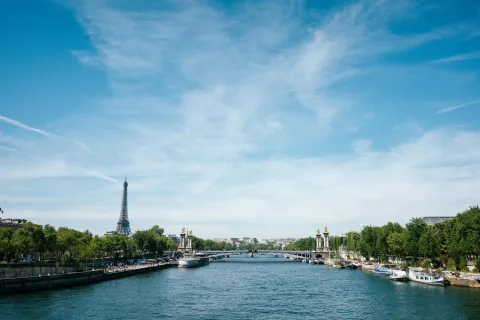
Paris Imposed Localized Curfew, Not Citywide Order
Paris imposed a localized curfew around Place de la République and Les Halles until 6 a.m. Oct. 20; Reuters’ Oct. 19 report did not establish a Tuesday-night renewal.
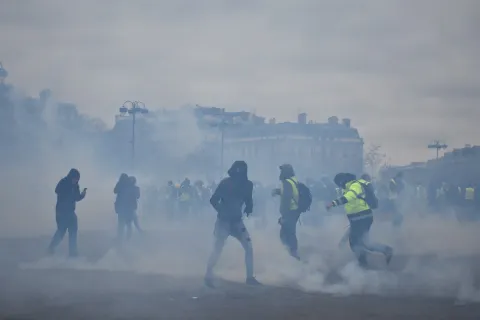
Viking Names Seven River Ships for Europe and Egypt
Four newly named Viking ships are assigned to the Rhine, Main and Danube, two to the Nile and one to the Seine; two were still in final construction. Guests must be 18 or older.

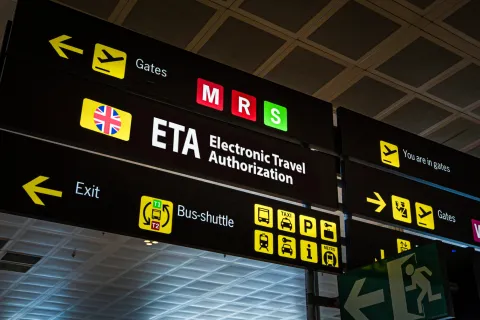
United Kingdom ETA checks require British-Canadian entry proof
Since Feb. 25, 2026, British-Canadian dual citizens flying to the UK need a valid British passport or a right-of-abode certificate in their Canadian passport.
About the Author

Jeff Colhoun
Jeff Colhoun is a photographer and filmmaker whose work has appeared in The Wall Street Journal, the Los Angeles Times, Matador Network and Barron’s.