Stay current with our airline news coverage.
Sorting Fact From Fiction in European Ski Travel Warnings
WASHINGTON — A story began circulating in late February claiming the U.S. State Department had issued Level 4 "Do Not Travel" advisories for Switzerland, France, and Austria due to avalanche risks. That claim doesn't hold up under scrutiny. Here's what's actually happening, what the State Department is really saying, and what travelers heading to the Alps need to understand about avalanche conditions this season.No Level 4 Advisories Exist for European Ski Destinations
As of February 2026, Switzerland holds a Level 2 advisory (Exercise Increased Caution), France holds a Level 2 advisory, and Austria maintains a Level 1 advisory (Exercise Normal Precautions). None of these countries have been elevated to Level 4 status. According to the U.S. Department of State, Level 4 advisories are reserved for extreme, life-threatening situations: armed conflict, terrorism, widespread violent crime, civil unrest, kidnapping, wrongful detention, and in rare cases, catastrophic natural disasters that make government assistance impossible. "This is the highest advisory level due to life-threatening risks. Specific risks are described in the Travel Advisory. The U.S. government may have very limited or no ability to help, including during an emergency. We advise that U.S. citizens do not travel to the country, or to leave as soon as it is safe to do so," according to the U.S. Department of State on Level 4 advisories. Currently, more than 20 countries hold Level 4 advisories. The list includes Afghanistan, Belarus, Burkina Faso, Iran, Mali, North Korea, Russia, Somalia, South Sudan, Sudan, Syria, Ukraine, Venezuela, and Yemen. Weather-related hazards like avalanche risk, even significant ones, don't trigger a Level 4 advisory. Regional closures, localized warnings, and resort-level risk assessments handle those concerns.What's Real: Avalanche Activity This Season
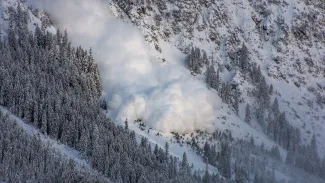
The winter of 2025-2026 has seen notable avalanche activity across multiple continents, and that part of the narrative is accurate. Near Lake Tahoe in California, 15 backcountry skiers were buried in an avalanche, with nine remaining missing. The incident became the deadliest U.S. avalanche in nearly 40 years, claiming eight lives. In Austria, at least 21 avalanche-related deaths have occurred this winter, with conditions reported at "Danger Level 3 (Considerable)" in several regions. These are serious statistics. They reflect heightened risk conditions in alpine environments globally, driven by variable snowpack, unstable weather patterns, and backcountry exposure. But they don't translate to a blanket prohibition on travel to entire countries.How Avalanche Warnings Actually Work
Avalanche forecasting operates on a localized, highly technical scale. European ski resorts employ advanced avalanche mitigation systems, including explosives, snow fencing, controlled terrain closures, and real-time monitoring by certified avalanche professionals. The danger scale runs from 1 (Low) to 5 (Extreme), and conditions shift daily based on slope aspect, elevation, recent precipitation, wind loading, and temperature fluctuations. When conditions escalate to Level 4 or 5, resorts close high-risk terrain. Backcountry access gets restricted. Ski patrol performs mitigation work before opening runs. These protocols are standard across Switzerland, France, and Austria, where mountain safety infrastructure is as sophisticated as anywhere in the world. The Lake Tahoe avalanche occurred in backcountry terrain, outside resort boundaries, where no mitigation exists. That distinction matters. Backcountry skiing carries inherent risk, regardless of location, and requires proper training, avalanche safety gear (beacon, probe, shovel), and knowledge of current conditions. The risks in backcountry zones and at professionally managed resorts are not equivalent.What Travelers Should Actually Do
If you're planning a ski trip to Switzerland, France, or Austria, here's the practical guidance: Check the current State Department travel advisory for your destination. As of now, none of these countries warrant avoiding travel based on official U.S. government guidance. Monitor local avalanche forecasts through regional avalanche centers. In Europe, consult the European Avalanche Warning Services (EAWS), which aggregates data from national forecasting agencies. France uses Météo-France's avalanche bulletin, Switzerland operates the WSL Institute for Snow and Avalanche Research SLF, and Austria maintains ZAMG and regional avalanche commissions. Stay within resort boundaries unless you have avalanche training and proper equipment. Most avalanche fatalities occur in backcountry terrain. If you're not trained in avalanche rescue, terrain assessment, and snowpack analysis, don't venture beyond marked runs. Heed resort closures and warnings. When patrol closes terrain, it's closed for a reason. Ducking ropes or ignoring signage puts you at risk and endangers rescue personnel.The Misinformation Problem in Travel
The spread of false or exaggerated travel warnings creates real consequences. Tourism-dependent economies suffer when inaccurate advisories circulate. Travelers make decisions based on flawed information, canceling trips unnecessarily or conversely, ignoring legitimate risks because they've learned to distrust all warnings. A nor'easter affecting the Northeastern U.S. caused over 3,500 flight cancellations in early 2026, disrupting transatlantic connections to Europe. Weather impacts travel infrastructure constantly. That's different from a diplomatic warning advising against all travel to a country due to existential threats. Conflating weather events with geopolitical crises erodes the usefulness of the State Department's advisory system. Level 4 advisories exist for places where American citizens face wrongful detention, active warfare, or systemic violent crime. They're reviewed every six months. Lower-level advisories get updated annually. The system works when it's used correctly and understood clearly.Bottom Line
No Level 4 travel advisory exists for Switzerland, France, or Austria. Avalanche conditions this winter are serious, particularly in backcountry zones, but they don't warrant avoiding European ski travel outright. Check official sources, respect local warnings, and understand the difference between resort skiing and backcountry exposure. The Alps aren't Yemen. The risks aren't comparable, and the guidance shouldn't be either.More travel news
Europe's 193 Million Face Deadly Heat Emergency
PARIS, France — A historic heatwave grips 193 million Europeans with record temperatures in Denmark and Germany as The Economist warns of catastrophic mortality rates.

Europe Grinds to Halt With Nearly 2000 Flights Delayed
BERLIN, Germany - Budget travelers face widespread disruptions as France, Norway, Switzerland delay 1,927 flights and cancel 70 more, hitting Eurowings, KLM, and Ryanair.
US Warns Citizens to Reconsider Travel to 14 Mideast Nations
Washington, D.C. - The U.S. State Department has reissued security alerts for 14 Middle Eastern countries, warning Americans of rapidly shifting threats and urging caution across the region.

Business Class Seats Add Weight for Comfort Demands
Business class travel surged 11.8% in 2024 to 116.9 million passengers, driven by leisure travelers and corporate executives seeking better seats.

About the Author

Jeff Colhoun
Jeff Colhoun is an acclaimed travel writer, photographer, and filmmaker, whose work is respected both in the United States and internationally.